
Filter
982
Featured
48
21
Language
Document type
516
89
81
52
45
43
37
37
29
21
11
10
4
3
Countries
88
22
13
10
9
9
8
8
8
6
6
6
6
5
5
5
4
4
4
3
3
3
3
3
3
3
2
2
2
2
2
2
2
2
2
2
1
1
1
1
1
1
1
1
1
1
1
1
1
1
1
1
1
1
1
1
1
1
1
1
1
1
1
1
1
Authors & Publishers
Publication Years
Category
116
61
27
15
15
7
4

WHO, as the coordinating authority on international health, supports countries in protecting public health through evidence-based policies and actions. Considering the significant health burden and the multiple potential benefits of interventions, the WHO Air Quality, Energy and Health Unit aims to
...

The health impacts of climate change are no longer a distant threat. They are being felt here and now and becoming more extreme.
To address these threats, the WHO Asia-Pacific Centre for Environment and Health in the Western Pacific Region (ACE) was established in 2019 through a partnership with
...
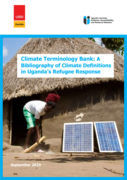
This Climate terminology bank provides key definitions and facts related to climate and resilience for Uganda’s refugee response. Its goal is to build a common understanding among stakeholders and support the integration of climate-smart practices in humanitarian efforts.

Why this document? The Waste Value Chain Analysis (WVCA) has been designed to help organizations understand local waste value chains, with the aim: To identify gaps and opportunities for improvement of local waste value chains (e.g. where shredding, baling can make recovery profitable) and much more
...
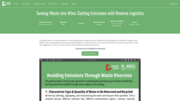
This guide outlines a practical approach to estimating greenhouse gas emissions avoided by diverting waste from landfills through reverse logistics and reuse/recycling. It provides step-by-step guidance, emission factors, and a scenario tailored to humanitarian operations, along with suggestions on
...
Más del 75 % de los cultivos alimentarios del mundo dependen de los polinizadores, que aportan anualmente entre 235 000 y 577 000 millones de dólares de los Estados Unidos a la producción agrícola mundial.
Las tormentas de arena y de polvo son fenómenos meteorológicos, habituales en las regiones áridas y semiáridas, que generan grandes cantidades de partículas de polvo mineral en suspensión.
A escala mundial, unos 2100 millones de personas siguen cocinando con combustibles sólidos (como leña, desechos agrícolas, carbón vegetal y mineral y excrementos de animales) y queroseno, en fuegos abiertos y fogones poco eficientes (1). En su mayor parte, se trata de personas en situación de p
...
La contaminación atmosférica proviene principalmente de cinco actividades humanas que emiten una gama de sustancias, tales como monóxido de carbono, dióxido de carbono, óxido de nitrógeno, dióxido de nitrógeno, dióxido de azufre, ozono troposférico o a nivel del suelo, material particulado
...
La contaminación atmosférica es una de las mayores amenazas para la salud infantil. El 99% de la población mundial vive en lugares donde el aire se considera nocivo. Respirar aire contaminado perjudica la salud de los niños y las niñas y pone en peligro su futuro.
El cambio climático, definido por las Naciones Unidas como “cambios a largo plazo en la temperatura y los patrones meteorológicos” debido a actividades humanas como la quema de combustibles fósiles en la era industrial, ha dado lugar a cambios profundos y continuos en nuestro entorno y en la
...
El cambio climático está intesificando el calor extremo, con efectos graves sobre la salud.

Necesitamos un cambio fundamental en la forma en que vivimos en la Tierra, es lo que llamamos la Gran Transición. Lograr la Gran Transición, requerirá cambios
estructurales rápidos y profundos en la mayoría de las dimensiones de la actividad humana. Esto incluye cómo producimos y consumimo
...
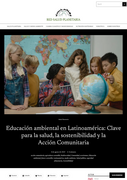
Educación ambiental en Latinoamérica: Clave para la salud, la sostenibilidad y la Acción Comunitaria
La educación ambiental también se convierte en un instrumento fundamental para abordar la relación inseparable entre el medio ambiente y la salud humana. En las grandes urbes de la región, la contaminación atmosférica —derivada del tráfico y la actividad industrial— incrementa el riesgo d
...
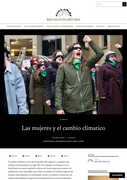
El cambio climático es uno de los desafíos más urgentes y complejos que enfrenta la humanidad en el siglo XXI. Sin embargo, sus impactos no se distribuyen de manera equitativa: afectan de forma desproporcionada a las poblaciones más vulnerables, entre ellas, las mujeres. En muchas regiones del m
...
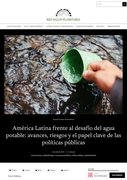
En América Latina, la calidad del agua potable presenta marcadas diferencias entre países, a pesar de la abundancia natural de recursos hídricos en la región. La distribución desigual del agua, la carencia de infraestructura en zonas rurales y la contaminación de cuerpos hídricos son problemÃ
...
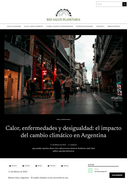
El cambio climático se ha convertido en una preocupación apremiante para la salud pública en Argentina. Con el aumento de las temperaturas, variaciones en las precipitaciones y una mayor frecuencia de fenómenos climáticos extremos, los efectos sobre la salud son cada vez más evidentes en todo
...

The State of Food Security and Nutrition in the World 2025 examines global progress towards ending hunger, food insecurity and malnutrition, with special attention to the impact of food price inflation. The report provides updated estimates on hunger, food insecurity, affordability of healthy diets
...
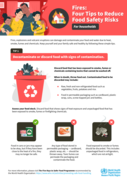
Fires, explosions and volcanic eruptions can damage and contaminate food and water due to heat, smoke, fumes and chemicals. These flyers include tips to reduce food safety risks during a fire incident for households, food suppliers, vendors, food industry inspectors and workers.
