
Filter
50
Featured
12
11
Language
Document type
14
12
11
5
2
2
1
1
1
1
Countries / Regions
3
1
1
1
1
1
Authors & Publishers
Publication Years
Category
9
5
2
2
2
2
1
1
1
1
1
1
Toolboxes
12
10
7
6
5
5
4
4
4
3
3
3
3
3
3
3
3
2
2
2
2
2
2
2
2
2
2
1
1
1
1
1
1
1
1
1
1
1
1
1
1
1
1
1
1
1
1
1
1
1
1
1
1
1
1
1
1
1
1
1
1
1

The Multi-Hazard Early Warning System (MHEWS) Checklist is a practical tool consisting of major components and actions that national governments, community organizations and partners within
and across all sectors can refer when developing or evaluating early warning systems
2nd edition.This updated publication provides programme managers with a user-friendly tool that can: (i) analyse and draw conclusions from historic dengue datasets; (ii) identify appropriate alarm indicators that can predict forthcoming outbreaks at smaller spatial scales; and (iii) use these result
...
The Guidance Notes seek to help operationalize, simplify and standardize the collection and reporting of data through the application of common language and methods. They provide information on the key issues to take into account in the collection of health data and the types of data that should be
...

This Guide provides practical guidance for governments regarding how to effectively communicate with communities during the recovery phase following an emergency. It explains how to identify communication needs, and presents “best fit” communication methods and strategies to deploy to support Di
...
Epidemiological Alerts and Updates
recommended
The Epidemiological Alerts are released in order to provide information about the occurrence of international public health events which have implications or could have implications for the countries and territories of the Americas; as well as recommendations issued by the Pan American Health Organi
...
Crisis Emergency Risk Communication. Manual
recommended
The CERC manual provides an evidence-based framework and recommended practices for anyone who communicates on behalf of an organization responding to major emergencies such as natural disasters.

In disaster preparedness, the participation of women, children, older people, persons with disabilities (PWDs), and other minority groups and sectors is important because they are the most vulnerable against disasters. Inclusive disaster preparedness provides technical and logical frameworks that as
...
The Strategic Framework for Emergency Preparedness is a unifying framework which identifies the principles and elements of effective country health emergency preparedness. It adopts the major lessons of previous initiatives and lays out the planning and implementation process by which countries can
...
International Health Regulations (2005)
recommended
Third edition. The International Health Regulations (2005) (IHR) provide an overarching legal framework that defines countries’ rights and obligations in handling public health events and emergencies that have the potential to cross borders.
A key purpose of the Recovery Toolkit is to support countries in the reactivation of health services which may have suffered as a result of the emergency. These services include ongoing programmes such as immunization and vaccinations, maternal and child health services, and noncommunicable diseases
...
With the increase in frequency of disasters, there is a need to improve early warning systems (EWS) for EA to reduce the risks faced by children and their families. As a consequence, the term early warning, early action (EWEA) has become increasingly common among those responding to slow-onset disas
...
Règlement sanitaire international (2005)
recommended
La troisième édition du RSI intègre les amendements à l’annexe 7 qui ont été adoptés par la Soixante-Septième Assemblée mondiale de la Santé, par la résolution WHA67.13 (2014). Aux termes de l’annexe 7 modifiée, la durée de la protection conférée par l’administration d’un vacc
...
Reglamento sanitario international (2005)
recommended
En la tercera edición del RSI se recogen las enmiendas al anexo 7 adoptadas por la 67.ª Asamblea Mundial de la Salud en virtud de la resolución WHA67.13 (2014). Con arreglo al anexo 7, en su versión enmendada, la protección contra la fiebre amarilla conferida por la administración de una vacun
...
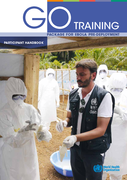
GO pre-deployment training: participant handbook
recommended
This is a pre-deployment training, tailored specially to the Ebola outbreak in West Africa, offered to WHO personnel, consultants, and key partners. The material covered in modules 1-4 is applicable and useful to frontline response workers, national and international. Only Module 5, which focuses on
...
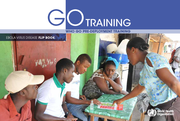
The flip book is for pre-deployment trainings for Ebola response, and is based on frequently asked questions about Ebola virus disease (EVD):
What is Ebola virus disease?
How do people become infected with EVD?
Why WHO is focusing on safe and dignified burials of people who have died
...
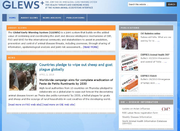
The Joint FAO-WHO-WOAH Global Early Warning System (GLEWS+) for health
threats and emerging risks at the human-animal-ecosystem interface
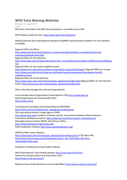
Early Warning Websites Linklist
recommended
Linklist

Eurosurveillance is a European peer-reviewed scientific journal devoted to the epidemiology, surveillance, prevention and control of communicable diseases, with a focus on such topics that are of relevance to Europe

This study aims to analyze national and international stakeholders and their initiatives in Early Warning Systems in Myanmar, to identify priority gaps that need to be addressed by all stakeholders. It is presented as a first step towards supporting GoUM in information-gathering under the Myanmar Ac
...
In order to contribute especially to the achievement of Target (g) of the Sendai Framework, several international and regional organizations as well as national institutions with a key role in early warning joined forces and established the International Network for Multi-Hazard Early Warning System
...
