
Filter
1387
Text search:
World
health
Organisation
(WHO)
Featured
Recommendations
105
New Publications
291
Language
Document type
No document type
698
Studies & Reports
301
Guidelines
145
Manuals
67
Strategic & Response Plan
65
Fact sheets
48
Training Material
25
Situation Updates
21
Infographics
7
Resource Platforms
5
Online Courses
3
Videos
2
Countries / Regions
India
60
Global
54
South Africa
47
Kenya
34
Africa
29
Nigeria
28
Uganda
26
Latin America and the Carribbean
26
Western and Central Europe
26
Sierra Leone
25
Zambia
25
Malawi
25
Ghana
24
Nepal
21
Syria
20
Tanzania
16
Namibia
16
Ethiopia
14
Rwanda
12
Myanmar / Burma
12
Congo, Democratic Republic of
10
Zimbabwe
10
Haiti
10
Indonesia
10
Lesotho
10
South Sudan
9
Ukraine
9
West and Central Africa
9
Mozambique
8
East and Southern Africa
8
Senegal
7
Cameroon
7
South–East Asia Region
7
Asia
7
Russia
7
Botswana
6
Madagascar
6
Eastern Europe
6
Guinea
5
Mali
5
Philippines
5
Afghanistan
5
Lebanon
5
Benin
5
Middle East and North Africa
5
Côte d’Ivoire / Ivory Coast
4
Niger
4
Pakistan
4
Chad
4
Cambodia
4
Thailand
4
Bangladesh
4
Central African Republic
4
Brazil
4
Sri Lanka
4
France
4
Burkina Faso
3
Liberia
3
Iraq
3
Jordan
3
Turkey
3
China
3
Eswatini/ Swaziland
3
Yemen
3
Kyrgyzstan
3
Kazakhstan
3
Togo
2
Germany
2
Malaysia
2
Argentina
2
Hungary
2
Croatia
2
Colombia
2
Greece
2
Angola
2
Eastern Europe and Central Asia
2
Venezuela
2
Laos
2
Timor Leste/ East Timor
2
Tajikistan
2
Iran
2
Georgia
2
Vietnam
2
Gabon
2
Japan
2
Portugal
2
Belarus
2
Morocco
1
USA
1
Mauritania
1
Ireland
1
Singapore
1
Papua New Guinea
1
North Macedonia
1
Serbia
1
Burundi
1
Ecuador
1
El Salvador
1
Libya
1
Mexico
1
Chile
1
Fiji
1
Bhutan
1
Poland
1
Palestine
1
Albania
1
Mongolia
1
Southern Africa
1
Congo-Brazzaville
1
Lithuania
1
Moldova
1
Uzbekistan
1
Turkmenistan
1
Jamaica
1
Denmark
1
Maldives
1
Mauritius
1
United Kingdom
1
Norway
1
Spain
1
Azerbaijan
1
Bosnia and Herzegovina
1
Authors & Publishers
Publication Years
Category
Countries
472
Clinical Guidelines
92
Key Resources
90
Public Health
73
Women & Child Health
69
Capacity Building
18
Pharmacy & Technologies
7
Toolboxes
COVID-19
117
Mental Health
113
Disability
104
AMR
78
HIV
71
Planetary Health
71
TB
51
Global Health Education
46
Caregiver
46
Conflict
43
Rapid Response
38
Refugee
34
Ebola & Marburg
32
NTDs
30
Health Financing Toolbox
26
NCDs
26
Natural Hazards
20
Pharmacy
20
2.0 Rapid Response
13
Specific Hazards
11
Social Ethics
10
Cholera
8
Zika
7
Polio
4
Malaria
4
In the WHO South-East Asia Region, epidemiological knowledge of mental health conditions remains
a relative unknown, given the sparsity of data and information on (a) the total burden associated
w
...
22 July 2022. This document provides the case definitions for public health surveillance of COVID-19 in humans caused by SARS-COV-2 infection.
There is growing understanding and high-level endorsement of the importance of strong collaborative multisectoral approaches to address a broad range of social, economic and governance issues for the prevention and control of noncommunicable disease (NCDs) and mental
...
WHO Director-General Dr Tedros Adhanom Ghebreyesus has determined that the upsurge of mpox in the Democratic Republic of the Congo (DRC) and a growing number of countries in Africa constitutes a public hea
...

Member States of the Region have initiated processes to strengthen leadership and governance for mental health. Several countries have developed and implemented mental health plans, strategies and l
...
The burden of mental health conditions in the Region is high and actions are being taken by WHO to address this issue. These include the PARO Declaration (1) by the
...
This strategy defines the World Health Organization (WHO) vision and framework for supporting Member States to accelerate the development, implemen
...

Every day in 2020, approximately 800 women died from preventable causes related to pregnancy and childbirth - meaning that a woman dies around every two minutes.
Sustainable Development Goal (SDG) target 3.1 is to reduce maternal mortality to less than 70 maternal deaths per 100 000 live births by
...

The overall objective of the framework is to support WHO and Members States in meaningful engagement of people living with NCDs, and mental health and neurological conditions to co-create and enhanc
...

Access to safe blood and blood products is recognized as one of the key requirements for delivery of modern health care in the journey towards health for all. The foundation of safe and sustainable
...

This document provides a list of key WHO-recommended maternal and newborn health commodities and aims to accelerate progress towards the SDGs. It consolidates the key and enabling commodities from e
...
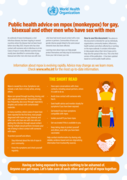
Outbreaks of mpox in newly affected countries have mostly been identified in communities of gay, bisexual and other men who have sex with men who have had recent sexual contact with a new partner or
...
Health in All Policies (HiAP) is not a new concept. While the term “HiAP” has received much attention since the 1990s, the concept
of working across sectors of government for improved population healt
...

The 2023 meeting of the WHO Clinical Consortium on Healthy Ageing (CCHA) was the group’s ninth gathering and took place in Geneva 5–7 December 2023. The meeting was structured around seven panels, with a series of technical presentations, plenar
...
Health-care waste management is a critical aspect of health-care systems, crucial for public health and environmental sustainability. This report p
...
The key updates include: content update in various sections based on new evidence; design changes for enhanced usability; a streamlined and simplified clinical assessment that includes an algorithm for follow-up; inclusion of two new modules
- Essential Care and Practice that includes general guid
...

During this short video, essential workers from around the world from the health, emergency and humanitarian sectors share their personal stories about mental
...
Sexual exploitation, sexual abuse and sexual harassment (SEAH) violate the rights and wellbeing of the people we serve and the people with whom we serve. Such behaviours are directly in opposition to WHO’s values and our abiding responsibility to
...

Obesity in all age groups, including children and adolescents, is a public health challenge across all settings. Obesity is now classified as a complex multifactorial chronic disease and not just a risk factor for other noncommunicable diseases and
...
