Search database
Filter
45
Text search: unidentified chemical
Featured
Language
Document type
No document type
25
Guidelines
11
Studies & Reports
4
Manuals
3
Strategic & Response Plan
2
Countries / Regions
Western and Central Europe
3
USA
2
Ethiopia
2
Ghana
2
India
2
Syria
2
Global
2
Sierra Leone
1
Nigeria
1
Zimbabwe
1
Nepal
1
Zambia
1
Kenya
1
Tanzania
1
Mozambique
1
Lesotho
1
Myanmar / Burma
1
Eastern Europe and Central Asia
1
Authors & Publishers
World Health Organization WHO
6
et al.
3
World Health Organization
3
EngenderHealth
2
Médecins Sans Frontières
2
World Health Organization World Health Organization WHO
2
Abdulrahim, D.
1
Agency for Toxic Substances & Disease Registry
1
and O. Bowden-Jones
1
Budreviciute, A.
1
C. Ferreira-Borges
1
Chakane, Ntema
1
Chatanga, Peter
1
Cordner, S.
1
Damiati, S.
1
Dr. J. Breda
1
Drug Administration and Control Authority of Ethiopia Contents
1
European Commission Humanitarian Aid
1
Federal Ministry of Health, Nigeria
1
Global Centre for the Responsibility to Protect
1
Government of India, Ministry of Health and Family Welfare, National AIDS Control Organisation (NACO)
1
Huihui Wang, Nathaniel Otoo, and Lydia Dsane-Selby
1
ICRC
1
IFRC
1
Inter-Agency Standing Committee IASC
1
International Atomic Energy Agency IAEA, WHO
1
International Union Against Tuberculosis and Lung Disease (The Union)
1
J.-J. Kim
1
José A. Caminero
1
Karen Vilholth
1
Kaz de Jong
1
Khdr Sabir, D. et al.
1
M. Dara
1
Mariam Kirollos, Caroline Anning, Gunvor Knag Fylkesnes et al.
1
Ministry of Health & Family Welfare, India, et al.
1
Ministry of Health and Child Welfare,Zimbabwe
1
Ministry of Health and Sanitation Sierra Leone,
1
Ministry of Health, Gabarone, Botswana
1
Mugomeri, Eltony
1
National Disaster Management Authority Government of India
1
Novel Psychoactive Treatment UK Network (NEPTUNE)
1
OCHA
1
PAHO/World Health Organization
1
Pan American Health Organization
1
R. Coninx
1
Save the Children
1
The Republic of the Union of Myanmar, Ministry of Social Welfare, Relief and Resettlement (MSWRR), Ministry of Health
1
U.S. Department of Health and Human Services, Agency for Toxic Substances and Disease Registry (ATSDR)
1
UN High Commissioner for Refugees
1
UN Office for the Coordination of Humanitarian Affairs
1
USAID
1
WHO
1
WHO, WEDC, and IWMI
1
World Bank Group
1
World Federation for Mental Health (WFMH)
1
World Health Organisation (WHO)
1
World Health Organization (Europe)
1
World Health Organization (WHO)
1
Zambia Medicines Regulatory Authority (ZAMRA)
1
Publication Years
Category
Countries
13
Clinical Guidelines
6
Key Resources
6
Pharmacy & Technologies
5
Capacity Building
1
Women & Child Health
1
Toolboxes
Conflict
4
Mental Health
4
Specific Hazards
4
Pharmacy
4
COVID-19
3
Ebola & Marburg
2
Natural Hazards
2
Rapid Response
2
Refugee
2
HIV
2
AMR
2
NTDs
2
Polio
1
TB
1
Planetary Health
1
NCDs
1
2.0 Rapid Response
1
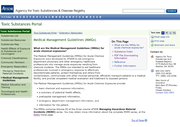
The Medical Management Guidelines (MMGs) for Acute Chemical Exposures were developed by ATSDR to aid emergency department physicians and other emergency healthcare professionals who manage acute exposures resulting from ... more
"National Disaster Management Guidelines: Management of Chemical (Terrorism) Disasters (are intended to focus on all aspects of the disaster management cycle, including prevention measures such as surveillance and intelligence, mitigation of dir ... more
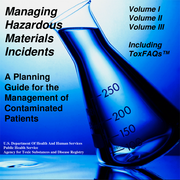
The Agency for Toxic Substances and Disease Registry (ATSDR) has produced a three-volume series entitled Managing Hazardous Material Incidents. The series is designed to help emergency response and health care professionals plan for and respond to hazardous material emergencies. - Volume I Emergenc ... more
First Edition
A community-based approach. These guidelines focus on manmade rather than natural disasters, but our experiences in India, El Salvador and Pakistan (earthquake interventions), and following the 2004 tsunami, cyclone Nargis in 2008 and the Haiti earthquake in 2010, showed that the principles describ ... more
3rd edition
interim guidance, 25 November 2024
Infectious diseases are constantly in transition. New diseases develop, known dis-eases become widespread or reemerge, and occasionally a disease is eradicated.Infectious diseases such as HIV, tuberculosis, and cholera are significant causes ofillness and death in many parts of the world. Health car ... more
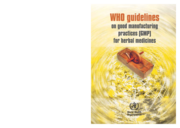
The manufacturing process is one of the key steps where quality control is required to ensure quality of medicinal products, including herbal medicines. Good manufacturing practices (GMP) is one of the most important tools for this measure.
At its 48th session of Codex Committee on Food Hygiene (CCFH), the Committee noted the importance of water quality and safety in food production and processing. CCFH requested the Food and Agriculture Organization of the United Nations (FAO) and the World Health Organization (WHO) to provide guidan ... more

The health and social effects of nonmedical cannabis use

World Health Organization (2016) C_WHO
Afr J Tradit Complement Altern Med. (2016) 13(4):123-131
Out of 400 questionnaires distributed to the participants, 389 were returned with data acceptable for analysis. Ages of the participants ranged from 18 to 75 years (Mean=43 + 11.6). Out of the 272 (69.9%) participants who conceded that th ... more
This publication describes the first WHO public-benefit Target Product Profiles (TPPs) for snakebite antivenoms. It focuses on antivenoms for treatment of snakebite envenoming in sub-Saharan Africa. Four TPPs are described in the document: Broad spectrum Pan-African polyvalent antivenoms: products ... more
The guidance aspires
• To emphasize the 'need' to mainstream disaster risk reduction (DRR) in the health sector initiatives.
• To identify key approaches for mainstreaming DRR in the health sector in Myanmar, particularly in rural areas, based on the good practices, innovative approach ... more
Proper and dignified management of the dead in disasters is one of the three key pillars of humanitarian response and a fundamental factor in facilitating identification of the deceased and helping families discover the fate of their loved ones. This second and updated edition of this hugely success ... more
The Sierra Leone National Infection Prevention and Control Guidelines were jointly developed and updated by the Ministry of Health and Sanitation in collaboration with the World Health Organization and the US Centers for Disease Control and Prevention.