
Filter
136
Text search:
Hemorrhagic
fevers
Featured
21
42
Language
Document type
89
13
13
6
6
2
2
2
1
1
1
Countries
24
20
19
15
13
12
11
10
10
8
7
7
5
5
4
4
4
4
3
3
2
1
1
1
1
1
1
1
1
1
1
Authors & Publishers
Publication Years
Category
31
20
6
3
3
Toolboxes
81
10
9
6
6
4
4
2
2
2
1
1
1
1

Here you can download Posters in English, French and Portuguese
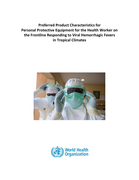
The scope of this PPC document is to serve as a guide to address the unmet public health need for a PPE system that protects the HW-F in tropical climate
s while caring for patients and providing heavy duty essential health services.
The characteristics described in this guidance are targeted fo
...

Online Training Course
Ebola hemorrhagic fever is one of many viral hemorrhagic fevers. It is a severe, often fatal disease in humans and nonhuma
...

Biorisk reduction combines expertise and advice on high consequence pathogens with guidance and training on safe handling and control of disease agents that pose significant health risks, with potential for adverse economic impact and public concern.
Biorisk management includes analysis of ways a
...
To guide One Health capacity building efforts in the Republic of Guinea in the wake of the 2014–2016 Ebola virus disease (EVD) outbreak, we sought to identify and assess the existing systems and structures for zoonotic disease detection and control. We partnered with the government ministries resp
...
This document provides a summary of infection control recommendations when providing direct and non-direct care to patients with suspected or confirmed Filovirus haemorrhagic fever (HF), including Ebola or Marburg haemorrhagic fevers. These recommen
...


Filoviral hemorrhagic fever (FHF) is caused by ebolaviruses and marburgviruses, which both belongto the family Filoviridae. Egyptian fruit bats (Rousettus aegyptiacus) are the most likely natural reservoir for marburg viruses and entry into caves an
...
Travelers planning to conduct humanitarian work in areas where outbreaks of Ebola hemorrhagic fever and Marburg hemorrhagic fever are known to occur need to be familiar with how Ebola virus and Marb
...

The waves of yellow fever transmission in the Region of the Americas in 2016–2018 involved the largest number of human and epizootic cases to be reported in several decades. Yellow fever is a serious viral hemorrhagic disease that poses a challeng
...

This review article examines 42 years of Ebola virus disease (EVD) outbreaks in Sub-Saharan Africa, from 1976 to 2019. The authors analyze the epidemiology, geographical distribution, mortality rates, and response strategies associated with 34 Ebola outbreaks across 11 African countries. The review
...

Ebola disease and Marburg disease outbreaks continue to occur in Africa, with increased frequency. In addition to resulting in high mortality and morbidity, the outbreaks generate fear and mistrust about the response activities within the communities affected.
Infection prevention and control (IP
...
