
Filter
1790
Text search:
ethical
guidelines
Featured
Recommendations
168
New Publications
445
Language
Document type
No document type
993
Guidelines
285
Studies & Reports
247
Manuals
144
Strategic & Response Plan
57
Training Material
29
Fact sheets
18
Situation Updates
7
Resource Platforms
5
Online Courses
3
Brochures
1
Countries / Regions
Kenya
76
India
70
Global
48
Ethiopia
45
Uganda
43
South Africa
42
Sierra Leone
41
Tanzania
35
Western and Central Europe
34
Nigeria
32
Nepal
31
Liberia
30
Zambia
26
Malawi
25
Namibia
25
Ghana
24
Africa
24
Ukraine
23
Latin America and the Carribbean
20
Syria
18
Rwanda
18
Bangladesh
17
Eastern Europe
17
Lesotho
13
South–East Asia Region
13
Russia
13
Philippines
12
Indonesia
12
Cambodia
10
Myanmar / Burma
10
Haiti
9
Botswana
9
Guinea
8
Congo, Democratic Republic of
8
Zimbabwe
8
South Sudan
8
Pakistan
7
Germany
7
Brazil
6
East and Southern Africa
6
Eastern Europe and Central Asia
6
Jordan
5
Eswatini/ Swaziland
5
Colombia
5
Yemen
5
Middle East and North Africa
5
Senegal
4
Benin
4
Ecuador
4
Western Pacific Region
4
Asia
4
Southern Africa
4
Burkina Faso
3
Cameroon
3
Afghanistan
3
Lebanon
3
Thailand
3
West and Central Africa
3
Armenia
3
Tajikistan
3
Mozambique
2
North Macedonia
2
Moldova
2
Kyrgyzstan
2
Kazakhstan
2
Georgia
2
Vietnam
2
United Kingdom
2
Somalia
1
Iraq
1
Egypt
1
China
1
Malaysia
1
Sudan
1
Argentina
1
Peru
1
Serbia
1
Hungary
1
Honduras
1
Greece
1
Libya
1
Angola
1
Guatemala
1
Chile
1
Other region
1
Paraguay
1
Fiji
1
Bhutan
1
Venezuela
1
Poland
1
Palestine
1
Italy
1
Albania
1
Laos
1
Timor Leste/ East Timor
1
Lithuania
1
Uzbekistan
1
Gabon
1
Jamaica
1
Japan
1
Belgium
1
Spain
1
Belarus
1
Authors & Publishers
Publication Years
Category
Countries
655
Key Resources
147
Clinical Guidelines
127
Public Health
94
Women & Child Health
93
Capacity Building
28
Pharmacy & Technologies
15
Annual Report MEDBOX
1
Toolboxes
HIV
186
Mental Health
152
COVID-19
127
TB
100
Caregiver
73
Disability
56
AMR
51
Ebola & Marburg
46
Rapid Response
44
Conflict
41
NTDs
39
Planetary Health
37
Pharmacy
37
Refugee
34
Global Health Education
31
Social Ethics
25
2.0 Rapid Response
20
Malaria
17
NCDs
16
Natural Hazards
14
Polio
8
Health Financing Toolbox
7
Zika
6
Cholera
5
Specific Hazards
4

Towards Attaining the Highest Standard of Mental Health

The Ministry of Education, Arts and Culture (MoEAC) has been implementing the Integrated School Health Programme in various forms since before the country attained political independence in 1990. School health goes beyond the physical health of the learner, in that it includes the holistic wellbeing
...

Available in English, French, Spanish, Russian, Chinese, Arabic and Portugues
The growing understanding of how sequence information can contribute to improved public health is driving global investments in sequencing facilities and programmes. The falling cost and complexity of generating GSD provides opportunities for expanding sequencing capacity; however, challenges to wid
...

The Councils share a common mandate of ensuring persons practising health related professions in Namibia are suitably qualified. Registration with the Councils is, thus, a pre-requisite for professional practice – and it is also a legal requirement too update personal details of all registered hea
...
Compilation of country case studies and best practices. World Health Report (2010) Background Paper, 25

This paper presents a bibliometric analysis of the literature on private health aid and official health assistance between 2000 and 2022. It provides an overview of the sites and themes in the literature pertaining to development assistance in health, and collates the significant policy recommendati
...

Namibia has, for many years, had a strong legislative and policy framework for the protection of children. These policies and laws have been developed through the combined expertise of those working in the field of child protection who have ensured Namibia has a robust legal framework that is in li
...

Trop. Med. Infect. Dis. 2022, 7, 152. https://doi.org/10.3390/tropicalmed7080152

Meeting report, Kampala, Uganda,
7–8 November 2023

Implementation reference guide. This Malaria Surveillance Assessment Toolkit implementation reference guide is a comprehensive reference document, as well as a step by-step guide. It aligns and adapts available tools into a single set of standardized tools, which can be used to conduct malaria surve
...

2nd edition. The purpose of this document is to present updated standardized protocols that P. falciparum-endemic countries can use to determine the prevalence of parasites with pfhrp2/3 gene deletions causing negative HRP2 RDT results among symptomatic falciparum patients. The findings should be us
...


The purpose of the guideline is to provide information to stakeholders on the necessary requirements for a complete prequalification dossier for insecticide-treated nets (ITNs). Its aim is to establish the baseline for dossier requirements which are necessary to assess ITN products for the purposes
...

This policy brief presents a summary of current evidence on vulnerability to TB and proposes interventions for equitable, person-centred, and human rights-based TB prevention and care. It aligns with WHO policies and guidance on TB prevention and screening, management of TB and comorbidities, access
...
This operational guidance provides a structured approach to support countries in sustaining priority services for HIV, viral hepatitis and sexually transmitted infections in the context of reduced external funding. The guidance is intended for national governments, public health programmes, communit
...

Access to safe, effective and quality-assured health products and technologies is crucial for achieving universal health coverage and primary health care goals. The continued growth of the aging population; increasing burden of noncommunicable diseases; growing burden of mental health issues; climat
...
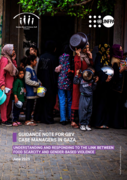
The Gaza Strip is experiencing one of the most severe food security crises globally, with the entire population of approximately 2.1 million people now facing crisis-level food insecurity or worse (IPC Phase 3+). As of May 2025, more than one in five Gazans—about
470,000 people—are at risk of s
...
