
Filter
1800
Text search:
preventive
mental
health
Featured
210
431
Language
Document type
924
290
280
113
101
31
23
19
7
6
4
1
Countries
90
79
68
62
38
38
37
37
31
31
30
30
29
28
28
25
25
24
24
24
21
18
17
15
14
14
14
10
10
10
10
10
10
9
9
9
9
8
8
8
8
7
7
7
6
6
5
5
5
5
5
5
5
4
4
4
4
4
4
4
4
4
3
3
3
3
3
3
3
3
2
2
2
2
2
2
2
2
2
2
2
1
1
1
1
1
1
1
1
1
1
1
1
1
1
1
1
1
1
1
1
1
1
1
1
1
1
1
1
1
1
1
Authors & Publishers
Publication Years
Category
727
135
108
107
98
33
8
Toolboxes
259
197
88
82
68
63
61
59
56
50
38
34
23
22
21
18
16
8
8
6
6
5
3
2
2
1
Best practice portal: standards and guidelines
recommended
The Best practice portal is a resource for professionals, policymakers and researchers in the drugs field. We provide information on the available evidence on drug-related prevention, treatment and harm reduction, focusing on the European context. The evidence is compiled following an explicit metho
...
April 2020
This Guidance Note offers a list of recommendations based on a combination of WHO guidelines, good practice and expert advice based on the latest scientific research. The situation with COVID-19 is evolving rapidly and the guidance will continue to be updated if and when new evidence o
...
Briefing note | 16 March 2020
Do no harm, equality, transparency, humanity: values should guide the criminal justice sector’s response to coronavirus
At the time of publishing there were more than 164,000* confirmed cases of COVID- 19, the novel form of Coronavirus, affecting 110 countries wit
...

This document provides guidance on the implementation of the shielding approach in urban areas in LICs and crisis-affected regions. It is intended for the community itself, national and local governance institutions, and humanitarian and development actors operating in the country.

Coronavirus Disease-19 (COVID-19) was declared a global pandemic on 11 March 2020, and Malawi declared its first case on 2 April. As of 30 April, there were 36 confirmed positive cases of COVID-19 and 3 deaths. A State of Disaster was declared by President Arthur Peter Mutharika on 20 March and a 21
...
As of 21 May 2020, 4.8 million confirmed cases of Coronavirus disease 2019 (COVID-19) have been reported globally. In South America, COVID-19 was first detected on 26 February 2020, when Brazil confirmed a case in São Paulo.
Recognizing the extent to which the COVID-19 outbreaks affects women and men differently is hugely important. Some preliminary data suggested that more men than women are dying, potentially due to sex-based immunological differences, higher rates of cardiovascular disease for men and lifestyle choic
...

How to respond to Covid19 pandemic in West and Central Africa

There is no secret to our procedure: the daily scanning of the literature helps us to stay afloat in the never-ending waves of new publications about SARS-CoV-2 and COVID-19. Many papers discussed in the Top 10 will eventually make it into subsequent editions of COVID Reference.
Finding community-led solutions to COVID-19
recommended
An interagency guidance note on working with communities in high density settings to plan local approaches to preventing and managing COVID-19. This guidance note is intended for anyone involved in COVID-19 risk communication and community engagement (RCCE) efforts in complex and fragile settings in
...
This is an abridged version of the 2019 Standards containing the evidence-based recommendations most pertinent to primary care. The tables and figures have been renum-bered from the original document to match this version. The complete 2019 Standards of Care do
...
Addendum: 2020 mid-year COVID-19 revision,summary of the reprioritisation & additional requirements in response to COVID-19
In June and July 2020, a mid-year revision of the 2020 Burundi Regional Refugee Response Plan (RRRP) was undertaken as an inter-agency consultative process to discuss and doc
...
This operation update provides a summary of key results achieved against the IFRC Syria Complex Emergency Plan of Action covering 13-month period, from 1 June 2019 to 30 June 2020.
December 2020 — May 2021
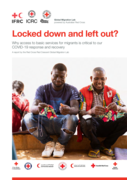
A new report released today documents an “invisible wall” which has blocked migrants from accessing basic services since the start of the COVID-19 pandemic, and is now preventing them from accessing vaccines.
