
Filter
189
Text search:
Rodrigues,
L.
Featured
Recommendations
9
New Publications
32
Language
Document type
No document type
70
Studies & Reports
57
Guidelines
40
Manuals
13
Training Material
4
Strategic & Response Plan
3
Situation Updates
1
Fact sheets
1
Countries / Regions
Brazil
32
Latin America and the Carribbean
14
Mozambique
7
Africa
6
Colombia
5
Western and Central Europe
5
Global
5
Uganda
4
Russia
4
India
3
South Africa
3
Angola
3
Nigeria
2
Zambia
2
Kenya
2
Tanzania
2
Malawi
2
Argentina
2
Middle East and North Africa
2
Venezuela
2
Eastern Europe
2
Ethiopia
1
Germany
1
Syria
1
Namibia
1
Ecuador
1
Bolivia
1
Yemen
1
Eastern Europe and Central Asia
1
Tajikistan
1
Moldova
1
Kyrgyzstan
1
Kazakhstan
1
North America
1
Authors & Publishers
Publication Years
Category
Countries
71
Clinical Guidelines
14
Public Health
11
Women & Child Health
10
Pharmacy & Technologies
5
Key Resources
4
Toolboxes
COVID-19
35
TB
28
NTDs
28
NCDs
10
HIV
9
Mental Health
9
AMR
9
Zika
6
Refugee
4
Caregiver
4
Planetary Health
4
Cholera
3
Rapid Response
3
Malaria
3
Natural Hazards
2
Polio
1
Social Ethics
1
2.0 Rapid Response
1
The emergence and transmission of zoonotic diseases are driven by complex interactions
between health, environmental, and socio-political systems. Human movement is considered
a significant and increasing factor in these processes, yet forced migration remains an
understudied area of zoonotic res
...
Update 2021; Immunization, Vaccines and Biologicals
The third edition, released in 2018, has grown to include a total of 18 chapters, contributed by 20 experts and authors from many countries. The goal remains the same: to educate primary care providers on the best practices in TB diagnosis, treatment and follow-up. All articles are richly illustrate
...
PLOS One November 20, 2020 https://doi.org/10.1371/journal.pone.0241799 . The first autochthonous case of chikungunya virus (CHIKV) infection in Brazil was in September 2014 in the State of Amapá, and from there it rapidly spread across the country. The present study was conducted in 2016 in the st
...

DEMOGRAPHIC AND HEALTH SURVEYS DHS WORKING PAPERS 2015 No. 117

The aim of the present paper is to review capacity building in public health nutrition (PHN), the need for which has been stressed for many years by a range of academics, national and international organisations. Although great strides have been made worldwide in the science of nutrition, there rema
...

16.7.2021

High salt consumption is an important determinant of high blood pressure and reducing it would improve health outcomes by lowering cardiovascular disease and therefore death rates. Reducing salt intake has been identified as one of the most effective public health measures and is one of the leading
...
Journal of Pulmonary & Respiratory Medicine 6: 326. doi:10.4172/2161-105X.1000326
Canadian Journal of Microbiology 25 June 2021 https://doi.org/10.1139/cjm-2020-0572
Panam Salud Publica. 2021;45:e22. https://doi.org/10.26633/RPSP.2021.22
The Guidelines for the Diagnosis, Treatment and Prevention of Leprosy provide state-of-the-art knowledge and evidence on leprosy diagnosis, treatment and prevention based on a public health approach in endemic countries. The target audience of this document includes policy-makers in leprosy or infec
...
PLOS ONE | https://doi.org/10.1371/journal.pone.0196380 May 15, 2018

Non-communicable diseases (NCDs) are the second common cause of death in sub-Saharan Africa (SSA) accounting for about 35% of all deaths, after a composite of communicable, maternal, neonatal, and nutritional diseases. Despite prior perception of low NCDs mortality rates, current evidence suggests t
...
The strategic framework gives guidance to public and private health facilities and health workers on compliance with standards relating to IPC practices. To further assist health facilities to implement the IPC strategic framework, this practical implementation manual has been developed in parallel
...
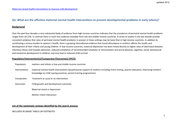
Q1: What are the effective maternal mental health interventions to prevent developmental problems in early infancy?

Pathak et al. (2016), PeerJ, DOI 10.7717/peerj.1738; 1-14
