
Filter
1585
Text search:
PATH
Featured
121
415
Language
Document type
783
366
167
113
64
34
29
14
5
4
3
1
1
Countries / Regions
119
58
41
33
32
31
30
28
28
26
26
25
23
22
21
19
19
18
18
15
15
14
12
11
11
11
11
10
10
10
9
9
9
8
8
7
7
6
6
6
6
6
5
5
5
5
4
4
4
4
4
4
4
4
4
4
3
3
3
3
3
3
3
3
2
2
2
2
2
2
2
2
2
1
1
1
1
1
1
1
1
1
1
1
1
1
1
1
1
1
1
1
1
1
1
Authors & Publishers
Publication Years
Category
493
111
111
108
81
23
22
Toolboxes
101
97
95
94
82
59
58
53
45
42
41
39
37
35
34
34
27
26
26
15
15
12
9
8
4
2
The longlist of knowledge gaps is based on existing research agendas published in 2015 or later and expert input from reviewers of the first draft of the longlist. It only includes knowledge gaps focussing on a better
understanding of the relationship between global environmental change and human h
...
During the 17 years since Surgical approaches to the urogenital manifestations of lymphatic filariasis was first published, there has been heightened awareness of the physical, economic and emotional burden of the genitourinary manifestations of filariasis. With the impetus to provide better guidanc
...
Africa is off track to reach the Sustainable Development Goals by 2030 and lags behind in building resilient health systems
and health security, against a backdrop of limited resources. The world envisaged a significant role for governments
in funding the Sustainable Development Agenda, but inadeq
...

This report includes six case studies from 12 individuals with lived experience of diverse health conditions. These case studies explore the topics of power dynamics and power reorientation towards individuals with lived experience; informed decision-making and health literacy; community engagement
...
Presentation on WASH in Malawi

The African Regional Convening of the Global Initiative to Support Parents (GISP) stimulated the interest or engagement of almost 1500 individuals from 742 unique organizations in the fields of health, education, social welfare, women’s affairs, early childhood, water and sanitation, mental health
...

This fourth WHO report on neglected tropical diseases (NTDs) reviews the progress made towards achieving the Roadmap targets for 2020, noting the remaining challenges, then looks beyond 2020 to evaluate the changing global health and development landscape, considering the implications of integrating
...
There has been important progress for the rights of adolescent girls and women in recent decades, yet millions still struggle to
access the nutritious diets, essential nutrition services and nutrition and care practices they need to prevent malnutrition.
Undernutrition, micronutrient deficiencies
...

The overall objective of the framework is to support WHO and Members States in meaningful engagement of people living with NCDs, and mental health and neurological conditions to co-create and enhance related policies, programmes and services. This framework will contribute to advancing understanding
...

The WHO standard: Universal access to rapid tuberculosis diagnostics sets benchmarks to achieve universal access to WHO-recommended rapid diagnostics (WRDs), increase bacteriologically confirmed tuberculosis and drug resistance detection, and reduce the time to diagnosis. WHO-recommended rapid diagn
...
The World health statistics report is the annual compilation of health and health-related indicators, which has been published by the World Health Organization since 2005.
The 2025 edition consolidates data for health-related indicators from the Sustainable Development Goals. It assesses progres
...
This toolkit is a "how to" guide for developing, implementing and evaluating a multisectoral action plan for prevention and control of NCDs. It is targeted at policy-makers, planners and programme managers, and is intended to help countries, provinces and cities meet the requirements for achieving g
...

This checklist is for any organization or person supporting the routine use of evidence in
the process of policy-making. Evidence-informed policy-making (EIPM) is essential for achieving the Sustainable Development Goals (SDGs) and universal health coverage (UHC). Its importance is emphasized in WH
...

There is growing international consensus that food systems transformation is important to address the challenges of malnutrition in all its forms, the burden of noncommunicable diseases (NCDs), environmental sustainability, increasing inequality and ensuring the welfare of workers and animals. In li
...
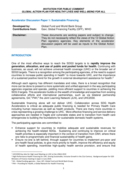
The Global Action Plan for Healthy Lives and Well-being for All (SDG3 GAP) is a set of commitments by 13 multilateral agencies to strengthen their collaboration. For this purpose several accelerators were created and an invitation for public comment was started. This document focuses on Accelerator
...

Annual and medium-term budget preparation processes are the platforms through which specific plans are transformed into actual resource allocation decisions. The aim of this Process Guide is to support key stakeholders involved in these processes (such as the Cabinet, Ministries of Finance and Healt
...

This paper has been prepared to inform discussion at the conference “Beating the DRUM - Domestic Resource Use and Mobilization for accelerating progress towards SDG3,”. Many countries face critical shortfalls in domestic resource use and mobilization (DRUM) for health, threatening to push health
...

The High-Level Panel on International Financial Accountability, Transparency and Integrity for Achieving the 2030 Agenda (FACTI Panel) was convened by the 74th President of United Nations General Assembly and the 75th President of the Economic and Social Council on 2 March 2020. The objective of the
...

The Sustainable Development Goals (SDGs) call for major societal transformations that will require significant fiscal outlays as well as private investments. The fiscal outlays cover public investments, the public provision of social services, and social protection for vulnerable populations. The ke
...

The standards define 10 key competencies for health and care workers to support self-care in their clinical practice as well as the specific, measurable behaviours that demonstrate those competencies, focusing on people-centredness; decision-making; effective communication; collaboration; evidence-i
...
