
Filter
1189
Text search:
maladies
non
transmissibles
Featured
78
155
Language
Document type
338
304
172
99
95
43
36
25
19
16
15
10
10
5
1
Countries
376
82
51
42
39
36
23
20
17
17
16
14
11
11
10
9
9
8
8
8
7
6
6
5
4
4
3
3
3
3
3
3
3
2
2
2
2
2
2
2
2
2
2
1
1
1
1
1
1
1
1
1
1
1
1
1
1
1
1
1
1
1
1
1
1
1
1
1
1
1
1
1
1
1
Authors & Publishers
Publication Years
Category
625
276
121
43
38
24
7
Toolboxes
546
56
41
24
24
22
18
18
17
16
15
11
10
10
9
9
7
7
6
5
4
2
2
A cardiac risk calculator is a screening tool to assess your future risk of cardiovascular disease. It uses personal health information to evaluate heart health.
The document provides information on physical activity (benefits, types, intensities etc.) in a descriptive way.
Coronary heart disease (CHD) is when your coronary arteries become narrowed by a build-up of fatty material within their walls. These arteries supply your heart muscle with oxygen-rich blood. CHD is sometimes called ischaemic heart disease.
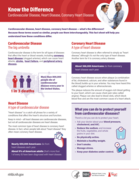
Cardiovascular disease, heart disease, and coronary heart disease may sound similar but they are not one in the same. This fact sheet will help you understand how these conditions differ.
Moving more is one of the easiest ways you can lower your risk of getting heart disease. Not sure where to begin? This fact sheet can give you ideas on how to move more and stay motivated while you make physical activity part of your healthy routine.

Interested in leading a more heart healthy lifestyle? Small steps go a long way especially when you connect with others to stay motivated. This fact sheet suggests several lifestyle changes you can make starting today and ways to get your friends, family, and colleagues involved.
Global progress against cardiovascular disease (CVD) is flatlining.
Though rates of CVD deaths globally have fallen in the last three
decades, this trend has begun to stall and, without concerted
efforts, is at risk of reversing.

The World Heart Federation (WHF) is a leading global advocate for stronger legislation and policies regarding cardiovascular disease (CVD) and its risk factors, including raised cholesterol. The present Cholesterol Advocacy Toolkit 2022 provides WHF member organizations with information as well as p
...

The Coronavirus Disease 2019 (COVID-19) has had a continuous and robust impact on world health. The resulting COVID-19 pandemic has had a devastating physical, mental and fiscal impact on the millions of people living with noncommunicable diseases (NCDs), as they have a higher risk of severe illness
...
Heart & Circulatory Diseases (Cardiovascular Disease; CVD)
Heart and circulatory diseases is an umbrella term for all diseases of the heart and circulation. It includes everything from conditions that are inherited or that a person is born with, to those that develop later, such as coronary heart d
...
Global cardiovascular disease (CVD) burden is high and rising, especially in low-income and middle-income countries (LMICs). Focussing on 45 LMICs, we aimed to determine (1) the adult population’s median 10-year predicted CVD risk, including its variation within countries by socio-demographic char
...

Socioeconomic status is associated with differences in risk factors for cardiovascular disease incidence and outcomes, including mortality. However, it is unclear whether the associations between cardiovascular disease and common measures of socioeconomic status—wealth and education—differ among
...

Objective: To identify gaps in national stroke guidelines that could be bridged to enhance the quality of stroke care services in low- and
middle-income countries.
Methods: We systematically searched medical databases and websites of medical societies and contacted international organizations.
Co
...

Diabetes mellitus is a leading cause of mortality and reduced life expectancy. We aim to estimate the burden of diabetes by type, year, regions, and socioeconomic status in 195 countries and territories over the past 28 years, which provide information to achieve the goal of World Health Organizatio
...

Diabetes is a serious, chronic disease that occurs either when the pancreas does not produce enough insulin (a hormone that regulates blood sugar, or glucose), or when the body cannot effectively use the insulin it produces. Diabetes is an important public health problem, one of four priority noncom
...

Diabetes mellitus has become a serious and chronic metabolic disorder that results from a complex interaction of genetic and environmental factors, principally characterized by hyperglycemia, polyuria, and polyphagia. Uncontrolled high blood sugar can result in a host of diabetic complications. Prol
...

Diabetes is not new to South-East Asia, since this condition was first described by Indian and Egyptian physicians three and a half thousand years ago. Diabetes is a serious, chronic disease characterized by chronic elevation of blood glucose and disturbance of carbohydrate, fat and protein metaboli
...

The epidemiology of adult-onset type 1 diabetes (T1D) incidence is not well-characterized due to the historic focus on T1D as a childhood-onset disease.

The document "Global Report on Diabetes" by the World Health Organization (WHO) provides an in-depth analysis of diabetes as a global health challenge. It covers the rising prevalence of the disease, the associated risk factors, and the increasing burden on healthcare systems, particularly in low- a
...

The number of people with diabetes has risen from 108 million in 1980 to 422 million in 2014.
The global prevalence of diabetes* among adults over 18 years of age has risen from 4.7% in 1980 to 8.5% in 2014.
Diabetes prevalence has been rising more rapidly in middle- and low-income countries.
Dia
...
