
Filter
1598
Text search:
policy
formulation
Featured
167
560
Language
Document type
940
269
208
80
66
14
12
4
3
1
1
Countries
69
66
65
54
50
43
38
35
35
35
34
33
33
29
28
24
22
21
21
21
18
18
16
15
12
11
10
10
9
9
9
8
8
8
8
5
5
5
5
4
4
3
3
3
3
3
3
3
3
3
3
3
3
3
3
2
2
2
2
2
2
2
2
2
2
2
2
1
1
1
1
1
1
1
1
1
1
1
1
1
1
1
1
1
1
1
1
1
1
1
1
1
1
1
1
1
1
1
1
1
1
1
1
1
1
1
Authors & Publishers
Publication Years
Category
763
137
131
97
74
17
8
Toolboxes
78
74
70
68
63
62
47
46
45
35
32
30
23
22
22
21
16
16
16
12
9
8
7
7
6
2
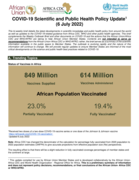
This bi-weekly brief details the latest developments in scientific knowledge and public health policy from around the world as well as updates to the COVID-19-related guidance from Africa CDC, WHO and other public health agencies.

The revision of the SRHR Policy is based on the results of the analysis of the implementation process of the past policy, which has provided evidence to
ensure that the revised
...
Following review of the latest evidence, WHO recommends that TB-LAMP can be used as a replacement for microscopy for the diagnosis of pulmonary TB in adults with signs and symptoms of TB. It can also be considered as a follow-on test to microscopy in adults with signs and symptoms of pulmonary TB, e
...

Antimicrobial resistance (AMR) has emerged as a major public health problem all over the world. Infections caused by resistant microbes fail to respond to treatment, resulting in prolonged illness and greater risk of death. This document focuses on the mechanism to develop a practically applicable h
...
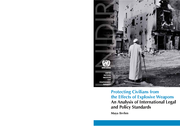
The use of explosive weapons, such as bombs, rockets, and mortar and
artillery shells, in cities, towns and villages and in other populated areas
has devastating humanitarian consequences. Explosive weapons act mainly
through the projection of blast and fragmentation wi
...
This paper provides case studies of several food product improvement policies from across the WHO European Region. The aim is to share country experience, assess the various merits of the different approaches, discuss lessons learned, and provide guidance for best practice that may be more widely ap
...
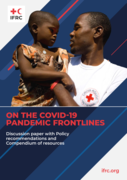
The primary audience of this report with the compendium of resources are youth engagement practitioners in the Red Cross Red Crescent National Societies as well as technical experts and policy makers across the humanitarian landscape that thrive for
...

The state of the Guinean health workforce is one of the country’s bottlenecks in advancing health outcomes. The impact of the 2014–2015 Ebola virus disease outbreak and resulting international attention has provided a policy window to invest in
...
Following review of evidence and advice from the Technical Advisory Group (TAG) on Tuberculosis (TB) Diagnostics and Laboratory Strengthening, the World Health Organization (WHO) announces that current WHO recommendations for the use of interferon-gamma release assays (IGRA) are also valid for Beij
...
Development finance is at a turning point, as the macroeconomic environment has changed profoundly and the financing gap for low- and middle-income countries has widened. The events that led to this new situation are the multiple crises that the global economy is facing, such as the climate crisis,
...
This document outlines the evaluation process that WHO undertakes to assess novel tools and strategies targeted at VBDs. Its aim is to articulate the linkage between the generation of evidence that demonstrates public health impact of novel interventions, and the development of
...

As a lower-middle-income country (LMIC), South Africa (SA) bears
the burden of maternal and neonatal mortality similar to other sub-
Saharan African countries. According to the Saving Mothers Report
2017/19, there has been a progressive and sustained reduction
in institutional maternal mortality
...
BMJ Global Health 2022;7:e008007. doi:10.1136/ bmjgh-2021-00800


Nepal is on target to meet the Millennium Development Goals for maternal and child health despite high levels of poverty, poor infrastructure, difficult terrain and recent conflict. Each year, nearly 35000 Nepali children die before their fifth birthday, with almost two-thirds of these deaths occurr
...
