
Filter
1136
Text search:
parasites
Featured
104
233
Language
Document type
373
267
173
74
66
52
40
26
18
16
14
5
5
3
2
Countries
83
35
27
23
22
22
21
19
19
16
16
16
15
14
12
12
12
10
10
10
9
9
9
9
8
8
7
7
7
7
6
6
6
5
5
5
5
5
4
4
4
4
4
3
3
3
3
3
3
2
2
2
2
2
2
2
2
2
2
2
2
2
2
2
2
2
2
2
2
2
1
1
1
1
1
1
1
1
1
1
1
1
1
1
1
1
1
1
1
1
1
1
1
1
1
1
1
1
1
1
1
1
1
1
1
Authors & Publishers
Publication Years
Category
377
98
69
65
40
36
33
Toolboxes
297
153
88
58
19
19
18
14
12
12
11
10
9
9
8
8
7
7
5
4
3
3
2
2
2
Infographic: Preventing and controlling neglected parasitic zoonoses: a key role for the animal health sector
Front. Public Health, 02 July 2019 Sec. Infectious Diseases: Epidemiology and Prevention
Volume 7 - 2019 | https://doi.org/10.3389/fpubh.2019.00166
Chagas disease (CD) is an anthropozoonosis caused by the protozoan parasite Trypanosoma cruzi, that affects about 6–8 million people worldwide (1) a
...

A qualitative assessment of knowledge gaps about female genital schistosomiasis among communities living in Schistosoma haematobium endemic districts of Zanzibar and Northwestern Tanzania.
PloS Neglected Tropical Diseases September 30, 2021 https://doi.org/10.1371/journal.pntd.0009789
Schistosoma
...
Chagas disease (CD), caused by the parasite Trypanosoma cruzi, affects ~6–7 million people worldwide. Significant limitations still exist in our understanding of CD. Harnessing individual participant data (IPD) from studies could support more in-depth analyses to address
the many outstanding rese
...

Chagas disease is a neglected tropical disease cause by the Trypanosoma cruzi parasite. It is spread mostly by insects known as Triatominae, or kissing bugs.
If left untreated, Chagas can cause serious problems to the heart and digestive system.

Chagas is a parasitic disease that affects over 6 million people in the
world. As the disease typically remains asymptomatic for years, new cases
often go unnoticed and unreported, and most people with the disease
are unaware of their condition. Less than 10% of people affected are
diagnosed and
...

The American Jornal of Tropical Medicine and Hygiene, vol. 105, no.6, pp.1772-1781.
Schistosomiasis, which is the second most important parasitic infection after malaria in terms of its socioeconomic impact, is responsible for the loss of an estimated 4.5 million disability-adjusted life years (DA
...

Schistosoma haematobium is a parasitic digenetic trematode responsible for schistosomiasis (also known as bilharzia). The disease is caused by penetration of the skin by the parasite, spread by intermediate host molluscs in stagnant waters, and can be treated by administration of praziquantel. Schis
...

La enfermedad de Chagas es parasitaria y afecta a más de 6 millones
de personas en el mundo. Como normalmente es asintomática durante
años, los nuevos casos suelen no detectarse ni reportarse y la mayoría
de las personas con la enfermedad no tiene conciencia de su condición.
Se diagnostica
...

Schistosomiasis is an acute and chronic parasitic disease caused by blood flukes (trematode worms) of the genus Schistosoma. Estimates show that at least 251.4 million people required preventive treatment in 2021. Preventive treatment, which should be repeated over a number of years, will reduce and
...

Schistosomiases are acute or chronic visceral parasitic diseases due to 5 species of trematodes (schistosomes). The three main species infecting humans are Schistosoma haematobium, Schistosoma mansoni and Schistosoma japonicum. Schistosoma mekongi and Schistosoma intercalatum have a more limited dis
...
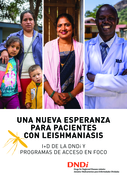
La leishmaniasis es una enfermedad tropical desatendida sensible
al clima, trasmitida por la picadura de insectos flebótomos y
se calcula que amenaza a mil millones de personas en todo el mundo.
Esta enfermedad altamente compleja se presenta de varias formas
clínicas, causadas por 20 especies
...
Dracunculiasis, also known as Guinea-worm disease is a parasitic disease caused by the nematode Dracunculus medinensis. The infection is transmitted to humans by drinking water contaminated with the small crustacean copepods (Cyclops) which contain the larvae of D. medinensis. Humans are the princip
...

La schistosomiase est une parasitose aiguë et chronique provoquée par des vers (trématodes) du genre Schistosoma. Selon les estimations, au moins 251,4 millions de personnes avaient besoin d’un traitement préventif en 2021. Le traitement préventif, qui devrait être renouvelé pendant un cert
...

La esquistosomiasis es una enfermedad parasitaria aguda y crónica causada por duelas sanguíneas (trematodos) del género Schistosoma. Se calcula que al menos 251,4 millones de personas necesitaron tratamiento profiláctico en 2021. El tratamiento profiláctico, que se debería repetir durante algu
...

داء البلهارسيات هو مرض طفيلي حاد ومزمن تسبّبه الديدان المثقوبة الدموية (المثقوبات) من جنس البلهارسية. وتشير التقديرات إلى أن 251.4 مليون شخص على الأقل كانوا بحاجة إلى Ø
...

Шистосомоз является острой и хронической паразитарной болезнью, вызываемой кровяными сосальщиками (трематодными червями) из рода Schistosoma. В 2021 г. количество нуждаюÑ
...
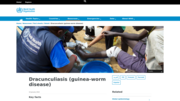
About a year after infection, a painful blister forms – 90% of the time on the lower leg – and one or more worms emerge accompanied by a burning sensation. To soothe the burning pain, patients often immerse the infected part of the body in water. The worm(s) then releases thousands of larvae (ba
...

Foodborne trematodiases are caused by parasitic trematode worms. People become infected by eating raw or undercooked fish, crustaceans and vegetables that contain the larval worms.

Fascioliasis is an animal parasitic disease (in cattle and sheep, but also pigs, donkeys, Llamas and alpacas that can be transmitted to humans. The infection is caught when aquatic or semi-aquatic plants with the larvae of the worm attached to their stem or leaves are ingested raw or poorly cooked.
...
