
Filter
1141
Text search:
sante
publique
Featured
95
285
Language
Document type
500
184
178
82
60
44
24
19
16
13
12
6
1
1
Countries / Regions
131
98
86
67
64
56
35
28
25
24
21
16
13
12
12
12
12
8
7
6
6
4
4
4
3
3
3
3
3
2
2
2
2
2
2
2
2
2
2
1
1
1
1
1
1
1
1
1
1
1
1
1
1
1
1
1
1
1
1
1
Authors & Publishers
Publication Years
Category
576
105
78
59
59
47
20
Toolboxes
133
64
56
46
41
34
26
25
24
24
23
22
17
15
11
11
10
8
7
7
6
5
4
2
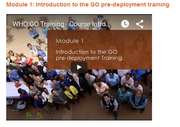
The GO training package was developed by the World Health Organization for use by staff, consultants and partners who are part of the emergency response, so that they can work safely as part of the teams working to bring the outbreak under control.
Training outline:
Module 1: Pre-deployment tr
...
Disaster Preparedness Training Programme
Disaster Preparedness Training Programme

Disaster Preparedness Training Programme

This Training module on malaria elimination has been developed by WHO to support health professionals in planning, managing, monitoring and evaluating malaria elimination programmes
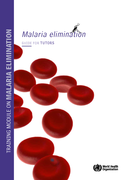
This Training module on malaria elimination has been developed by WHO to support health professionals in planning, managing, monitoring and evaluating malaria elimination programmes.
Supporting exercises: These files are necessary for participants to complete a number of exercises listed in the man
...
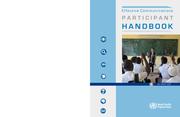
The WHO Effective Communications Participant Handbook was created to support WHO staff around the world in enhancing their communications skills as part of the global communications capacity-building efforts of the WHO Department of Communications (DCO)
Plague: Knowledge resources for responders
recommended
Plague is a zoonotic disease caused by the bacteria Yersinia pestis, found in small mammals. It is transmitted between animals by their fleas.
The bacteria, the animal reservoir and the vector in a given area are collectively called a “plague natural focus”. Humans can become infected by bein
...
This document provides a generic model that can be used for risk assessment of exposure to insecticide products applied as indoor residual sprays. It aims to harmonize the risk assessment of such insecticides for public health use in order to generate comparable data for their registering and labell
...

The report reflects on the trends, achievements and challenges in global health over the past decade during which Dr Margaret Chan has been Director-General of WHO. It discusses the role of WHO in dealing with such issues as the rise of noncommunicable diseases, leaps in life expectancy, and emergin
...

Infectious disease outbreaks are frequently characterized by scientific uncertainty, social and institutional disruption, and an overall climate of fear and distrust. Policy makers and public health professionals may be forced to weigh and prioritize potentially competing ethical values in the face
...
The GCF aims to support developing countries in achieving a paradigm shift to low-emission and climate-resilient pathways. This is achieved by funding innovative and transformative lowemission (mitigation) and climate-resilient (adaptation) projects and programmes developed by the public and private
...

WHO recommendations on adolescent health: guidelines approved by the WHO Guidelines Review Committee
This document is meant to respond to the questions:
■ What health interventions should the adolescent receive and when should s/he receive it?
■ What health behaviours should the adolescent practise (or not practise)?
■ What health interventions should the adolescent receive and when should s/he receive it?
■ What health behaviours should the adolescent practise (or not practise)?

CHW Central is an online community of practice that brings together program managers, experts, practitioners, researchers, and supporters of CHW programs. The website is a virtual meeting place to share resources and experiences and to discuss and develop questions and ideas on CHW programs and poli
...
New and updated information.
Adverse health effects of hot weather and heat-waves are largely preventable. Prevention requires a portfolio of actions at different levels:from health system preparedness, coordinated with meteorological early warning systems, to timely public
...
This project aims to support host nations in delivering a safe and successful event, as part of WHO’s ongoing support to countries in strengthening the International Health Regulations capacities for prevention, detection and response to the public health events in the context of hosting Mass Gath
...
