
Filter
4148
Text search:
Emergency
Medical
Services
for
Children
Featured
Recommendations
435
New Publications
1226
Language
Document type
No document type
2398
Studies & Reports
614
Guidelines
505
Manuals
237
Strategic & Response Plan
195
Situation Updates
66
Training Material
62
Fact sheets
41
Brochures
11
Resource Platforms
10
Infographics
6
Online Courses
2
App
1
Countries / Regions
Global
179
India
174
Kenya
128
Sierra Leone
108
Syria
105
Liberia
104
Nigeria
96
Nepal
96
Ethiopia
92
Uganda
91
South Africa
83
Bangladesh
82
Myanmar / Burma
79
Western and Central Europe
78
Tanzania
67
Rwanda
64
Malawi
62
Ukraine
60
Zambia
59
Latin America and the Carribbean
54
Namibia
53
Ghana
52
Africa
51
South Sudan
49
Congo, Democratic Republic of
40
Philippines
35
Mozambique
35
Zimbabwe
31
Yemen
31
Guinea
30
Haiti
30
Asia
28
Venezuela
27
Lesotho
26
Indonesia
24
South–East Asia Region
22
Germany
20
Cambodia
20
Lebanon
19
Eastern Europe and Central Asia
19
Pakistan
18
Brazil
18
Eastern Europe
18
Senegal
17
West and Central Africa
17
Jordan
16
Russia
16
Afghanistan
15
Sudan
15
Eswatini/ Swaziland
15
Botswana
15
East and Southern Africa
15
Middle East and North Africa
15
Central African Republic
14
Somalia
13
Burkina Faso
12
Iraq
12
Moldova
12
Turkey
11
Colombia
11
Thailand
10
Vietnam
10
Laos
9
USA
8
Cameroon
8
Western Pacific Region
8
Mali
7
Palestine
7
Iran
7
China
6
Benin
6
Greece
6
Angola
6
Sri Lanka
6
Poland
6
Albania
6
Côte d’Ivoire / Ivory Coast
5
Papua New Guinea
5
Burundi
5
Romania
5
Singapore
4
Peru
4
Libya
4
Mexico
4
Tajikistan
4
Portugal
4
Niger
3
Egypt
3
Gambia
3
Malaysia
3
North Macedonia
3
Hungary
3
Armenia
3
Southern Africa
3
Timor Leste/ East Timor
3
Kazakhstan
3
North America
3
Saudi Arabia
2
Togo
2
Argentina
2
Croatia
2
Bolivia
2
Madagascar
2
Paraguay
2
Bhutan
2
Italy
2
Mongolia
2
Qatar
2
Bulgaria
2
Estonia
2
Slovakia
2
Uzbekistan
2
Georgia
2
Japan
2
Spain
2
Guinea-Bissau
1
Morocco
1
Chad
1
Dominican Republic
1
Switzerland
1
Serbia
1
Honduras
1
Ecuador
1
Guatemala
1
Chile
1
Fiji
1
Djibouti
1
Lithuania
1
Kyrgyzstan
1
Turkmenistan
1
France
1
Maldives
1
Mauritius
1
Tunisia
1
United Kingdom
1
South Korea
1
Belarus
1
Israel
1
Authors & Publishers
Publication Years
Category
Countries
1724
Key Resources
301
Women & Child Health
280
Clinical Guidelines
254
Public Health
196
Capacity Building
90
Pharmacy & Technologies
29
Annual Report MEDBOX
1
Toolboxes
COVID-19
394
Mental Health
311
HIV
296
Conflict
233
Disability
139
Ebola & Marburg
135
Refugee
131
TB
120
Caregiver
101
Natural Hazards
90
Planetary Health
90
Rapid Response
86
Global Health Education
64
Pharmacy
51
NCDs
51
AMR
46
Health Financing Toolbox
43
NTDs
40
2.0 Rapid Response
33
Specific Hazards
32
Cholera
31
Zika
31
Malaria
28
Polio
22
Social Ethics
7
Typhoon
5
South Sudan
2

Version 2, January 2016
The primary purpose of this document is to provide 3MDG stakeholders with some essential information on the MNCH core-indicators for 3MDG, which were derived from the 3MDG Logical Framework, Data Dictionary ... (2014 June, DoPH, MoH), A Guide for Monitoring and Evaluating Child Health Programmes (MEASURE Evaluation, September 2005) and Monitoring Emergency Obstetric Care (WHO/UNICEF/UNFPA/AMDD). Partners are strongly encouraged to integrate the MNCH indicators into their ongoing monitoring and evaluation (M&E) activities.
These indicators are designed to help Partners assess the current state of their activities, their progress towards achieving their targets, and contribution towards the national response. This guideline is designed to improve the quality and consistency of data collected at the township level, which will enhance the accuracy of conclusions drawn when the data are aggregated.
The primary purpose of this document is to provide 3MDG stakeholders with some essential information on the MNCH core-indicators for 3MDG, which were derived from the 3MDG Logical Framework, Data Dictionary ... (2014 June, DoPH, MoH), A Guide for Monitoring and Evaluating Child Health Programmes (MEASURE Evaluation, September 2005) and Monitoring Emergency Obstetric Care (WHO/UNICEF/UNFPA/AMDD). Partners are strongly encouraged to integrate the MNCH indicators into their ongoing monitoring and evaluation (M&E) activities.
These indicators are designed to help Partners assess the current state of their activities, their progress towards achieving their targets, and contribution towards the national response. This guideline is designed to improve the quality and consistency of data collected at the township level, which will enhance the accuracy of conclusions drawn when the data are aggregated.
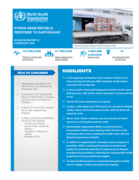
TUATION UPDATE
In the early morning of 6 February 2023, a magnitude 7.8 earthquake occurred in southern Türkiye near the
northern border of Syria. The earthquake was followed 11 minutes later by a magnitude 6.7 aftershock. Many
aftershocks are still being felt across the region. Whilst the imp
...
This report presents, for the first time, a global assessment of the extent to which health care facilities provide essential water, sanitation and hygiene (WASH) services. Drawing on data from 54 l
...

Rabies is fatal, vaccine-preventable disease responsible for an estimated 59,000 human deaths each year. Most cases are transmitted by dogs, and most deaths occur in underserved populations in Africa and Asia. Approximately 40% of deaths occur in
...

Key messages
● Pre-crisis Infant and Young Child Feeding (IYCF) Practices:
The Code has not been adequately implemented and enforced in Ukraine.
Multiple Indicator Cluster Survey (MCIS) data from 2012: Child ever breastfed (95.4%); early initiation of breastfeeding (EIBF) within 1
...

The present book deals not only with emergency response, but also with measures designed to reduce the impact of disasters on environmental health infrastructure, such as water supply and sanitation facilities. It also aims to strengthen the ability
...

A lot has happened this year. While we continued to tackle the COVID-19 pandemic, we were hit by disease outbreaks and
humanitarian crises. Yet, despite these challenges, we marched on, resolute in resolving critical health systems issues to increase
access to quality healthcare
...

The Royal College of Paediatrics and Child Health recognises that climate change
is an existential threat to the health and wellbeing of children and young people.
In October 2020, we joined national health and academic alliances to declare
cl
...

This assessment is the first of its kind to be conducted in the south-eastern region of Myanmar. It is an important contribution to ensuring the full inclusion of women and children in Myanmar’s political, social, and cultural systems, with a spec
...
This report tells the stories of some of the world’s 7.1 million refugee children of school age under UNHCR’s mandate. In addition, it looks at the educational aspirations of refugee youth eager to continue learning after secondary education, a
...
A key purpose of the Recovery Toolkit is to support countries in the reactivation of health services which may have suffered as a result of the emergency. These
...

Refugee 1 men and boys can be subjected to sexual and gender‑based violence (SGBV). Survivors have specific health, psychosocial, legal, and safety needs, but often find it hard to discuss their experience and access the support they need. It is important that UNHCR and its partners take steps to
...
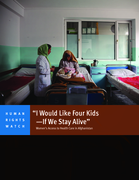
Over the past two decades, Afghanistan has depended on international donor support to fund essential services like health care. But this donor support has been falling for years and will likely to c
...

WHO guideline on HIV service delivery
recommended
Updated guidance on the integration of diabetes, hypertension and mental health services, and interventions to support adherence to antiretroviral therapy. The guideline offers practical implementation guidance
...

This Guideline, the first for the country, draws from national health sector reforms and integration agenda as outlined in the key national strategic documents. The Guide applies lessons learnt from the SRH/HIV Linkages project and its scale-up; oth
...
One of the principles underpinning the delivery of all essential services and coordination of those services is the “survivor-centered approach”, which places the human rights, needs, and wishes
...

This document sets out the preparedness and response plan of the Nigerian Primary Health Care System for COVID-19 Acute Respiratory Disease. It outlines the planning scenarios, key areas of work and priority activities required
...

The COVID-19 pandemic is a rapidly evolving global crisis and there
is much that is still emerging in terms of the psychosocial and mental
health consequences for the diverse populations affected by this
...
The guidelines presented in this document are designed to provide a useful resource for healthcare professionals involved in clinical case management. They were developed taking into consideration services
...
After the earthquake in Türkiye-Syria in February 2023 an emergency response was provided to the affected population. Young persons with disabilities were one of the social groups most affected by the crisis. These were either young persons who acq
...
