
Filter
3457
Text search:
Human
resources
for
mental
health
Featured
382
786
Language
3348
84
81
57
43
24
23
14
8
6
5
4
4
4
4
4
3
3
3
3
3
3
3
3
2
2
2
2
2
2
2
2
2
2
2
2
2
2
2
1
1
1
1
1
1
1
1
1
1
1
1
1
1
1
1
1
1
1
1
1
1
1
1
Document type
1872
591
422
242
160
72
40
34
8
7
2
1
1
Countries
182
128
93
87
83
71
64
63
60
58
58
51
51
50
47
43
40
38
38
37
35
31
26
26
24
23
23
21
21
20
19
18
17
16
16
14
14
14
13
11
11
11
11
11
11
10
10
10
10
10
10
10
8
8
8
8
8
8
7
7
7
7
7
7
6
6
5
5
5
5
4
4
4
4
4
4
3
3
3
3
3
3
3
3
3
3
3
3
2
2
2
2
2
2
2
2
2
2
2
2
2
2
1
1
1
1
1
1
1
1
1
1
1
1
1
1
1
1
1
1
1
1
1
1
1
1
1
Authors & Publishers
493
150
108
108
100
72
69
41
39
35
23
22
21
21
20
19
18
18
18
17
17
17
16
15
15
14
13
13
13
12
12
11
11
11
11
10
10
10
10
10
9
9
9
9
9
9
9
9
9
9
9
8
8
8
8
8
8
8
7
7
7
7
7
7
6
6
6
6
6
6
6
6
6
6
6
6
6
6
6
6
6
6
6
5
5
5
5
5
5
5
5
5
5
5
5
5
5
5
5
5
5
5
5
5
5
5
5
5
5
4
4
4
4
4
4
4
4
4
4
4
4
4
4
4
4
4
4
4
4
4
4
4
4
4
4
4
4
4
4
4
4
4
4
4
4
4
3
3
3
3
3
3
3
3
3
3
3
3
3
3
3
3
3
3
3
3
3
3
3
3
3
3
3
3
3
3
3
3
3
3
3
3
3
3
3
3
3
3
3
3
3
3
3
3
3
3
3
3
3
3
3
3
3
3
2
2
2
2
2
2
2
2
2
2
2
2
2
2
2
2
2
2
2
2
2
2
2
2
2
2
2
2
2
2
2
2
2
2
2
2
2
2
2
2
2
2
2
2
2
2
2
2
2
2
2
2
2
2
2
2
2
2
2
2
2
2
2
2
2
2
2
2
2
2
2
2
2
2
2
2
2
2
2
2
2
2
2
2
2
2
2
2
2
2
2
2
2
2
2
2
2
2
2
2
2
2
2
2
2
2
2
2
2
2
2
2
2
2
2
2
2
2
2
2
2
2
2
2
2
2
2
2
2
2
2
2
2
2
2
2
2
2
2
2
2
2
2
2
2
2
2
2
2
2
2
2
2
2
2
2
2
2
2
2
2
2
2
2
2
2
2
2
2
2
2
2
2
2
2
2
2
2
2
2
2
2
2
1
1
1
1
1
1
1
1
1
1
1
1
1
1
1
1
1
1
1
1
1
1
1
1
1
1
1
1
1
1
1
1
1
1
1
1
1
1
1
1
1
1
1
1
1
1
1
1
1
1
1
1
1
1
1
1
1
1
1
1
1
1
1
1
1
1
1
1
1
1
1
1
1
1
1
1
1
1
1
1
1
1
1
1
1
1
1
1
1
1
1
1
1
1
1
1
1
1
1
1
1
1
1
1
1
1
1
1
1
1
1
1
1
1
1
1
1
1
1
1
1
1
1
1
1
1
1
1
1
1
1
1
1
1
1
1
1
1
1
1
1
1
1
1
1
1
1
1
1
1
1
1
1
1
1
1
1
1
1
1
1
1
1
1
1
1
1
1
1
1
1
1
1
1
1
1
1
1
1
1
1
1
1
1
1
1
1
1
1
1
1
1
1
1
1
1
1
1
1
1
1
1
1
1
1
1
1
1
1
1
1
1
1
1
1
1
1
1
1
1
1
1
1
1
1
1
1
1
1
1
1
1
1
1
1
1
1
1
1
1
1
1
1
1
1
1
1
1
1
1
1
1
1
1
1
1
1
1
1
1
1
1
1
1
1
1
1
1
1
1
1
1
1
1
1
1
1
1
1
1
1
1
1
1
1
1
1
1
1
1
1
1
1
1
1
1
1
1
1
1
1
1
1
1
1
1
1
1
1
1
1
1
1
1
1
1
1
1
1
1
1
1
1
1
1
1
1
1
1
1
1
1
1
1
1
1
1
1
1
1
1
1
1
1
1
1
1
1
1
1
1
1
1
1
1
1
1
1
1
1
1
1
1
1
1
1
1
1
1
1
1
1
1
1
1
1
1
1
1
1
1
1
1
1
1
1
1
1
1
1
1
1
1
1
1
1
1
1
1
1
1
1
1
1
1
1
1
1
1
1
1
1
1
1
1
1
1
1
1
1
1
1
1
1
1
1
1
1
1
1
1
1
1
1
1
1
1
1
1
1
1
1
1
1
1
1
1
1
1
1
1
1
1
1
1
1
1
1
1
1
1
1
1
1
1
1
1
1
1
1
1
1
1
1
1
1
1
1
1
1
1
1
1
1
1
1
1
1
1
1
1
1
1
1
1
1
1
1
1
1
1
1
1
1
1
1
1
1
1
1
1
1
1
1
1
1
1
1
1
1
1
1
1
1
1
1
1
1
1
1
1
1
1
1
1
1
1
1
1
1
1
1
1
1
1
1
1
1
1
1
1
1
1
1
1
1
1
1
1
1
1
1
1
1
1
1
1
1
1
1
1
1
1
1
1
1
1
1
1
1
1
1
1
1
1
1
1
1
1
1
1
1
1
1
1
1
1
1
1
1
1
1
1
1
1
1
1
1
1
1
1
1
1
1
1
1
1
1
1
1
1
1
1
1
1
1
1
1
1
1
1
1
1
1
1
1
1
1
1
1
1
1
1
1
1
1
1
1
1
1
1
1
1
1
1
1
1
1
1
1
1
1
1
1
1
1
1
1
1
1
1
1
1
1
1
1
1
1
1
1
1
1
1
1
1
1
1
1
1
1
1
1
1
1
1
1
1
1
1
1
1
1
1
1
1
1
1
1
1
1
1
1
1
1
1
1
1
1
1
1
1
1
1
1
1
1
1
1
1
1
1
1
1
1
1
1
1
1
1
1
1
1
1
1
1
1
1
1
1
1
1
1
1
1
1
1
1
1
1
1
1
1
1
1
1
1
1
1
1
1
1
1
1
1
1
1
1
1
1
1
1
1
1
1
1
1
1
1
1
1
1
1
1
1
1
1
1
1
1
1
1
1
1
1
1
1
1
1
1
1
1
1
1
1
1
1
1
1
1
1
1
1
1
1
1
1
1
1
1
1
1
1
1
1
1
1
1
1
1
1
1
1
1
1
1
1
1
1
1
1
1
1
1
1
1
1
1
1
1
1
1
1
1
1
1
1
1
1
1
1
1
1
1
1
1
1
1
1
1
1
1
1
1
1
1
1
1
1
1
1
1
1
1
1
1
1
1
1
1
1
1
1
1
1
1
1
1
1
1
1
1
1
1
1
1
1
1
1
1
1
1
1
1
1
1
1
1
1
1
1
1
1
1
1
1
1
1
1
1
1
1
1
1
1
1
1
1
1
1
1
1
1
1
1
1
1
1
1
1
1
1
1
1
1
1
1
1
1
1
1
1
1
1
1
1
1
1
1
1
1
1
1
1
1
1
1
1
1
1
1
1
1
1
1
1
1
1
1
1
1
1
1
1
1
1
1
1
1
1
1
1
1
1
1
1
1
1
1
1
1
1
1
1
1
1
1
1
1
1
1
1
1
1
1
1
1
1
1
1
1
1
1
1
1
1
1
1
1
1
1
1
1
1
1
1
1
1
1
1
1
1
1
1
1
1
1
1
1
1
1
1
1
1
1
1
1
1
1
1
1
1
1
1
1
1
1
1
1
1
1
1
1
1
1
1
1
1
1
1
1
1
1
1
1
1
1
1
1
1
1
1
1
1
1
1
1
1
1
1
1
1
1
1
1
1
1
1
1
1
1
1
1
1
1
1
1
1
1
1
1
1
1
1
1
1
1
1
1
1
1
1
1
1
1
1
1
1
1
1
1
1
1
1
1
1
1
1
1
1
1
1
1
1
1
1
1
1
1
1
1
1
1
1
1
1
1
1
1
1
1
1
1
1
1
1
1
1
1
1
1
1
1
1
1
1
1
1
1
1
1
1
1
1
1
1
1
1
1
1
1
1
1
1
1
1
1
1
1
1
1
1
1
1
1
1
1
1
1
1
1
1
1
1
1
1
1
1
1
1
1
1
1
1
1
1
1
1
1
1
1
1
1
1
1
1
1
1
1
1
1
1
1
1
1
1
1
1
1
1
1
1
1
1
1
1
1
1
1
1
1
1
1
1
1
1
1
1
1
1
1
1
1
1
1
1
1
1
1
1
1
1
1
1
1
1
1
1
1
1
1
1
1
1
1
1
1
1
1
1
1
1
1
1
1
1
1
1
1
1
1
1
1
1
1
1
1
1
1
1
1
1
1
1
1
1
1
1
1
1
1
1
1
1
1
1
1
1
1
1
1
1
1
1
1
1
1
1
1
1
1
1
1
1
1
1
1
1
1
1
1
1
1
1
1
1
1
1
1
1
1
1
1
1
1
1
1
1
1
1
1
1
1
1
1
1
1
1
1
1
1
1
1
1
1
1
1
1
1
1
1
1
1
1
1
1
1
1
1
1
1
1
1
1
1
1
1
1
1
1
1
1
1
1
1
1
1
1
1
1
1
1
1
1
1
1
1
1
1
1
1
1
1
1
1
1
1
1
1
1
1
1
1
1
1
1
1
1
1
1
1
1
1
1
1
1
1
1
1
1
1
1
1
1
1
1
1
1
1
1
1
1
1
1
1
1
1
1
1
1
1
1
1
1
1
1
1
1
1
1
1
1
1
1
1
1
1
1
1
1
1
1
1
1
1
1
1
1
1
1
1
1
1
1
1
1
1
1
1
1
1
1
1
1
1
1
1
1
1
1
1
1
1
1
1
1
1
1
1
1
1
1
1
1
1
1
1
1
1
1
1
1
1
1
1
1
1
1
1
1
1
1
1
1
1
1
1
1
1
1
1
1
1
1
1
1
1
1
1
1
1
1
1
1
1
1
1
1
1
1
1
1
1
1
1
1
1
1
1
1
1
1
1
1
1
1
1
1
1
1
1
1
1
1
1
1
1
1
1
1
1
1
1
1
1
1
1
1
1
1
1
1
1
1
1
1
1
1
1
1
1
1
1
1
1
1
1
1
1
1
1
1
1
1
1
1
1
1
1
1
1
1
1
1
1
1
1
1
1
1
1
1
1
1
1
1
1
1
1
1
1
1
1
1
1
1
1
1
1
1
1
1
1
1
1
1
1
1
1
1
1
1
1
1
1
1
1
1
1
1
1
1
1
1
1
1
1
1
1
1
1
1
1
1
1
1
1
1
1
1
1
1
1
1
1
1
1
1
1
1
1
1
1
1
1
1
1
1
1
1
1
1
1
1
1
1
1
1
1
1
1
1
1
1
1
1
1
1
1
1
1
1
1
1
1
1
1
1
1
1
1
1
1
1
1
1
1
1
1
1
1
1
1
1
1
1
1
1
1
1
1
1
1
1
1
1
1
1
1
1
1
1
1
1
1
1
1
1
1
1
1
1
1
1
1
1
1
1
1
1
1
1
1
1
1
1
1
1
1
1
1
1
1
1
1
1
1
1
1
1
1
1
1
1
1
1
1
1
1
1
1
1
1
1
1
1
1
1
1
1
1
1
1
1
1
1
1
1
1
1
1
1
1
1
1
1
1
1
1
1
1
1
1
1
1
1
1
1
1
1
1
1
1
1
1
1
1
1
1
1
1
1
1
1
1
1
1
1
1
1
1
1
1
1
1
1
1
1
1
1
1
1
1
1
1
1
1
1
1
1
1
1
1
1
1
1
1
1
1
1
1
1
1
1
1
1
1
1
1
1
1
1
1
1
1
1
1
1
1
1
1
1
1
1
1
1
1
1
1
1
1
1
1
1
1
1
1
1
1
1
1
1
1
1
1
1
1
1
1
1
1
1
1
1
1
1
1
1
1
1
1
1
1
1
1
1
1
1
1
1
1
1
1
1
1
1
1
1
1
1
1
1
1
1
1
1
1
1
1
1
1
1
1
1
1
1
1
1
1
1
1
1
1
1
1
1
1
1
1
1
1
1
1
1
1
1
1
1
1
1
1
1
1
1
1
1
1
1
1
1
1
1
1
1
1
1
1
1
1
1
1
1
1
1
1
1
1
1
1
1
1
1
1
1
1
1
1
1
1
1
1
1
1
1
1
1
1
1
1
1
1
1
1
1
1
1
1
1
1
1
1
1
1
1
1
1
1
1
1
1
1
1
1
1
1
1
1
1
1
1
1
1
1
1
1
1
1
1
1
1
1
1
1
1
1
1
1
1
1
1
1
1
1
1
1
1
1
1
1
1
1
1
1
1
1
1
1
1
1
1
1
1
1
1
1
1
1
1
1
1
1
1
1
1
1
1
1
1
1
1
1
1
1
1
1
1
1
1
1
1
1
1
1
1
1
1
1
1
1
1
1
1
1
1
1
1
1
1
1
1
1
1
1
1
1
1
1
1
1
1
1
1
1
1
1
1
1
1
1
1
1
1
1
1
1
1
1
1
1
1
1
1
1
1
1
1
1
1
1
1
1
1
1
1
1
1
1
1
1
1
1
1
1
1
1
1
1
1
1
1
1
1
1
1
1
1
1
1
1
1
1
1
1
1
1
1
Publication Years
1117
1979
339
20
1
1
Category
1167
235
227
223
179
87
13
3
Toolboxes
596
297
290
161
160
123
104
102
86
84
60
58
55
54
51
37
31
25
24
17
12
9
7
6
3
1
1

The World Health Organization Disability Assessment Schedule (WHODAS 2.0) is a generic assessment instrument developed by WHO to provide a standardized method for measuring
...
health and disability across cultures. It was developed from a comprehensive set of International Classification of Functioning, Disability and Health (ICF) items that are sufficiently reliable and sensitive to measure the difference made by a given intervention.
more
Objective: To review research on associations of trauma type with PTSD in the WHO World Mental Health (WMH) surveys, a series of epidemiological surveys that obtained representative data on trauma-s
...
pecific PTSD.
more

1 June 2020
Countries around the world are facing the challenge of increased demand for care of people with COVID-19, compounded by fear, misinformation and limitations on movement that disrupt the delivery of
...
health care for all conditions. Maintaining essential health services: operational guidance for the COVID-19 context recommends practical actions that countries can take at national, subregional and local levels to reorganize and safely maintain access to high-quality, essential health services in the pandemic context. It also outlines sample indicators for monitoring essential health services, and describes considerations on when to stop and restart services as COVID-19 transmission recedes and surges. This document expands on the content of pillar 9 of the COVID-19 strategic preparedness and response plan, supersedes the earlier Operational guidance for maintaining essential health services during an outbreak, and complements the recently-released Community-based health care, including outreach and campaigns, in the context of the COVID-19 pandemic. It is intended for decision-makers and managers at the national and subnational levels.
This is an update to COVID-19: Operational guidance for maintaining essential health services during an outbreak: Interim guidance, 25 March 2020
more

Countries around the world are facing the challenge of increased demand for care of people with COVID-19, compounded by fear, misinformation and limitations on movement that disrupt the delivery of health
...
care for all conditions. Maintaining essential health services: operational guidance for the COVID-19 context recommends practical actions that countries can take at national, subregional and local levels to reorganize and safely maintain access to high-quality, essential health services in the pandemic context. It also outlines sample indicators for monitoring essential health services, and describes considerations on when to stop and restart services as COVID-19 transmission recedes and surges.
more
This 400 page guide, created by PHI’s Center for Climate Change and Health and the American Public Health Association (APHA), with support from t
...
he California Department of Public Health helps local health departments prepare for and mitigate climate change effects—from drought and heat to flooding and food security—with concrete, implementable suggestions.
The guide: Provides a basic summary of climate change and climate impacts on health; Prioritizes health equity, explains the disproportionate impacts of climate change on vulnerable communities, and targets solutions first to the communities where they are most needed, including low-income, elderly and people of color communities; Connects what we know about climate impacts and climate solutions with the work of local health departments; and Offers specific examples of how local health departments can address and ameliorate the impacts of climate change in every area of public health practice.
more

Regional implementation framework for elimination of cervical cancer as a public health problem: 2021–2030
recommended
Cervical cancer continues to be a significant public health problem and a major cause of premature mortality among women, disproportionately affecting the socioeconomically disadvantaged population in low- and middle-income countries (LMICs). In the
...
absence of implementing the known evidence-based, cost-effective interventions, the number of deaths per year is projected to reach approximately 416 000 globally in 2035. It was estimated in 2020 that 32% of incident cervical cancer cases and 34% of cervical cancer deaths in the world occurred in the 11 Member States of the WHO South-East Asia (SEA) Region. In 2020, 190 874 new cases and 116 015 deaths were estimated due to cervical cancer, which is the third commonest cancer in the Region
more

PHSM are vital in reducing the risk and scale of infectious disease transmission and lowering hospitalization and deaths. Examples include contact tracing, quarantine and isolation, mask use, ventilation, school or workplace measures, mobility restrictions and travel requirements.
While these mea
...
sures are essential, decision-making on PHSM becomes particularly complex during rapidly evolving health emergencies, with incomplete information and under significant public and political pressure, especially when the pathogen is novel or poorly understood. In such contexts, guidance needs to be agile and responsive, developed and adapted based on emerging evidence and shifting epidemiological patterns. Decision-makers are frequently confronted with difficult trade-offs, having to balance measures that are:
─ effective but socially disruptive;
─ cost-effective but logistically burdensome;
─ beneficial for public health but economically disruptive; or
─ practical but inequitable or unethical
more

The document “Strengthening the global architecture for health emergency prevention, preparedness, response and resilience” presents a report by the Director-General of the World
...
Health Organization (WHO) to the World Health Assembly on global efforts to improve preparedness and response to health emergencies. It reviews the implementation of the Health Emergency Prevention, Preparedness, Response and Resilience (HEPR) framework and highlights lessons learned from recent crises such as COVID-19. The report describes international initiatives to strengthen global health governance, surveillance systems, laboratory networks, community protection measures, healthcare capacity and access to medical countermeasures like vaccines and diagnostics. It also discusses coordination of emergency responses, support for countries facing outbreaks or humanitarian crises, and the importance of international cooperation. In addition, the report emphasizes the need for sustainable and coordinated financing to strengthen global health security and ensure that countries can better prevent, detect and respond to future health threats.
more



The Guide on HIV Services for Adolescents Living with HIV (ALHIV) describes
organization of adolescent-friendly services to guide heath management teams and health
care workers (HCWs) on their rol
...
es. It also outlines important aspects to consider when
offering comprehensive care to adolescents and their parents/caregivers at health facilities
and in the community. Comprehensive care should include the provision of quality clinical
and psychosocial support (PSS) services with clear linkages to the community. These
services need to be adolescent-friendly at any health facility with clear prescription of
minimal standards, and has to be integrated into existing services at the health facility
more


ICF is WHO's framework for health and disability. It is the conceptual basis for the definition, measurement and policy formulations
...
for health and disability. It is a universal classification of disability and health for use in health and health related sectors. ICF therefore looks like a simple health classifiation, but it can be used for a number of purposes. The most important is as a planning and policy tool for decision-makers.
more

The International Classification of Functioning, Disability and Health, known more commonly as ICF, provides a standard language and framework for the description of
...
health and health-related states. Like the first version published by the World Health Organization for trial purposes in 1980, ICF is a multipurpose classification intended for a wide range of uses in different sectors. It is a classification of health and health-related domains -- domains that help us to describe changes in body function and structure, what a person with a health condition can do in a standard environment (their level of capacity), as well as what they actually do in their usual environment (their level of performance).
These domains are classified from body, individual and societal perspectives by means of two lists: a list of body functions and structure, and a list of domains of activity and participation. In ICF, the term functioning refers to all body functions, activities and participation, while disability is similarly an umbrella term for impairments, activity limitations and participation restrictions. ICF also lists environmental factors that interact with all these components.
more

Accessed: 02.05.2020
These interim IPC recommendations for health settings have been developed through the contributions of many individuals and institutions, such as the Centers
...
for Disease Control-Kenya; ITECH; US Agency for International Development (USAID) Medicines, Technologies, and Pharmaceutical Services (MTaPS) Program; and WHO that are committed to ensuring that the transmission of COVID-19 to HCWs and the public within the health care setting is limited. The Ministry of Health (MOH) through the Directorate of Health Standards Quality Assurance and Regulations wishes to thank all the contributing authors led by the sub-committee on case management and IPC for the COVID-19 response for their expertise and time given to writing these guidelines.
more
22 July 2022. This document summarizes current WHO guidance for public health surveillance of coronavirus disease 2019 (COVID-19) in humans caused by infection with severe acute respiratory syndrome
...
coronavirus 2 (SARS-CoV-2).
more
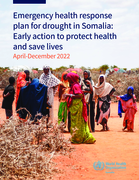
Nearly 260 000 people died in parts of Somalia between October 2010 and April 2012, including
133 000 children under five during the famine and food crisis in Somalia making it the worst famine in history.
A study commissioned and funded by the Food and Agriculture Organization of the United Natio
...
n’s food security and nutrition analysis unit for Somalia stated that the famine early warning systems clearly identified the risk of famine in South Central Somalia in 2010–2011 but timely action to prevent the onset of famine was not taken. The result was large scale
mortality, morbidity and population displacement.
more
