
Filter
957
Text search:
World
Health
Organization
-
Regional
Office
for
South-East
Asia
Featured
Recommendations
120
New Publications
250
Language
Document type
No document type
435
Studies & Reports
201
Guidelines
171
Manuals
55
Strategic & Response Plan
48
Training Material
13
Fact sheets
10
Situation Updates
8
Resource Platforms
8
Infographics
4
Brochures
2
Online Courses
2
Countries / Regions
Global
70
South–East Asia Region
67
India
47
Asia
39
Myanmar / Burma
31
Nepal
27
Bangladesh
20
Philippines
13
Africa
12
Indonesia
11
Western Pacific Region
11
Western and Central Europe
11
Cambodia
10
Thailand
10
Sri Lanka
6
Eastern Europe
6
Ethiopia
5
Afghanistan
5
Uganda
4
Pakistan
4
Kenya
4
China
4
South Africa
4
Middle East and North Africa
4
Laos
4
Russia
4
Vietnam
4
Nigeria
3
Ghana
3
Syria
3
East and Southern Africa
3
West and Central Africa
3
Latin America and the Carribbean
3
Venezuela
3
Timor Leste/ East Timor
3
Burkina Faso
2
Liberia
2
Senegal
2
Congo, Democratic Republic of
2
Haiti
2
South Sudan
2
Tanzania
2
Rwanda
2
Mozambique
2
Sudan
2
Yemen
2
Albania
2
Iran
2
Sierra Leone
1
Morocco
1
USA
1
Saudi Arabia
1
Cameroon
1
Somalia
1
Iraq
1
Jordan
1
Lebanon
1
Zambia
1
Turkey
1
Papua New Guinea
1
Central African Republic
1
Namibia
1
Eswatini/ Swaziland
1
Brazil
1
Croatia
1
Ukraine
1
Ecuador
1
Greece
1
Mexico
1
Eastern Europe and Central Asia
1
Other region
1
Paraguay
1
Bhutan
1
Palestine
1
North Korea
1
Mongolia
1
Tajikistan
1
Kazakhstan
1
Georgia
1
Maldives
1
Tunisia
1
Bosnia and Herzegovina
1
Authors & Publishers
Publication Years
Category
Countries
206
Clinical Guidelines
133
Public Health
81
Women & Child Health
74
Key Resources
49
Capacity Building
21
Pharmacy & Technologies
15
Toolboxes
HIV
97
Mental Health
89
TB
62
COVID-19
62
NTDs
55
Planetary Health
50
AMR
38
Global Health Education
33
Caregiver
32
Rapid Response
28
NCDs
23
Malaria
21
Disability
20
2.0 Rapid Response
18
Pharmacy
16
Zika
13
Refugee
11
Health Financing Toolbox
11
Natural Hazards
10
Conflict
7
Ebola & Marburg
6
Cholera
6
Specific Hazards
6
Polio
5
Typhoon
1
Social Ethics
1
Preliminary overview of refugees and migrants self-reported impact of COVID-19
The study surveyed over 30,000 refugees and migrants living in 170 countries. Many of the respondents had fled war or dire economic conditions in their home country only to be faced with the additional challenges posed b
...
The global burden of disease associated with air pollution exposure exacts a massive toll on human health worldwide: exposure to air pollution is estimated to cause millions of deaths and lost years of healthy life annually. The burden of disease at
...


The main message emerging from this new comprehensive global assessment is that premature death and disease can be prevented through healthier environments – and to a significant degree. Analysing the latest data on the environment-disease nexus and the devastating impact of environmental hazards
...
Against this background of nearly 20 years of experience of research, development and
improvement in patient safety, the role of incident and adverse event reporting, as well as the
benefits that derive from it, is still a work in progress.This document has two main purposes:
• to provide an up
...

Growing emergencies and displacements across the world demand increasingly complex interventions and responses. The World Health
...
orientations provisoires, 25 juin 2021. Des tests de diagnostic rapides et précis sont un outil essentiel pour prévenir et contrôler la propagation du COVID-19. Ce document décrit les recommandations relatives aux stratégies nationales de dépistage et à l'utilisation de la PCR et des tests an
...
Eradication of yaws in India | Éradication du pian en Inde - 17 April 2015, 90th Year / 17 Avril 2015, 90e Année | No. 16, 2015, 90, 161–168 | http://www.who.int/wer

Taking a multisectoral, One Health approach is necessary to address complex health threats at the human-animal-environment interface, such as rabies, zoonotic influenza, anthrax, and Rift Valley fev
...
New research exposes how women and children are disproportionally affected by climate migration, which puts them at greater risk of gender-based violence, child labour and exploitation.
Governments must ensure the safety and protection of women and girls in climate emergencies, including the safe
...

The purpose of this report is to provide an overview of the issues in regulating and managing international emergency in a selection of large and small-scale sudden onset disasters (SODs). In doing so, it aims to contribute to several key international commitments as well as its objective in disaste
...
The 2019 edition treating data for 2018 marks sustained international efforts dedicated to reporting on, analysing and understanding the year-to-year variations and long-term trends of a changing climate.

This report summarizes the World Health Organization’s (WHO) global work on water, sanitation and hygiene (WASH) during 2022. It describes how th
...

The WHO Global tuberculosis report 2024 provides a comprehensive and up-to-date assessment of the TB epidemic, and of progress in prevention, diagnosis and treatment of the disease, at global, regional and country levels. This is done in the context
...
The WHO Pharmaceuticals Newsletter provides you with the latest information on the safety of medicinal products and regulatory actions taken by authorities around the world.
In addition, this edition includes summary and recommendations from the vi
...
The 2023 Country Presence Report provides an overview of what WHO does in countries to advance towards the SDGs and implement GPW13, how we do it, with whom we work, and what is needed to overcome challenges for achieving results and impact in count
...
Sepsis contributes significantly to preventable mortality and is the final common pathway to death for severe infectious diseases; it can also arise as a complication of injuries and non-communicable diseases.

The Best Buys for Disease Elimination is a practical, evidence-based guide to the most effective actions for countries to implement in order to eliminate communicable diseases. The guide highlights
...
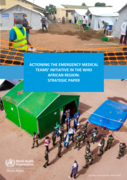
Emergency medical teams (EMT) are first response health care providers – doctors, nurses, paramedics, and others – during outbreaks and emergencies or disasters, working with governments, charities such as nongovernmental organizations (NGOs), a
...
