
Filter
1695
Text search:
vector
Featured
159
458
Language
Document type
658
389
250
124
115
53
39
16
15
13
6
5
4
4
3
Countries
123
65
57
31
30
29
27
22
21
21
21
20
18
18
18
18
17
17
16
16
16
15
15
14
13
12
11
10
10
10
10
10
10
9
9
9
8
7
7
7
7
7
6
6
6
6
6
5
5
5
5
5
5
5
4
4
4
4
4
4
4
3
3
3
3
3
3
3
3
3
3
3
3
3
3
3
3
3
3
2
2
2
2
2
2
2
2
2
2
2
1
1
1
1
1
1
1
1
1
1
1
1
1
1
1
1
1
1
1
1
1
1
1
1
1
1
1
1
1
1
Authors & Publishers
Publication Years
Category
580
134
112
109
26
24
23
Toolboxes
260
183
163
128
117
60
56
46
46
30
22
21
17
16
15
13
12
10
10
9
6
4
4
3
1

This article provides an overview of the current and projected climate change risks and impacts to mental health and provides recommendations for priority actions to address the mental health consequences of climate change.

In 2015, 26% of the deaths of 5.9 million children who died before reaching their fifth birthday could have been prevented
through addressing environmental risks – a shocking missed opportunity. The prenatal and early childhood period represents
a window of particular vulnerability, where enviro
...
Mosquito-borne diseases are expanding their range, and re-emerging in areas where they had subsided for decades. The extent to which climate change influences the transmission suitability and population at risk of mosquito-borne diseases across different altitudes and population densities has not be
...
Published: November 24, 2020 https://doi.org/10.1371/journal.pbio.3000938
Climate change is expected to have complex effects on infectious diseases, causing some to increase, others to decrease, and many to shift their distributions. There have been several important advances in understanding the
...
As the nation’s public health leader, the Centers for Disease Control and Prevention (CDC) is actively engaged in a national effort to protect the public’s health from the harmful effects of climate change. Scientists from CDC’s National Center for Emerging and Zoonotic Infectious Diseases (NC
...

nt. J. Environ. Res. Public Health 2014, 11(12), 13097-13116; https://doi.org/10.3390/ijerph111213097
Climate change will increase the frequency and magnitude of extreme weather events and create risks that will impact health care facilities. Health care facilities will need to assess climate chang
...
The American Journal of Tropical Medicine and Hygiene Volume 106: Issue 1 p.12-14.he piece highlights a body of research that suggests tiny plastic particles could disrupt immune and endocrine systems, damage organs, and cause other health problems. “Without a fundamental reimagining of global
...
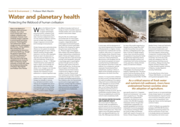
Water is the lifeblood of planetary health and human civilisation. As a critical source of fresh water, rivers underpin civilisations, past and present. However, rivers constantly change in response to environmental and human pressures. Protecting global river systems from climate change and other a
...
One Health 5 (2018) 34–36
These guidelines are based on the 3rd Edition of the WHO Guidelines (Published 2015) World Health Organization’s Guidelines for the treatment of malaria. Additional literature surveys have been undertaken. Factors that were considered in the choice of therapeutic options included effectiveness, sa
...

Epidemics of infectious diseases are occurring more often, and spreading faster and further than ever, in many different regions of the world. The background factors of this threat are biological, environmental and lifestyle changes, among others. A potentially fatal combination of newly-discovered
...

The Committee discussed the implications for preparedness for smallpox-like events reflected by the ongoing COVID-19 pandemic. The Committee noted how quickly diagnostics and vaccines could be developed and deployed when resources and political will were abundant. This rapidity was also due to the f
...

The leishmaniases are a group of diseases caused by Leishmania spp., which occur in cutaneous, mucocutaneous and visceral forms. They are neglected tropical diseases (NTDs), which disproportionately affect marginalized populations who have limited access to health care. HIV co-infected patients with
...

2nd edition. These guidelines include several notable changes from the first edition. For cutaneous leishmaniasis, ketoconazole has been removed from the list of treatment options; the number of Leishmania species for which there is strong evidence for the efficacy of miltefosine has increased from
...
Objetivo general: Delinear las recomendaciones para la atención médica de niños, adolescentes y adultos infectados por el T. cruzi, en cualquiera de sus fases y formas clínicas. Se espera de esta forma optimizar el uso de recursos y mejorar la calidad de atención de los pacientes, con el fin de
...

Guía Nacional para el Manejo de la Enfermedad por el Virus de la Chikungunya

The Quadripartite Organizations – the Food and Agriculture Organization of the United Nations (FAO), the United Nations Environment Programme (UNEP), the World Organisation for Animal Health (WOAH, founded as OIE), and the World Health Organization (WHO) – collaborate to drive the change and tra
...

Buruli ulcer caused by Mycobacterium ulcerans is a neglected tropical disease characterized by extensive ulceration involving predominantly the upper and lower limbs of patients. The disease is common in rural tropical communities in West and Central Africa, where access to proper health care is lim
...
The socioeconomic factors and public health inadequacies that facilitated the rapid spread of this infection continue to exist. As it is a new and emerging disease it has not received sufficient coverage yet in the medical curricula of Member States. Specific treatment is not available, and there is
...
