
Filter
932
Text search:
biological
agents
Featured
109
205
Language
Document type
430
196
167
77
24
18
11
3
2
2
1
1
Countries
56
37
24
23
21
21
18
18
14
13
13
13
13
12
11
9
9
8
8
8
7
7
6
6
6
6
6
5
5
4
4
4
4
4
3
3
3
3
3
3
2
2
2
2
2
2
2
2
2
2
2
2
2
2
1
1
1
1
1
1
1
1
1
1
1
1
1
1
1
1
1
1
1
1
1
1
1
1
1
1
1
Authors & Publishers
Publication Years
Category
289
85
77
52
38
23
19
Toolboxes
75
58
56
56
52
46
44
40
40
39
38
21
21
20
19
15
13
13
9
9
9
4
3
3
1
With its expert practical advice on security in situations of armed conflict, this updated set of guidelines will prove invaluable to humanitarian personnel working at the operational level. Following on from the success of the first edition, published in 1999, it addresses new and developing threat
...

This document provides additional guidance for the responsible and prudent use of antimicrobials in food-producing animals, and should be read in conjunction with the Recommended International Code of Practice for Control of the Use of Veterinary Drugs CAC/RCP 38-1993. Its obj
...
A Step-by-Step Guide.
It is intended for health planners, dengue or vector control programme managers and individuals, nongovernmental organizations (NGOs) and other agencies with interests and/or expertise in developing biological, chemical, envir
...

The era of effective antibiotics is coming to a close. In just a few generations, many “miracle medicines”have been beaten into ineffectiveness by the bacteria they were intended to eradicate. Bacteria quickly adapt to the presence of antibacterial
...

This document provides additional guidance for the responsible and prudent use of antimicrobials in food-producing animals, and should be read in conjunction with the Recommended International Code of Practice for Control of the Use of Veterinary Drugs CAC/RCP 38-1993. Its objectives are to minimize
...
Textes du Codex concernant la résistance aux antimicrobiens d’origine alimentaire
Textos del Codex sobre la resistencia a los antimicrobianos transmitida por los alimentos
Antimicrobial resistance (AMR) is a major global public health concern and a food safety issue. When pathogens become r
...
Antibiotics have been useful in fighting infectious diseases in our country for decades, but because of the overuse and misuse of these agents, an increasing number of organisms are now resistant to them. The Philippines, like other Southeast Asian
...
Healthy communities rely on well-functioning ecosystems. They provide clean air, fresh water, medicines and food security. They also limit disease and stabilize the climate. But biodiversity loss is happening at unprecedented rates, impacting human health worldwide, according to a new state of knowl
...
This report of the EFSA and ECDC presents the results of zoonoses monitoring activities carried out in 2020 in 27 EU Member States (MS) and nine non-MS. Key statistics on zoonoses and zoonotic agents in humans, food, animals and feed are provided an
...
Infectious diseases continue to impose unpredictable burdens on global health and economies, a subject that requires constant research and updates. In this sense, the objective of the present article was to review studies on the role of wild animals as reservoirs and/or dispersers of etiological
...

The Investment guidelines for youth in agrifood systems in Africa, developed jointly by FAO and the African Union Commission (AUC) through a multi-stakeholder and participatory process, highlight the importance of youth as change agents and key stak
...

This report assesses the impact of the conflict in Ukraine and its implications for organized crime and security-related issues for neighbouring countries, with a focus on Moldova.
These include:
Organized crime and illicit trafficking (including trafficking in persons, drugs, arms, illicit toba
...
This policy brief has been developed in response to the contemporary challenge of antibiotic resistance (ABR). ABR poses a formidable threat to global health and sustainable development. It is now increasingly recognized that the systematic neglect of cultural factors is one of the biggest obs
...
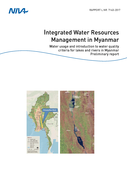
The purpose of the report is to present some first recommendation for the development of Myanmar ecological quality criteria using the system of the EU Water Framework Directive (EU WFD) as baseline, with main focus on the characterization and classification processes. As background for the recommen
...

This document adopts a health determinants framework for examining the evidence related to women’s poor mental health. From this perspective, public policy including economic policy, socio-cultural and environmental factors, community and social support, stressors and life events, personal behavio
...

Antimicrobial resistance (AMR) is an important public health concern shared by developed and developing countries. In developing countries the burden of infectious diseases is greater and exacerbated by limited access to, and availability and affordability of, antimicrobials required to treat infect
...

The International Council of Nurses (ICN) Code of Ethics ([1], p. 5) specifies the nurse’s role of promoting “an environment in which the human rights, values, customs and spiritual beliefs of the individual, family and community are respected”. The Malta Code of Ethics supports this for nurse
...

A fact sheet from the National Academies and the U.S. Department of Homeland Security
3 March 2022
The WHO Therapeutics and COVID-19: living guideline contains the Organization’s most up-to-date recommendations for the use of therapeutics in the treatment of COVID-19. The latest version of this living guideline is available in pdf format (via the ‘Download’ button) and via an
...
