Filter
999
Text search:
World
Health
Organization,
Regional
Office
Africa
Featured
Recommendations
106
New Publications
245
Language
Document type
No document type
490
Studies & Reports
203
Guidelines
133
Strategic & Response Plan
60
Manuals
53
Training Material
19
Situation Updates
19
Fact sheets
15
Resource Platforms
4
App
1
Online Courses
1
Videos
1
Countries / Regions
Global
56
Kenya
38
Ethiopia
30
Sierra Leone
29
Africa
27
Uganda
24
Liberia
22
Tanzania
20
Malawi
19
Zambia
17
India
16
South Africa
15
West and Central Africa
14
Congo, Democratic Republic of
13
South Sudan
13
Western and Central Europe
13
Ghana
12
Guinea
11
Nigeria
11
Syria
11
Senegal
10
Rwanda
10
East and Southern Africa
10
Middle East and North Africa
10
Asia
10
Latin America and the Carribbean
9
Zimbabwe
7
Yemen
7
South–East Asia Region
7
Cameroon
6
Ukraine
6
Somalia
5
Mozambique
5
Namibia
5
Lesotho
5
Mali
4
Nepal
4
Sudan
4
Brazil
4
Myanmar / Burma
4
Russia
4
Togo
3
Philippines
3
Bangladesh
3
Central African Republic
3
Eswatini/ Swaziland
3
Botswana
3
Eastern Europe
3
Côte d’Ivoire / Ivory Coast
2
Haiti
2
Pakistan
2
Afghanistan
2
Lebanon
2
Chad
2
Thailand
2
Benin
2
North Macedonia
2
Colombia
2
Madagascar
2
Sri Lanka
2
Eastern Europe and Central Asia
2
Venezuela
2
Kazakhstan
2
Burkina Faso
1
Guinea-Bissau
1
Morocco
1
Niger
1
Jordan
1
Cambodia
1
China
1
Indonesia
1
Argentina
1
Peru
1
Hungary
1
Burundi
1
Angola
1
Mexico
1
Western Pacific Region
1
Southern Africa
1
Laos
1
Tajikistan
1
Estonia
1
Moldova
1
Iran
1
Kyrgyzstan
1
Georgia
1
Jamaica
1
Mauritius
1
Norway
1
Portugal
1
Authors & Publishers
Publication Years
Category
Countries
302
Clinical Guidelines
87
Key Resources
69
Public Health
65
Women & Child Health
63
Capacity Building
18
Pharmacy & Technologies
14
Toolboxes
HIV
107
COVID-19
86
Planetary Health
60
Mental Health
53
Ebola & Marburg
46
TB
44
AMR
38
Disability
35
Rapid Response
34
Caregiver
28
Conflict
27
NTDs
25
2.0 Rapid Response
25
Refugee
20
Global Health Education
20
Pharmacy
15
NCDs
14
Health Financing Toolbox
13
Natural Hazards
9
Polio
7
Zika
7
Cholera
6
Malaria
5
Typhoon
3
Specific Hazards
2
Social Ethics
2
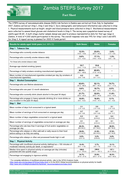
The STEPS survey of noncommunicable disease (NCD) risk factors in Zambia was carried out from July to September 2017. Zambia carried out Step 1, Step 2 and Step 3. Socio demographic and behavioural information was collected in Step 1. Physical measurements such as height, weight and blood pressure w
...

APRIL 2021- JULY 2022
Uganda Ebola Virus Disease Situation Report
recommended
Here you can find the latest Updates on Ebola Outbreak in Uganda



This updated step by step guide aims to assist the ministries of health (MoHs) in developing the national action plans for noma prevention and control, with a view to sustainably reducing the incidence of noma as a public
...
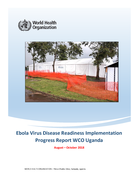
Risk of spill-over of EVD to Uganda has been categorised as very high. On 28 September 2018, WHO elevated the risk at the regional level which includes Uganda from ‘high’ to ‘very high’. Uganda has a very long and largely porous border with
...
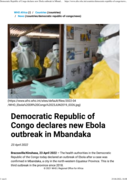
he health authorities in the Democratic Republic of the Congo today declared an outbreak of Ebola after a case was confirmed in Mbandaka, a city in the north-western Equateur Province. This is the third outbreak in the province since 2018.

This report is one of the first major products of the newly established Precision Public Health Metrics unit of the UCN cluster of the WHO Regional Office
...

The South African WHO Country Cooperation Strategy (CCS) 2023–2027 focuses on four key strategic priorities based on the country’s health needs and disease epidemiology, while also considering the need for building resilient
...
Snakebite is a neglected public health problem. Rural populations are frequent victims as they go about their daily food production and animal rearing activities and as they reside in the comfort of their homes. Unfortunatly, many of these snakebite
...

The World Health Organization Regional Office
...

WHO Regional Office for Africa

The report “Build back fairer: achieving health equity in the Eastern Mediterranean Region” provides ground breaking insights into the state of health inequities in the Region and urges countrie
...
This publication represents a key step forward in translating Control of the leishmaniases (WHO Technical Report Series, No. 949) into a more practical tool for health personnel directly involved in the case management of cutaneous leishmaniasis. Wi
...
hese are two parallel guidelines, one for small hospitals and another one for large hospitals. In view of heavy burden of malaria and prevalence of drug resistant falciparum malaria in the South-East Asia Region, the guidelines were developed for use by medical personnel who treat severe malaria pat
...
The Asia Pacific Observatory on Health Systems and Policies is a collaborative partnership which supports and promotes evidence-based health policy making in the Asia Pacific Region. Based in WHO’
...

There is a broad consensus nowadays that the Earth is warming up as a result of greenhouse gas emissions caused by anthropogenic activities. It is also clear that current trends in the fields of energy, development and population growth will lead to continuous and ever more dramatic climate change.
...