
Filter
588
Text search:
irrigation
Featured
44
193
Language
Document type
273
137
62
46
39
10
10
7
2
1
Countries
35
30
24
24
23
22
19
17
11
10
9
9
8
8
7
7
7
6
6
5
5
5
4
4
4
4
4
4
4
4
3
3
3
3
3
3
3
3
3
3
3
3
3
2
2
2
2
2
2
2
2
2
2
1
1
1
1
1
1
1
1
1
1
1
1
1
1
1
1
1
1
1
1
1
1
1
1
1
1
1
1
1
1
1
Authors & Publishers
Publication Years
Category
269
82
34
27
18
6
1
Toolboxes
103
42
40
33
22
15
14
14
13
8
7
7
5
5
4
4
4
4
3
3
2
2
2
2
1
1
1
Children without access to safe water are more likely to die in infancy -- and throughout childhood -- from diseases caused by
water-borne bacteria, to which their small bodies are more vulnerable.

Safe water, sanitation and hygiene (collectively known as WASH) are crucial for human health and well-being. Yet, millions of people globally lack adequate WASH services and consequently suffer from or are exposed to a multitude of preventable illnesses.
This report, which involved input from across WaterAid, in particular from the Programme Support Unit (PSU) of WaterAid UK, includes case studies from a variety of countries, including Bangladesh, Burkina Faso, Eswatini, Ethiopia, Ghana, India and Nepal, each demonstrating what must be done now to i
...
The Lancet, Planetary Health Volume 5, ISSUE 11, e766-e774, November 01, 2021
Increasing human demand for water and changes in water availability due to climate change threatens water security worldwide. Additionally, exploitation of water resources induces stress on freshwater environments, leadi
...

Human use of land has been transforming Earth's ecology for millennia. From hunting and foraging to burning the land to farming to industrial agriculture, increasingly intensive human use of land has reshaped global patterns of biodiversity, ecosystems, landscapes, and climate. This review examines
...

In 2015, 26% of the deaths of 5.9 million children who died before reaching their fifth birthday could have been prevented
through addressing environmental risks – a shocking missed opportunity. The prenatal and early childhood period represents
a window of particular vulnerability, where enviro
...


An interdisciplinary study within the framework of the dialogue project on the contribution of the Catholic Church to a socio-ecological transformation.
The study examines the obstacles to the implementation of the socio-ecological transformation and develops recommendations for action.

National-scale databases and reliability issue
Background report
Environmental Research Volume 151, November 2016, Pages 115-123
Dengue is the world’s most important arboviral disease in terms of number of people affected. Over the past 50 years, incidence increased 30-fold: there were approximately 390 million infections in 2010. Globalization, trade, travel,
...
One Earth Perspective. Cell Press
February 2020Earth's Future 8(2):e2019EF001377.The water planetary boundary attempts to provide a global limit to anthropogenic water cycle modifications, but it has been challenging to translate and apply it to the regional and local scales at which water problems and management typically occur. We
...

Project Drawdown (2022) provides evidence of how climate solutions can also be win-win opportunities for meeting development and human well-being needs while boosting prosperity for rural communities in sub-Saharan Africa and South Asia. The report summarizes the co-benefits of five groups of a subs
...
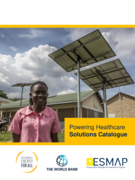
This catalogue serves the purpose of connecting stakeholders from the
energy and health sectors with solutions providers, to help meet the
energy needs of healthcare facilities in response to COVID-19 and
beyond. The solutions provided herein represent a sample of a larger
group of solution prov
...

Briefing Note no. 80 November 2015

The Lab identifies, develops, and launches sustainable finance
instruments that can drive billions to a low-carbon economy. The
2019 Global Lab Cycle targets four specific sectors across
mitigation and adaptation: blue carbon in marine & coastal
ecosystems; sustainable agriculture for smallholde
...
Climate Smart Agriculture provides an excellent opportunity for the transformation by uniting agriculture, development and climate change under a common agenda through integrating the three dimensions of sustainable development (economic, social and environmental) by jointly addressing food security
...
The Government recognizes the critical role of the built environment in addressing climate change and environmental degradation. To this end, it has identified and empowered the Kenya Building Research Centre to champion and coordinate the government’s green building agenda in relation to climate
...
This manual for trainers outlines the information and materials required to undertake training in line with the WASH FIT Guide, including background documents, the content of the recommended training modules and training evaluation approaches. The modular approach outlined enables trainers to decide
...
