
Filter
1980
Text search:
Centers
for
Disease
Control
(CDC)
Featured
200
518
Language
Document type
964
325
186
119
109
76
62
52
43
18
10
8
4
2
1
Countries
115
83
70
56
51
47
42
41
40
40
40
35
34
28
27
27
26
26
24
24
24
23
23
21
20
18
16
16
15
15
14
14
14
14
14
14
13
13
12
11
10
10
9
9
8
8
8
7
7
6
6
6
6
5
5
4
4
4
4
4
4
3
3
3
3
3
3
3
2
2
2
2
2
2
2
2
2
1
1
1
1
1
1
1
1
1
1
1
1
1
1
1
1
1
1
1
1
1
1
1
1
1
Authors & Publishers
Publication Years
Category
599
176
112
107
65
30
27
Toolboxes
249
203
149
107
105
79
68
66
63
57
46
45
40
39
33
31
28
27
24
19
14
10
8
7
2

The Public Health Burden of Commercial Tobacco Use
The burden of disease and death from commercial tobacco* use in the United States is
overwhelmingly caused by cigarettes and other combustible tobacco products.
The purpose of this interim guidance is to provide information and insight to assist public policy and
health system leaders in preparing for and responding to an MCE caused by terrorist use of explosives
(TUE). This document provides practical in
...


Acute Radiation Syndrome (ARS) (sometimes known as radiation
toxicity or radiation sickness) is an acute illness caused by
irradiation of the entire body (or most of the body) by a high dose
of penetrating radiation in a very short period of time (usually
...
The roundtable provided a forum that allowed communicators across a number of Federal agencies to share information, strategies, and challenges in developing and providing communication messages and materials to the public in preparation
...

This statement aims to provide guidance and recommendation to African Union Member States in responding to the following questions:
What should countries do when announcing identification of a herbal remedy or medicine?
What are the implications
...

This guidance document is based on research of social media activity related to antibiotic use at EU level, as well as on a survey of the social media activities of EAAD partner organisations, mostly EU umbrella organisations of patients and health professionals. The research showed that there is al
...
On 13 August 2024, the Africa Centres for Disease Control (Africa CDC) declared the multi-countr
...

2nd edition. The Event-based Surveillance Framework is intended to be used by authorities and agencies responsible for surveillance and response. This framework serves as an outline to guide stakeholders interested in implementing event-based survei
...

24 September 2021. The vaccine has been authorized by the Chinese National Regulatory Authority (NRA) – the National Medicinal Product Administration (NMPA) – as well as other regulatory authorities. Because WHO has granted Emergency Use Listing (EUL)
...
Ensure effective and coordinated public health emergency preparedness and response using a One Health approach

This document outlines the plan for a continental cholera prevention and control with the implementation framework for the Cholera IMST, detailing
...
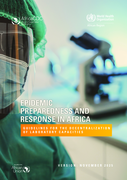
Epidemic Preparedness and Response in Africa | Guidelines for the Decentralization of Laboratory Capacity
recommended
The decentralization of laboratory capacities is a critical strategy for improving epidemic preparedness and response in Africa. Centralized systems often delay case confirmation, hinder timely interventions, and exacerbate the impact of outbreaks,
...
A Public Health EOC (PHEOC) serves as a hub for coordinating the preparation for, response to, and recovery from public health emergencies. The preparation includes planning, such as risk and resour
...
Quality Assurance Framework for SARS-CoV-2 Antigen Rapid Testing for Diagnosis of COVID-19
recommended
ASLM in collaboration with the Africa Centres for Disease Control and Prevention, and in partnership with the Clinton Health Access Initiative, Amr
...

Event-based surveillance (EBS) is defined as the organized collection, monitoring, assessment and interpretation of mainly unstructured ad hoc information regarding health events or risks, which may represent an acute risk to health. Both indicator-based and event-based surveillance components serve
...

The article "Non-communicable diseases, injuries, and mental ill-health in Africa: the role of the Africa Centres for Disease Control and Preventio
...


Non-Communicable Diseases (NCDs), including mental disorders, currently pose one of the biggest threats to health and development globally, particularly in low and middle income countries2. It is predicted that unless proven interventions are rapidly implemented in countries, in the short to medium
...
This book is one of fifteen modules of the “Noncommunicable disease education manual for primary health care professionals and patients”. This manual is intended to provide health information on
...
