
Filter
810
Text search:
UN
Convention
on
the
Rights
of
Persons
with
Disabilities
Featured
64
184
Language
Document type
582
95
43
41
30
14
2
1
1
Countries
28
23
23
22
20
20
19
17
16
14
14
13
13
12
12
12
12
11
11
9
8
8
8
8
7
7
7
7
6
5
5
5
5
5
5
5
4
4
4
4
4
4
3
3
3
3
3
3
2
2
2
2
2
2
2
2
2
2
2
2
2
1
1
1
1
1
1
1
1
1
1
1
1
1
1
1
1
1
1
1
1
1
Authors & Publishers
Publication Years
Category
280
50
45
37
10
7
1
Toolboxes
325
108
41
26
24
13
12
10
7
7
7
6
3
3
3
2
2
2
1
This document is part of the process for improving the quality of care in family planning. Medic
...

The harmful use of alcohol causes approximately 3 million deaths every year and the overall burden of
...

This booklet shows what disability inclusive development for poverty alleviation looks like in a range of settings and with different challenges through eight case studies
...

Case management is an approach at the core of social work. Case management is the process required for improving
...

The WHO country office for Ghana, began the year 2019 with a 4-day staff retreat at the Busua Be
...

This annual report highlights the work of the WHO from January to June 2021 ( December 2021). The
...

The document presents a strategic framework by the World Health Organization for managing risks related to emergencies and disasters in the health
...

Inequality of access to palliative care and symptom relief is one of the greatest disparities in global health care (1). Currently, there is avoida
...
The toolkit provides practical guidance and tools that can support efforts, including planning and implementation activities, to create dementia-inclusive societies.
The toolkit is divided into t
...
Recommendations to develop guidelines on community-based rehabilitation (CBR) were made during the International Consultation to Review Community-based Rehabilitation which was held in Helsinki, Fin
...
Improving access to assistive technology for everyone, everywhere.
The first WHO Priority Assistive Products List was launched in May 2016. The List includes hearing aids, wheelchairs, communicati
...
There is a substantial and ever-increasing unmet need for rehabilitation worldwide, which is particularly profound in low- and middle
-income countries. The availability of accessible and affordabl
...
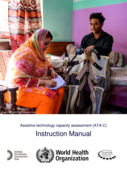
The assistive technology capacity assessment (ATA-C) is a system-level tool to evaluate a country’s capacity to finance, regulate, procure and provide assistive technology. It can be used for awareness raising, policy and programme design, and ong
...

This handbook is a quick-reference tool that provides practical, field-level guidance to establish and maintain a GBV sub-cluster in a humanitarian emergency. It provides the foundations for coordination. More in-depth information can be pursued thr
...

Humanitarian emergencies and crises (Humanitarian emergencies and crises) are large-scale events that may result in the breakdown of health care systems and society, forced displacement, death, and
...

This booklet presents key messages for action, summarized from a set of chapters on different environmental health issues, available at www.who.int/ ceh/publications/healthyenvironmentsforhealthychi
...

Gender-based violence is a life-threatening, global health and human rights issue that violates international human rights law and principles of ge
...

In an ambitious new era for health development under the 2030 Agenda for Sustainable Development, WHO and
its partners have a solid foundation of success
...

The National Strategy for Natural Disaster, Prevention, Response and Mitigation to 2020, which outlines Vietnam’s main disaster risk management objectives and the National Target Program (NTP) for
...

Mental health is critically important to everyone, everywhere. All over the world, mental health needs are high but responses are insufficient and inadequate. The World mental health report: transfo
...
