
Filter
635
Text search:
paediatrics
Featured
87
163
Language
Document type
342
129
73
50
20
6
5
3
3
2
1
Countries
44
21
20
15
15
14
10
9
9
7
7
7
6
5
5
5
5
5
5
5
4
4
4
3
3
3
3
3
2
2
2
2
2
2
2
2
2
2
2
1
1
1
1
1
1
1
1
1
1
1
1
1
1
1
1
1
1
1
1
1
Authors & Publishers
Publication Years
Category
188
161
145
31
22
19
7
Toolboxes
61
47
38
22
21
21
19
18
16
11
11
10
10
9
8
6
3
3
2
2
2
2
2

Children's Health and the Environment WHO Training Package for the Health Sector World Health Organization
Guidelines for the production of extemporaenous formulations and hospital based sterile preparations
In order to streamline and effectively control compounding of medicinal products in hospitals and pharmacies, these Guidelines for Production of Extemporaneous and Hospital Based Sterile Preparations has been crafted. The purpose of these guidelines therefore is to assist pharmacists in
...

mhGAP is based on evidence-based technical guidelines (4) and provides a set of tools and
training packages to extend service provision. The mhGAP Intervention Guide (mhGAP-IG)
for MNS disorders in non-specialized health settings (8) is a clinical decision-making tool
for assessing and managing p
...
In this report, potential reasons for this apparent
contradiction between cherished human values
and observed social actions are explored with a
view to better formulating concrete steps that
governments and other stakeholders can take to
reshape social attitudes and public policy.
World Drug Report 2018
-4-
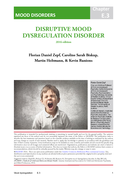
Mood disorders
Chapter E.3
2016 edition

Substance use disorders
Chapter G.3
Other disorders Chapter H.1
Other disorders
Chapter H.3
Psychatry & Pediatrics
Chapter I.3

Trastornos del desarrollo
Capítulo C.4
Otros Trastornos
Capítulo H.1
Edición 2016
Edición: Matías Irarrázaval & Andres Martin
Revisión: Fernanda Prieto-Tagle & Jasna Raventós
Otros trastornos
Capítulo H.3
Edición 2018
Edición: Matías Irarrázaval & Andres Martin
Traducción: Beatriz Ortega & Macarena Espinoza

Miscellaneous
Chapter J.4
Autres troubles
Chapitre H.1
Edition en français
Traduction : Priscille Gérardin et Malaïka Lasfar Sous la direction de : Priscille Gérardin Avec le soutien de la SFPEADA

Mental, Neurological, and Substance Use Disorders: Disease Control Priorities, Third Edition (Volume 4).
Patel V, Chisholm D, Dua T, et al., editors.
Washington (DC): The International Bank for Reconstruction and Development / The World Bank; 2016 Mar 14.
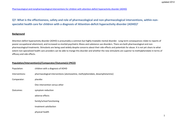
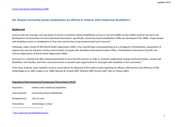
Q7: What is the effectiveness, safety and role of pharmacological and non-pharmacological interventions, within non- specialist health care for children with a diagnosis of Attention-deficit hyperactivity disorder (ADHD)?
Early childhood matters.
This document looks at specific issues regarding the development of young children, in particular from a psychosocial perspective. It is published twice per year by the Bernard van Leer Foundation. The views expressed in Early Childhood Matters are those of the authors and
...
Q4: Should community based rehabilitation be offered to children with intellectual disabilities?
