
Filter
1059
Filtered Results: 1059
Text search:
Ministry
for
Health
and
Social
Welfare,
The
United
Republic
of
Tanzania
Featured
Recommendations
71
New Publications
371
Language
Document type
No document type
731
Studies & Reports
167
Guidelines
67
Strategic & Response Plan
38
Manuals
36
Training Material
9
Situation Updates
4
Fact sheets
3
Brochures
1
App
1
Resource Platforms
1
Infographics
1
Countries / Regions
Tanzania
80
Liberia
56
Myanmar / Burma
45
Namibia
38
Bangladesh
35
Zambia
33
Global
31
Sierra Leone
30
Ethiopia
26
Malawi
24
Kenya
22
Nigeria
22
Western and Central Europe
22
Ghana
21
Uganda
20
India
19
Indonesia
18
Rwanda
16
South Sudan
16
Nepal
14
Asia
14
Africa
13
Zimbabwe
12
Botswana
12
Latin America and the Carribbean
11
Lesotho
10
South–East Asia Region
10
Eastern Europe
10
Congo, Democratic Republic of
9
South Africa
9
Syria
7
Philippines
7
Guinea
7
Mozambique
7
Ukraine
5
Laos
5
Germany
5
East and Southern Africa
5
Eswatini/ Swaziland
5
Albania
4
Senegal
4
Cambodia
4
Eastern Europe and Central Asia
4
Vietnam
4
Colombia
3
China
3
Cameroon
3
Haiti
3
Venezuela
3
Sri Lanka
3
Russia
3
Sudan
3
Thailand
2
Peru
2
Malaysia
2
Lithuania
2
West and Central Africa
2
Middle East and North Africa
2
Western Pacific Region
2
Mauritius
2
Bolivia
2
Brazil
2
Yemen
2
Ecuador
2
North Macedonia
1
Tajikistan
1
Benin
1
Gambia
1
Kazakhstan
1
Chile
1
Iran
1
Singapore
1
Kyrgyzstan
1
Burkina Faso
1
Afghanistan
1
Burundi
1
Bulgaria
1
Armenia
1
Hungary
1
Jordan
1
Turkmenistan
1
Japan
1
Bosnia and Herzegovina
1
Southern Africa
1
Lebanon
1
Central African Republic
1
Poland
1
Angola
1
Bhutan
1
Pakistan
1
Authors & Publishers
Publication Years
Category
Countries
543
Public Health
56
Women & Child Health
56
Key Resources
37
Clinical Guidelines
32
Capacity Building
11
Pharmacy & Technologies
4
Toolboxes
Mental Health
97
HIV
78
Disability
67
TB
48
COVID-19
41
Conflict
33
Planetary Health
29
Refugee
26
Ebola & Marburg
25
Global Health Education
21
NTDs
18
Rapid Response
15
AMR
15
Caregiver
14
Health Financing Toolbox
13
Pharmacy
8
Natural Hazards
7
NCDs
7
Malaria
5
Polio
3
Specific Hazards
2
Social Ethics
2
2.0 Rapid Response
2
Zika
1

Policy brief, 24 July 2020
The COVID-19 pandemic has affected older people disproportionately, especially those living in long-term care facilities. In many countries, evidence shows that more than 40% of COVID-19 related deaths have been linked to long-term care facilities, with figures being as h...
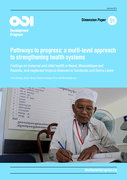
Findings on maternal and child health in Nepal, Mozambique and
Rwanda, and neglected tropical diseases in Cambodia and Sierra Leone | This report synthesises findings from five country case studies from the health dimension of this project, which focus on maternal and child health (MCH) (Mozambique...

The WHO Global Antimicrobial Resistance and Use Surveillance System (GLASS) was launched in 2015 to foster AMR surveillance and inform strategies to contain AMR. The system started with surveillance of AMR in bacteria causing common human infections and has expanded its scope to include surveillance...

Small drinking-water supplies commonly experience operational, managerial, technical and resourcing challenges that impact their ability to deliver safe and reliable services. The needs and opportunities associated with these supplies therefore warrant explicit consideration in policies and regulati...

In Tanzania, institutional efforts to combat HIV/AIDS started in 1985 by establishing a National Taskforce within the Ministry of Health. This was so because the HIV/AIDS epidemic was first perceived as a health problem, and the initial control efforts were formulated and based within the health sec...

The Government of Republic of Zambia reported the first confirmed cases of COVID-19 on 18th March 2020. As of April 27th, 2020, there were 89 confirmed cases, three deaths and 42 recoveries. Confirmed cases are located in three provinces: Lusaka (83 cases), Copperbelt province (5 cases) and Central ...

The study analyses the current situation of children with disabilities in relation to realizing their rights and accessing basic services, as well as their life experiences in their communities. It also focuses on identifying the barriers created by society that prevent children with disabilities fr...

Rehabilitation in health systems provides recommendations for Member States and other relevant stakeholders to strengthen and expand the availability of quality rehabilitation services. Currently, there is a significant unmet need for rehabilitation services and it is frequently undervalued in the h...
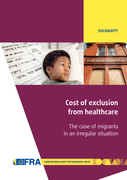
This report aims to estimate the economic cost of providing regular access to healthcare for migrants in an irregular situation, compared with the cost of providing treatment in emergency cases only. Two specific medical conditions – hypertension and prenatal care – were selected as examples, an...

Despite the existence of criminal law, which is an important aspect of anti-FGM policies and programmes, there is not much research on the effects of cross-border practices that invalidate the law as a deterrent. Much remains unknown about the practice of cross-border FGM, specifically about gaps in...

Policy Note #2: Myanmar Health Systems in Transition Policy Notes Series
Myanmar is a country in which people’s access to health services is determined more by where they live than their need for care – a situation that is fundamentally inequitable. The challenge is to reduce levels of ineq...
Myanmar is a country in which people’s access to health services is determined more by where they live than their need for care – a situation that is fundamentally inequitable. The challenge is to reduce levels of ineq...

The WHO/UNICEF JMP report, WASH in Health Care Facilities, is the first comprehensive global assessment of water, sanitation and hygiene (WASH) in health care facilities. It also finds that 1 in 5 health care facilities has no sanitation service*, impacting 1.5 billion people. The report further rev...

This document aims to assist policy‑makers, health care providers and researchers to understand key concepts in health ethics and to identify basic ethical questions surrounding health and health care. It illustrates the challenges of applying ethical principles to global public health and outline...
Please download the latest report from the official website:
http://www.nacp.go.tz/site/publications/epidemiology-and-research-coordination
Monitoring the situation of children and women

Purpose of this document: to present eight practical steps that Member States can take at the national and sub-national level to improve WASH in health care facilities

Fostering resilient development through integrated action plan
The Myanmar Action Plan on Disaster Risk Reduction, 2017 is a comprehensive and unified action plan for disaster risk reduction with prioritized interventions across Myanmar till 2020. With a long term vision and considering deep-root...
The Myanmar Action Plan on Disaster Risk Reduction, 2017 is a comprehensive and unified action plan for disaster risk reduction with prioritized interventions across Myanmar till 2020. With a long term vision and considering deep-root...


The strategic priorities of the CCS 2014–2018 are:
(1) Strengthening the health system.
(2) Enhancing the achievement of communicable disease control targets.
(3) Controlling the growth of the noncommunicable disease burden.
(4) Promoting health throughout the life course.
...
(1) Strengthening the health system.
(2) Enhancing the achievement of communicable disease control targets.
(3) Controlling the growth of the noncommunicable disease burden.
(4) Promoting health throughout the life course.
...
