
Filter
1508
Text search:
Infectious
waste
Featured
221
388
Language
Document type
603
334
250
124
92
36
36
14
13
4
1
1
Countries
97
72
65
64
52
47
39
34
29
29
26
24
22
22
20
20
18
17
16
14
13
12
12
12
12
12
11
11
10
9
9
9
8
8
7
7
6
6
6
6
5
5
4
4
4
4
4
4
3
3
3
3
3
3
3
3
3
3
3
3
2
2
2
2
2
2
2
2
2
2
2
2
1
1
1
1
1
1
1
1
1
1
1
1
1
1
1
1
1
1
1
1
1
1
1
Authors & Publishers
Publication Years
Category
558
165
107
70
47
40
37
1
Toolboxes
179
145
131
111
67
53
50
48
48
44
38
36
27
21
20
20
19
14
12
9
8
8
3
3

This checklist helps to identify the necessary measures to be implemented to mitigate infection transmission among travellers and ground-crossing staff in the context of the COVID-19 pandemic. It features key questions and considerations for gauging the capacity of responding to COVID-19 transmissio
...


Information note of the Global Leaders Group on Antimicrobial Resistance.
Available in English, French, Spanish, Russian, Chinese and Arabic

Infection prevention and control in the context of coronavirus disease (COVID-19): A living guideline
recommended
This second edition of the Infection prevention and control in the context of coronavirus disease (COVID-19): A living guideline provides the most up to date technical guidance on mask use in community settings in the context of COVID-19.
In this edition, new information includes updated mask re
...
The 20th century was a period of unprecedented ecological change, with dramatic reductions in natural ecosystems and biodiversity and equally dramatic increases in people and domestic animals. Never before have so many animals been kept by so many people—and never before have so many opportunities
...
The authors conduct an integrated survey of Antimicrobial Resistant Organisms (AMR) in drinking water, wastewater and surface water in three settings in Bangladesh: rural households, rural poultry farms, and urban food markets. Results show that untreated water discharged from rural households, poul
...
This document aims to encourage countries to develop and implement policies to maintain and strengthen IPC programmes and measures in health care facilities in the context of the current ongoing transmission of the SARS-CoV-2, with recognition that epidemiological trends may vary and the risk of tra
...

14 June 2022.
The aim of this document is to provide concise advice to public health authorities and guide their prevention, awareness-raising and behaviour change interventions before, during and after upcoming summer events.

This document compiles the recommendations made by the World Health Organization (WHO) and the Pan American Health Organization (PAHO) to help professionals in charge of vector control programs in Latin America and the Caribbean at the national, subnational, and local level update their knowledge in
...

El presente documento reúne un conjunto de recomendaciones formuladas por la Organización Mundial de la Salud (OMS) y la Organización Panamericana de la Salud (OPS) para ayudar, a los profesionales encargados de los programas de control de vectores de Latinoamérica y el Caribe a nivel nacional,
...

This report provides a review and analysis of the research landscape for three diseases – Chagas disease, human African trypanosomiasis and leishmaniasis – that disproportionately afflict poor and remote populations with limited access to health services. It represents the work of the disease re
...

Schistosomiasis is widely recognized as a disease that is socially determined. An understanding of the social and behavioural factors linked to disease transmission and control should play a vital role in designing policies and strategies for schistosomiasis prevention and control. To this must be a
...

The WHO continuously reviews available data on SARS-CoV-2 variants of concern. For this version, the global epidemiological
situation of the COVID-19 pandemic as of 21 January 2022 – at a time when the Omicron VOC had been identified in 171
countries across all six WHO Regions and was rapidly re
...

Schistosomiasis is widely recognized as a disease that is socially determined. An
understanding of the social and behavioural factors linked to disease transmission and
control should play a vital role in designing policies and strategies for schistosomiasis
prevention and control. To this must b
...

The longlist of knowledge gaps is based on existing research agendas published in 2015 or later and expert input from reviewers of the first draft of the longlist. It only includes knowledge gaps focussing on a better
understanding of the relationship between global environmental change and human h
...
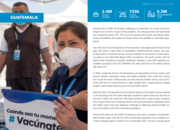
Recovery from COVID-19 has been challenging in Guatemala. As a result of the prolonged socio-economic impact of the pandemic, the average poverty rate nationwide has increased by almost 5%. This rise in the poverty level further exacerbates preexisting vulnerabilities and erodes the limited safety n
...
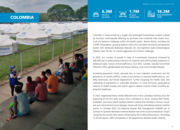
Colombia is characterized by a fragile and prolonged humanitarian context marked by recurrent multi-hazards affecting its territories and combined with severe structural and systemic challenges within the health system. Recent shocks, including the
COVID-19 pandemic, growing violence within the Col
...

Ebola disease and Marburg disease outbreaks continue to occur in Africa, with increased frequency. In addition to resulting in high mortality and morbidity, the outbreaks generate fear and mistrust about the response activities within the communities affected.
Infection prevention and control (IP
...

The Infection Prevention and Control (IPC) Guidelines aim to support healthcare workers improve quality and safety health care. The Guidelines further aim to promote and facilitate the overall goal of IPC by providing evidence-based recommendations on the critical aspects of IPC, focusing on the fun
...
