
Filter
2299
Filtered Results: 2299
Text search:
World
Health
Organization
WHO
Tecnical
Advisory
Group
and
FIND
Featured
Recommendations
205
New Publications
644
Language
Document type
No document type
1290
Studies & Reports
355
Guidelines
308
Manuals
153
Strategic & Response Plan
117
Training Material
30
Fact sheets
22
Situation Updates
18
Resource Platforms
4
App
1
Infographics
1
Countries / Regions
India
100
Global
86
Kenya
62
Ethiopia
62
Nepal
54
Uganda
52
Sierra Leone
47
Bangladesh
44
South Africa
41
Malawi
40
Myanmar / Burma
37
Zambia
34
Nigeria
33
Latin America and the Carribbean
32
Namibia
30
Liberia
30
Africa
29
Western and Central Europe
29
Ghana
26
Rwanda
25
Syria
22
Tanzania
22
Ukraine
21
Guinea
20
Asia
20
South–East Asia Region
18
Zimbabwe
15
Cambodia
15
West and Central Africa
13
Afghanistan
12
Philippines
12
Congo, Democratic Republic of
12
East and Southern Africa
12
South Sudan
12
Indonesia
12
Pakistan
12
Mozambique
10
Thailand
9
Haiti
9
Lesotho
8
Cameroon
7
Senegal
7
Western Pacific Region
7
Botswana
7
Benin
6
Jordan
6
Germany
6
Eastern Europe
6
Russia
6
Central African Republic
6
Eastern Europe and Central Asia
5
Lebanon
5
Vietnam
5
Moldova
5
North Macedonia
4
Togo
4
Laos
4
Middle East and North Africa
4
Southern Africa
4
Côte d’Ivoire / Ivory Coast
4
Sudan
4
Georgia
4
Chad
4
Colombia
3
China
3
Burkina Faso
3
Hungary
3
Brazil
3
Yemen
3
Somalia
3
Eswatini/ Swaziland
3
Tajikistan
2
Gambia
2
Kazakhstan
2
Iran
2
Albania
2
Fiji
2
Morocco
2
Venezuela
2
North America
2
Portugal
2
Spain
2
Belarus
2
Papua New Guinea
2
Sri Lanka
2
Romania
2
Poland
2
Mali
2
Iraq
2
Mexico
1
Turkey
1
Estonia
1
Kyrgyzstan
1
Niger
1
Uzbekistan
1
Burundi
1
Peru
1
Malaysia
1
Armenia
1
USA
1
Guinea-Bissau
1
Saudi Arabia
1
Turkmenistan
1
Jamaica
1
Japan
1
Denmark
1
Belgium
1
Maldives
1
Mauritius
1
Tunisia
1
United Kingdom
1
Norway
1
Israel
1
Bolivia
1
Argentina
1
Egypt
1
Slovakia
1
Greece
1
Angola
1
Libya
1
Ecuador
1
Authors & Publishers
Publication Years
Category
Countries
805
Clinical Guidelines
184
Key Resources
169
Women & Child Health
162
Public Health
138
Capacity Building
50
Pharmacy & Technologies
25
Annual Report MEDBOX
1
Toolboxes
HIV
168
COVID-19
155
TB
147
Mental Health
128
Disability
114
AMR
84
NTDs
73
Planetary Health
72
Caregiver
61
Rapid Response
55
Conflict
51
Ebola & Marburg
49
Pharmacy
47
2.0 Rapid Response
43
Malaria
42
Global Health Education
42
Refugee
36
Natural Hazards
27
NCDs
27
Polio
23
Specific Hazards
17
Health Financing Toolbox
14
Cholera
12
Zika
10
Social Ethics
5
Typhoon
2
Guidelines for Diagnosing and Managing Disseminated Histoplasmosis among People Living with HIV
recommended
Histoplasmosis is a disease caused by the fungus Histoplasma capsulatum. This disease is highly endemic in some regions of North America, Central America, and South America and is also reported in certain countries of Asia and Africa. It often affects people with impaired immunity, including people ...

Purpose of this document: to present eight practical steps that Member States can take at the national and sub-national level to improve WASH in health care facilities
Report of a regional workshop, New Delhi, India, 29–30 September 2014
To reduce the burden of cardiovascular disease and its subsequent problems, the WHO Regional Office for South-East Asia organized a regional workshop on sodium intake and iodized salt for Member States in the South-East Asi...
To reduce the burden of cardiovascular disease and its subsequent problems, the WHO Regional Office for South-East Asia organized a regional workshop on sodium intake and iodized salt for Member States in the South-East Asi...
Guidelines for drinking-water quality: Fourth edition incorporating the first and second addenda
recommended
Guidance has been updated on a number of chemicals: asbestos, bentazone, chromium, iodine, manganese, microcystins, nickel, silver, tetrachloroethene and trichloroethene. Guidance has also been added for chemicals not previously assessed in the Guidelines: anatoxin-a and analogues, cylindrospermopsi...
The backsliding of immunization coverage during the COVID-19 pandemic, combined with delayed catch-up efforts has resulted in a large and growing immunity gap. There is an urgent need to close this gap, and enable millions of missed children to be vaccinated. The Essential Immunization Recovery Plan...
The main purpose of the meeting was to review tsetse control tools, activities and their contribution to the elimination of gHAT and the monitoring thereof. Seven endemic countries provided reports on recent and ongoing vector control interventions at the national level (Angola, Cameroon, Côte d’...

It is impossible to address the many complex needs of respiratory virus surveillance with a single surveillance system. Multiple systems, investigations and studies must each be fit-for-purpose to specific priority surveillance objectives, and only together can they provide essential information to ...

Poor quality health services are holding back progress on improving health in countries at all income levels.
Today, inaccurate diagnosis, medication errors, inappropriate or unnecessary treatment, inadequate or unsafe clinical facilities or practices, or providers who lack adequate training an...
Today, inaccurate diagnosis, medication errors, inappropriate or unnecessary treatment, inadequate or unsafe clinical facilities or practices, or providers who lack adequate training an...

The Global guidance framework for the responsible use of the life sciences: mitigating biorisks and governing dual-use research (the framework) aims to provide values and principles, tools and mechanisms to support Member States and key stakeholders to mitigate and prevent biorisks and govern dual-u...

This publication provides guidance for planning country-specific programming to achieve the triple elimination of mother-to-child (or vertical) transmission of HIV, syphilis and hepatitis B virus. It is based on the WHO Triple Elimination Framework, which promotes an integrated, person-centred appro...


Challenges and Opportunities. This report presents a comprehensive assessment of the education and labor markets for nurses in the ECSA region. It documents the main challenges to train and deploy nurses and discusses opportunities for government and private sector employers to overcome these chall...
A Systematic Review, Country Case Studies, and Recommendations for Integration into National Health Systems
Alliance Report
Participation of community health workers (CHWs) in the provision of primary health care has been experienced all over the world for several decades, and there is an amount ...

Epilepsy: a public health imperative
recommended
This is the first global report on epilepsy summarizing the available evidence on the burden of epilepsy and the public health response required at global, regional and national levels.
The reports highlights major gaps in awareness, diagnosis, treatment, and health policies through a series of a...

The far-reaching impacts of the COVID-19 pandemic underscore the critical need for evidence-informed, transparent and inclusive decision-making. Policy-makers have grappled with complex choices amidst uncertainty. They have constantly reassessed response measures while navigating their economic impl...

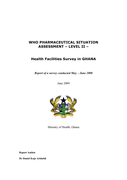
This field study to assess the pharmaceutical situation was undertaken in Ghana in May-June 2008 using a standardized methodology developed by the World Health Organization. The study assessed medicines availability and affordability, geographical accessibility, quality and r...
