Filter
816
Text search:
World
Health
Organization
(WHO),
Regional
Office
for
South-East-Asia
Featured
114
218
Language
Document type
359
172
156
45
40
13
9
8
7
2
2
2
1
Countries / Regions
63
62
44
28
27
22
16
12
11
11
10
9
9
9
4
4
4
4
4
4
4
3
3
3
3
3
3
3
3
3
3
3
3
3
2
2
2
2
2
2
2
2
2
2
2
2
1
1
1
1
1
1
1
1
1
1
1
1
1
1
1
1
1
1
1
1
1
1
1
1
1
1
1
1
1
1
1
Authors & Publishers
Publication Years
Category
185
113
73
66
41
21
13
Toolboxes
72
58
58
49
49
41
36
31
29
22
21
20
19
19
16
12
10
9
7
7
6
6
4
4
1

The standards define 10 key competencies for health and care workers to support self-care in their clinical practice as well as the specific, measurable behaviours that demonstrate those competencie
...

The knowledge guide is the second publication in the Self-care competency framework to support health and care workers.
This describes how health and care workers can apply each of the 10 compete
...
The key updates include: content update in various sections based on new evidence; design changes for enhanced usability; a streamlined and simplified clinical assessment that includes an algorithm for
...
A global Review of evidence and practice

In an ambitious new era for health development under the 2030 Agenda for Sustainable Development, WHO
...

These guidelines – an update to the World Health Organization’s 2015 publication Consolidated strategic information guidelines – present a se
...
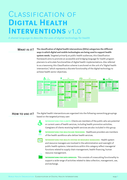
The classification of digital health interventions (DHIs) categorizes the different ways in which digital and mobile technologies are being used to support health system needs. Historically, the di
...

Achieving financial risk protection for the whole population requires significant financing for health.
...
As a new chapter in the response to the world drug problem begins, UNAIDS calls on countries to adopt the recommendations contained within this report, and to rapidly transform those commitments into laws, policies, services and support that allow p
...

Global cardiovascular disease (CVD) burden is high and rising, especially in low-income and middle-income countries (LMICs). Focussing on 45 LMICs, we aimed to determine (1) the adult population’s median 10-year predicted CVD risk, including its variation within countries by socio-demographic char
...


Antimicrobial resistance (AMR) has emerged as a major public health problem all over the world. Infections caused by resistant microbes fail to respond to treatment, resulting in prolonged illness a
...

(Health Systems in Transition, Vol. 4, No. 3, 2014)
The window to 2030, the SDG target year, is closing. Without accelerated and sustained progress, hard-won UHC gains risk being lost. Using revised and improved UHC indicators the report presents the latest available UHC data and concludes with a call to shared action.
Despite the considerable improvement in global health, millions of people still lack access to quality health services, including access to effective antimicrobial medicines, or are impoverished as
...

10–11 May 2016, Catania, Italy