Filter
1350
Text search:
mass
violence
Featured
125
425
Language
Document type
781
249
111
70
65
36
16
16
2
2
1
1
Countries
54
54
42
42
40
38
35
35
34
32
31
29
29
28
25
21
21
20
20
19
17
17
15
15
14
13
12
12
12
11
10
10
9
9
9
9
9
8
8
7
5
5
5
5
5
4
4
4
4
4
3
3
3
3
3
3
3
3
3
3
3
3
3
2
2
2
2
2
2
2
2
2
2
2
2
2
2
1
1
1
1
1
1
1
1
1
1
1
1
1
1
1
1
1
1
1
1
1
1
1
1
1
1
1
1
Authors & Publishers
Publication Years
Category
609
115
77
57
41
22
1
1
Toolboxes
138
124
110
54
43
42
37
34
28
27
19
18
14
12
11
11
10
9
6
5
4
4
3
3
2
1

Health Workers and Health Facilities under Attack 2015, and Early 2016
Currently there is no publicly available source of consolidated information on attacks on health care in emergencies. This report is a first attempt to consolidate and analyse the data that is available from open sources. While the data are not comprehensive, the findings shed light on the severity
...


Section One
summarizes UNHCR’s mandate of international protecdtion and the aim and principles of emergency
response;
Section Two
deals with emergency management;
Section Three
covers the vital sectors and problem areas in refugee emergencies, including health, food, sanitation
and water, a
...
Psoriasis, which can involve the skin, nails and joints, is a chronic, painful, disfiguring and disabling noncommunicable disease (NCD) for which there is no cure. It negatively impacts on quality of life. Some of those who suffer from the disease develop chronic, inflammatory arthritis (psoriatic a
...

The report is based on in-depth qualitative research in countries along the Eastern and Central Mediterranean routes. It focuses on Iraqi and Nigerian migrants as case studies, as Nigeria is the number one country of origin for migrants travelling along the Central Mediterranean route. Iraqis repres
...
The World Health Organization (WHO) Global Status Report on Noncommunicable Diseases 2010 projects that noncommunicable diseases (NCDs) will be responsible for over 44 million deaths during the next decade, representing an increase of about 15% since 2010. Most of these deaths will occur in the WHO
...

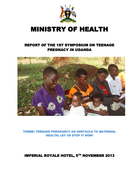
THEME: TEENAGE PREGNANCY AN OBSTACLE TO MATERNAL HEALTH; LET US STOP IT NOW. 5th November 2013