Filter
100
Text search:
underfunding
Featured
6
17
Language
Document type
44
39
8
3
2
2
1
1
Countries
11
10
6
4
4
4
3
3
3
3
2
2
2
2
2
2
2
2
2
2
1
1
1
1
1
1
1
1
1
1
1
1
1
1
1
1
1
1
1
1
1
1
1
1
1
1
Authors & Publishers
Publication Years
Category
45
5
4
3
2
1
Toolboxes
14
12
9
8
7
5
4
4
2
2
2
1
1
1
1
1
1
1
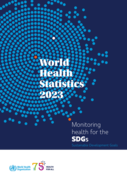
The World health statistics report is the annual compilation of health and health-related indicators, which has been published by the World Health Organization since 2005.
The 2025 edition consolidates data for health-related indicators from the Sustainable Development Goals. It assesses progres
...
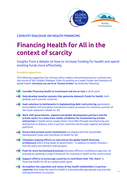
CATALYST DIALOGUE ON HEALTH FINANCING
Insights from a debate on how to increase funding for health and spend existing funds more effectively.
Catalyst Dialogue participants:
Christoph Benn, Director for Global Health Diplomacy, Joep Lange Institute • Jayati Ghosh, Professor of Economics, Univer
...

Noncommunicable diseases (NCDs) (e.g., cardiovascular diseases, cancers, diabetes, and chronic respiratory diseases) and mental health conditions (e.g., Alzheimer’s disease and related dementias, depression, anxiety, autism spectrum disorders) are the world’s leading cause of preventable illness
...


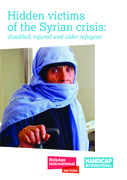
New research published today shows that older, disabled and injured Syrian refugees are paying a double toll as a result of the conflict. The report, released by Handicap International and HelpAge International, provides new data showing how much these vulnerable refugees are struggling to meet thei
...

This Framework offers a coherent approach for eliminating tuberculosis (TB) in low-incidence countries. It is designed to guide national policy-makers and those responsible for technical aspects of the national TB response in accelerating efforts towards elimination. The document will also be inform
...

The scale of West Africa’s Ebola epidemic has been attributed to the weak health systems of affected countries,
their lack of resources, the mobility of communities and their inexperience in dealing with Ebola. This briefing for African Affairs argues that these explanations lack important contex
...
Almost 30 countries vulnerable to a new Ebola-style Epidemic, jeopardising the future of millions of Children. The report ranks the world’s poorest countries on the state of their public health systems, finding that 28 have weaker defences in place than Liberia where, alongside Sierra Leone and Gu
...

Towards the Elimination of Mother-to-Child Transmission of HIV and keeping mothers Alive. 2012-2015
From policy to practice: how the TB-HIV response is working
“The HIV community must place much more focus on TB co-infection than
it has done to date. TB takes the lives of over 1000 people living with HIV
every day, a number which is absolutely unacceptable. This report highlights that
TB d
...