
Filter
2227
Text search:
tb
strategy
Featured
229
706
Language
2095
46
40
39
16
11
8
6
5
4
1
1
1
1
1
1
1
1
1
1
1
Document type
1356
347
244
116
80
29
28
10
6
5
2
1
1
Countries
125
96
82
79
66
65
63
59
51
49
47
47
47
40
39
39
38
38
35
31
26
25
25
23
21
20
18
17
17
15
13
12
11
11
11
11
9
8
8
8
7
7
7
6
6
5
5
5
5
5
5
4
4
4
4
4
4
4
4
4
3
3
3
3
3
3
3
3
3
3
2
2
2
2
2
2
2
2
2
2
1
1
1
1
1
1
1
1
1
1
1
1
1
1
1
1
1
1
1
1
1
1
1
1
1
1
1
1
1
1
1
1
1
1
1
Authors & Publishers
241
118
57
56
53
47
44
33
25
23
23
22
19
16
16
15
15
14
14
14
12
11
11
10
10
10
10
9
9
9
9
9
9
8
8
8
8
8
8
8
7
7
7
7
7
7
7
7
6
6
6
6
6
6
6
6
6
6
6
6
6
6
5
5
5
5
5
5
5
5
5
5
5
5
5
5
5
5
4
4
4
4
4
4
4
4
4
4
4
4
4
4
4
4
4
4
4
4
4
4
4
4
4
3
3
3
3
3
3
3
3
3
3
3
3
3
3
3
3
3
3
3
3
3
3
3
3
3
3
3
3
3
3
3
3
3
3
3
3
3
3
3
3
3
3
3
3
3
3
3
3
3
2
2
2
2
2
2
2
2
2
2
2
2
2
2
2
2
2
2
2
2
2
2
2
2
2
2
2
2
2
2
2
2
2
2
2
2
2
2
2
2
2
2
2
2
2
2
2
2
2
2
2
2
2
2
2
2
2
2
2
2
2
2
2
2
2
2
2
2
2
2
2
2
2
2
2
2
2
2
2
2
2
2
2
2
2
2
2
2
2
2
2
2
2
2
2
2
2
2
2
2
2
2
2
2
2
2
2
2
2
2
2
2
2
2
2
2
2
2
2
2
2
2
2
2
2
2
2
2
2
2
2
2
2
2
2
2
2
2
2
2
2
1
1
1
1
1
1
1
1
1
1
1
1
1
1
1
1
1
1
1
1
1
1
1
1
1
1
1
1
1
1
1
1
1
1
1
1
1
1
1
1
1
1
1
1
1
1
1
1
1
1
1
1
1
1
1
1
1
1
1
1
1
1
1
1
1
1
1
1
1
1
1
1
1
1
1
1
1
1
1
1
1
1
1
1
1
1
1
1
1
1
1
1
1
1
1
1
1
1
1
1
1
1
1
1
1
1
1
1
1
1
1
1
1
1
1
1
1
1
1
1
1
1
1
1
1
1
1
1
1
1
1
1
1
1
1
1
1
1
1
1
1
1
1
1
1
1
1
1
1
1
1
1
1
1
1
1
1
1
1
1
1
1
1
1
1
1
1
1
1
1
1
1
1
1
1
1
1
1
1
1
1
1
1
1
1
1
1
1
1
1
1
1
1
1
1
1
1
1
1
1
1
1
1
1
1
1
1
1
1
1
1
1
1
1
1
1
1
1
1
1
1
1
1
1
1
1
1
1
1
1
1
1
1
1
1
1
1
1
1
1
1
1
1
1
1
1
1
1
1
1
1
1
1
1
1
1
1
1
1
1
1
1
1
1
1
1
1
1
1
1
1
1
1
1
1
1
1
1
1
1
1
1
1
1
1
1
1
1
1
1
1
1
1
1
1
1
1
1
1
1
1
1
1
1
1
1
1
1
1
1
1
1
1
1
1
1
1
1
1
1
1
1
1
1
1
1
1
1
1
1
1
1
1
1
1
1
1
1
1
1
1
1
1
1
1
1
1
1
1
1
1
1
1
1
1
1
1
1
1
1
1
1
1
1
1
1
1
1
1
1
1
1
1
1
1
1
1
1
1
1
1
1
1
1
1
1
1
1
1
1
1
1
1
1
1
1
1
1
1
1
1
1
1
1
1
1
1
1
1
1
1
1
1
1
1
1
1
1
1
1
1
1
1
1
1
1
1
1
1
1
1
1
1
1
1
1
1
1
1
1
1
1
1
1
1
1
1
1
1
1
1
1
1
1
1
1
1
1
1
1
1
1
1
1
1
1
1
1
1
1
1
1
1
1
1
1
1
1
1
1
1
1
1
1
1
1
1
1
1
1
1
1
1
1
1
1
1
1
1
1
1
1
1
1
1
1
1
1
1
1
1
1
1
1
1
1
1
1
1
1
1
1
1
1
1
1
1
1
1
1
1
1
1
1
1
1
1
1
1
1
1
1
1
1
1
1
1
1
1
1
1
1
1
1
1
1
1
1
1
1
1
1
1
1
1
1
1
1
1
1
1
1
1
1
1
1
1
1
1
1
1
1
1
1
1
1
1
1
1
1
1
1
1
1
1
1
1
1
1
1
1
1
1
1
1
1
1
1
1
1
1
1
1
1
1
1
1
1
1
1
1
1
1
1
1
1
1
1
1
1
1
1
1
1
1
1
1
1
1
1
1
1
1
1
1
1
1
1
1
1
1
1
1
1
1
1
1
1
1
1
1
1
1
1
1
1
1
1
1
1
1
1
1
1
1
1
1
1
1
1
1
1
1
1
1
1
1
1
1
1
1
1
1
1
1
1
1
1
1
1
1
1
1
1
1
1
1
1
1
1
1
1
1
1
1
1
1
1
1
1
1
1
1
1
1
1
1
1
1
1
1
1
1
1
1
1
1
1
1
1
1
1
1
1
1
1
1
1
1
1
1
1
1
1
1
1
1
1
1
1
1
1
1
1
1
1
1
1
1
1
1
1
1
1
1
1
1
1
1
1
1
1
1
1
1
1
1
1
1
1
1
1
1
1
1
1
1
1
1
1
1
1
1
1
1
1
1
1
1
1
1
1
1
1
1
1
1
1
1
1
1
1
1
1
1
1
1
1
1
1
1
1
1
1
1
1
1
1
1
1
1
1
1
1
1
1
1
1
1
1
1
1
1
1
1
1
1
1
1
1
1
1
1
1
1
1
1
1
1
1
1
1
1
1
1
1
1
1
1
1
1
1
1
1
1
1
1
1
1
1
1
1
1
1
1
1
1
1
1
1
1
1
1
1
1
1
1
1
1
1
1
1
1
1
1
1
1
1
1
1
1
1
1
1
1
1
1
1
1
1
1
1
1
1
1
1
1
1
1
1
1
1
1
1
1
1
1
1
1
1
1
1
1
1
1
1
1
1
1
1
1
1
1
1
1
1
1
1
1
1
1
1
1
1
1
1
1
1
1
1
1
1
1
1
1
1
1
1
1
1
1
1
1
1
1
1
1
1
1
1
1
1
1
1
1
1
1
1
1
1
1
1
1
1
1
1
1
1
1
1
1
1
1
1
1
1
1
1
1
1
1
1
1
1
1
1
1
1
1
1
1
1
1
1
1
1
1
1
1
1
1
1
1
1
1
1
1
1
1
1
1
1
1
1
1
1
1
1
1
1
1
1
1
1
1
1
1
1
1
1
1
1
1
1
1
1
1
1
1
1
1
1
1
1
1
1
1
1
1
1
1
1
1
1
1
1
1
1
1
1
1
1
1
1
1
1
1
1
1
1
1
1
1
1
1
1
1
1
1
1
1
1
1
1
1
1
1
1
1
1
1
1
1
1
1
1
1
1
1
1
1
1
1
1
1
1
1
1
1
1
1
1
1
1
1
1
1
1
1
1
1
1
1
1
1
1
1
1
1
1
1
1
1
1
1
1
1
1
1
1
1
1
1
1
1
1
1
1
1
1
1
1
1
1
1
1
1
1
1
1
1
1
1
1
1
1
1
1
1
1
1
1
1
1
1
1
1
1
1
1
1
1
1
1
1
1
1
1
1
1
1
1
1
1
1
1
1
1
1
1
1
1
1
1
1
1
1
1
1
1
1
1
1
1
1
1
1
1
1
1
1
1
1
1
1
1
1
1
1
1
1
1
1
1
1
1
1
1
1
1
1
1
1
1
1
1
1
1
1
1
1
1
1
1
1
1
1
1
1
1
1
1
1
1
1
1
1
1
1
1
1
1
1
1
1
1
1
1
1
1
1
1
1
1
1
1
1
1
1
1
1
1
1
1
1
1
1
1
1
1
1
1
1
1
1
1
1
1
1
1
1
1
1
1
1
1
1
1
1
1
1
1
1
1
1
1
1
1
1
1
1
1
1
1
1
1
1
1
1
1
1
1
1
1
1
1
1
1
1
1
1
1
1
1
1
1
1
1
1
1
1
1
1
1
1
1
1
1
1
1
1
1
1
1
1
1
1
1
1
1
1
1
1
1
1
1
1
1
1
1
1
1
1
1
1
1
1
1
1
1
1
1
1
1
1
1
1
1
1
1
1
1
1
1
Publication Years
563
1439
221
4
Category
1121
139
112
64
58
33
22
2
Toolboxes
452
127
93
88
47
47
45
39
35
35
34
33
26
25
22
21
18
16
16
14
14
3
3
3
2
The WHO Global strategy on human resources for health: workforce 2030 encourages development partners and global health initiatives to leverage their support to health systems in countries to sustainably strengthen the health workforce. To assess th
...
e impact of these investments, a methodology was developed and pilot tested by WHO.
The impact assessment tool (consisting of an MS Excel calculator with two subsets) supports users to:
• assess and quantify the health impact of HRH investments made in the context of HIV, tuberculosis (TB) and malaria programmes through their modelled effect on health service coverage of these three diseases; and
• provide aggregate indicative estimates of the range of health workers required to attain high coverage of selected health services.
more

Tuberculosis (TB) remains a significant global health challenge, with an estimated annual death rate of approximately one per 100,000 people in countries with low TB prevalence. Rapid reductions in
...
TB cases and deaths worldwide depend on research breakthroughs, including the development of new vaccines. There has recently been an increase in political commitment, as evidenced by two UN high-level meetings on TB in 2018 and 2023. The 2023 political declaration reaffirmed the goals set out in the UN Sustainable Development Goals and the WHO's End TB Strategy, and established new targets for the period 2023–2027
more
The National Tuberculosis Programme (NTP) of Rwanda (known as TB & ORD Division/IHDPC/RBC) is preparing to write their next National Strategic Plan and for this reason Rwanda was selected as a country to received technical assistance (TA) to conduct
...
an assessment of their surveillance system using the surveillance checklist as input for the new strategy. This TA was provided under the USAID TBCARE I Core project on Monitoring and Evaluation, Operational Research and Surveillance (C7.08) developed a surveillance checklist with the objectives to assess a national surveillance system’s ability to accurately measure TB cases and deaths and to identify gaps in national surveillance systems that need to be addressed in order to improve TB surveillance.
more

In the last decade, Timor-Leste has made remarkable progress in strengthening its health system and improving the health status of its population. This has resulted in an increased life expectancy, and the achievement of Millennium Development Goals such as a reduction in infant and under-five morta
...
lity, an improvement in maternal and child health outcomes, and an increase in immunization coverage. Further, the country has successfully eliminated infectious diseases such as polio, measles, and maternal and neonatal tetanus. There is full political commitment to reducing the incidence of tuberculosis (TB) by 80% and the number of deaths due to TB by 90% by 2030. The country has made great progress in the context of the pandemic, having established numerous quarantine facilities/isolation centres; trained health-care workers; streamlined the procurement and supply of medicines, consumables, personal protective equipment and other equipment; and strengthened the capacity in critical care across secondary and tertiary health care, to better respond to future pandemics and other disaster situations.
more

South Sudan continues to struggle with a severe health crisis affecting 8.9 million people, primarily in flood- and conflict-affected regions with population movements (displacement and returns), and disease outbreaks. The nation's health system, heavily reliant on international aid, faces staffing
...
and resource shortages. Vulnerable groups, including women, children, the elderly, and those with disabilities, have limited healthcare access and face heightened risks of mortality and illness.
The life expectancy at birth (55 years) is among the lowest globally, as mortality rates remain among the highest with neonatal, infant, under-five mortality rates estimated at 39.63, 63.76 and 98.69 deaths per 1000 live births respectively, and a maternal mortality ratio of 1,223 deaths per 100,000 live births. Although some disease specific mortality rates such as TB and AIDS-related mortality have declined, mortality due to malaria and non-communicable diseases have increased over the past five years.
The main causes of morbidity remain communicable diseases; malaria, is the top cause of morbidity (64%) and mortality (45%) among outpatients, followed by pneumonia and diarrhea.20 Several Counties report malaria cases above the threshold perennially especially during the rainy seasons, affecting mainly children under five years. The last malaria indicator survey (2017) estimated malaria prevalence of 32%, 34% and 18% among children under-five, protection of civilian’s sites, and internally displaced persons, respectively.
more
To support countries in their efforts to strengthen detection of tuberculosis (TB) disease and drug resistance, WHO issues evidence-based policy guidance on TB testing that is routinely updated.
...
Since the most recent consolidated guidelines on TB diagnosis were issued in 2025, evidence became available on new tests, sample types, and strategies for the initial diagnosis of TB with and without drug resistance detection. In an updated edition that will be published shortly, WHO is recommending for the first time, new near-point-of-care (NPOC) molecular tests for the diagnosis of TB; easy-to-collect tongue swab samples to simplify and expand access to testing; and a cost-saving sputum pooling strategy to increase testing efficiency for TB and rifampicin-resistant TB.
more

Annex 1: Measuring progress towards targets
Annex 2: Modelling the impact of the 90-(90)-90 strategy
Annex 3: Investment packages by country setting
Annex 4: Country strategies
Annex 5: Strategic frameworks for research and development for new t
...
ools
Annex 6 : Estimating the cost of the 90-(90)-90 strategy
Accessed November 2017
more

Framework for implementation.
The END TB Strategy.
Quick guide to video-supported treatment of tuberculosis (2020).
Despite being a curable and preventable disease, tuberculosis (TB) remains as one of the major challenges for health systems, globally. Every year,
...
TB affects more than 10 million people and kills more than 1.4 million people. WHO’s Digital Health for the End TB Strategy – an Agenda for Action outlines a conceptual framework in which advantageously positioned digital health solutions are matched to the most urgent needs of TB programmes. Video-supported treatment is a component of one of the four core functions of this framework, the Patient Care domain, and primarily supports the first pillar of the End TB Strategy. This quick guide provides information on the solutions available for asynchronous modes of video communication and how these can be of use to TB programmes.
more

HIV/TB workplace policy and Implementation Strategy
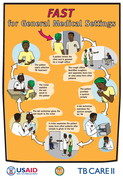
This core package of materials provides a comprehensive introduction to the FAST strategy: a focused approach to stopping TB spread in congregate settings. In English, FAST stands for:
Finding
...
TB cases
Actively,
Separating safely, and
Treating effectively.
FAST focuses health care workers on the most important TB transmission control intervention: effective treatment.
FAST can also be extrapolated to national policy where it serves as a framework for allocating resources to interventions that will have the greatest impact on reducing TB transmission.
This core package is composed of a booklet, job aids, posters, and a button which serves as a visual reminder to staff and patients of the importance of this strategy in TB control. FAST can be implemented in both general and TB specific medical settings.
For full package visit: https://drtbnetwork.org/fast-tb-infection-control-strategy-core-package
more

The overall objective of this implementation plan is to define the strategy for implementation of the Xpert MTB/RIF test for rapid detection of TB and rifampicin (RIF) resistance in Tanzania, within
...
the context of the National Tuberculosis and Leprosy Programme (NTLP) strategic plan and other national health guidelines. It is intended to serve as the main guiding document for national, regional and local programme managers, clinicians, coordinators, laboratory staff and other health workers; national and regional reference laboratories; local and international implementing partners; and donors involved in TB control.
more

The review’s objectives are to review progress in TB control with emphasis on DOTS strategy implementation, summarize the experience, lessons learnt and methods of work and to make recommendations
...
for international donors, technical agencies and the Ministry of Health.
more
A review of available evidence (2016).
28-29 June 2016; Geneva, Switzerland
The END TB strategy.

Despite being a curable and preventable disease, tuberculosis (TB) remains as one of the major challenges for health systems, globally. Every year, TB affects more than 10 million people and kills m
...
ore than 1.4 million people. WHO’s Digital Health for the End TB Strategy – an Agenda for Action outlines a conceptual framework in which advantageously positioned digital health solutions are matched to the most urgent needs of TB programmes. Video-supported treatment is a component of one of the four core functions of this framework, the Patient Care domain, and primarily supports the first pillar of the End TB Strategy. This quick guide provides information on the solutions available for asynchronous modes of video communication and how these can be of use to TB programmes.
more

The importance of community and civil society engagement to end TB has been highlighted in various strategies and global commitments. The WHO End TB Strat
...
egy, aligned with the United Nations Sustainable Development Goals, emphasizes the role of communities and civil society in ending the TB epidemic by 2030. Furthermore, the political declaration of the 2023 United Nations High-level Meeting on TB highlights the need to ensure people-centred health services, with meaningful engagement of communities in the full spectrum of TB response.
more

WHO consolidated guidelines on tuberculosis: Module 6: tuberculosis and comorbidities, 2nd ed
recommended
Addressing TB comorbidities and risk factors is central to the World Health Organization (WHO) End TB Strategy. These guidelines consolidate the la
...
test WHO recommendations on TB and key comorbidities. The guidelines are a living document and will include dedicated sections for each key TB comorbidity or health-related risk factor. The first edition focused on HIV-associated TB, updating the WHO policy on collaborative TB/HIV activities. This second edition expands on the previous edition and consolidates new and existing recommendations on interventions to address undernutrition in people with TB, to provide food assistance to households of people with TB in food-insecure settings, and to screen for TB among those who are undernourished or food insecure.
more

Tuberculosis (TB) is the leading cause of death from a single infectious agent even if is largely curable and
preventable. In 2019 an estimated 2.9 million of the 10 million people who fell ill with
...
TB were not
diagnosed or reported to the World Health Organization1. The Political Declaration adopted by the United
Nations General Assembly in September 2018 commits, amongst others, to diagnosing and treating 40
million people with TB. In order to achieve these ambitious targets, there is an urgent need to deploy
strategies to improve diagnosis and initiation of care for people with TB. One of them is systematic
screening for TB disease, which is included in the End TB Strategy as a central component of its first pillar
to ensure early diagnosis for all with TB.
more
Health Policy and Planning, Volume 35, Issue 1, February 2020, Pages 47–57, https://doi.org/10.1093/heapol/czz122
Colombia has an underreporting of 30% of the total cases, according to World Health Organization (WHO) estimations. In 2016, successful tuberculosis (
...
TB) treatment rate was 70%, and the mortality rate ranged between 3.5% and 10%. In 2015, Colombia adopted and adapted the End TB strategy and set a target of 50% reduction in incidence and mortality by 2035 compared with 2015.
more
