
Filter
513
Text search:
sleep
disorder
Featured
71
90
Language
Document type
325
58
56
40
20
5
5
3
1
Countries
38
15
12
12
10
8
7
7
7
7
6
6
6
5
5
5
5
5
5
4
4
4
3
3
3
3
3
3
3
2
2
2
2
2
2
2
2
2
1
1
1
1
1
1
1
1
1
1
1
1
1
1
1
1
1
1
1
1
1
1
1
1
1
1
Authors & Publishers
Publication Years
Category
119
29
25
19
14
12
1
Toolboxes
252
25
22
19
15
15
13
8
6
6
5
5
4
4
3
3
3
1
1
1
The aim of this study is to research deeply on the post-traumatic stress disorder in sexually abused children. Proving the presence of forms of the disorder in children and the their treatment mode
...
Background: Several studies have demonstrated that South African children and adolescents are
exposed to high levels of violent trauma with a significant proportion developing PTSD, however,
limited resources make it difficult to accurately identify traumatized children.
Conclusions: Our result
...

After a frightening or distressing experience (any kind of injury, a physical or sexual assault, car crash, fire, or other natural disaster), a child or teen may suffer psychological
stress in addition to any physical injuries.
When these reactions last for more than a month and are strong enough
...
This guide aims to inform about these illnesses - so-called ‘trauma-induced disorders’ - in general and ‘post-traumatic stress disorder’ (PTSD) in particular. It is also designed to offer support in finding treatment and counselling options.
...
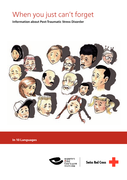
This brochure is designed to help people who have experienced traumatic events and their families.
Available in 10 languages: albanian, arabic, german, french, english, serbian/bosnian/croatian, farsi, tamil, tigrinya, turkish. For other versions check: https://www.redcross.ch/de/shop/gesundheit-
...
Objective: This study examined the experiential factors and interacting vulnerabilities that contribute to the development of posttraumatic stress disorder (PTSD) in children and adolescents
Am J Psychiatry 2000; 157:1229–1235)
Curr Psychiatry Rep. 2011 Dec;13(6):493-9. doi: 10.1007/s11920-011-0229-8.
Background. Children and adolescents can develop post-traumatic stress disorder (PTSD) after exposure to a range of traumatic events, including domestic, political or community violence, violent crime, physical and sexual abuse, hijacking, witnessin
...
Externalizing disorders
Chapter 1.1

Published: February 23, 2010
https://doi.org/10.1371/journal.pmed.1000235
Volume 7 | Issue 2 | e1000235

Indian J Psychiatry. 2017 Jan; 59(Suppl 1): S67–S73.
doi: 10.4103/0019-5545.196975: 10.4103/0019-5545.196975

Research Article | Aim: This study aimed to find the most common stressors facing the adolescents in the Gaza Strip, to explore the types and severity of the traumatic experiences, and to estimate the prevalence rate of post-traumatic events.
J Trauma Crit Care 2017 Volume 1 Issue 2 pp-25-33
Developmental disorders
Chapter C.2
2014 Edition
Q8: What is the effectiveness, safety and role of pharmacological interventions, by non-specialized health care providers, for the broad category of Disruptive Behaviour Disorders (DBDs), Conduct Disorder (CD), Oppositional Defiant
...
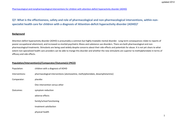
Q7: What is the effectiveness, safety and role of pharmacological and non-pharmacological interventions, within non- specialist health care for children with a diagnosis of Attention-deficit hyperactivity disorder (ADHD)?

This Practice Parameter reviews the evidence from research and clinical experience and highlights significant advances in the assessment and treatment of posttraumatic stress disorder since the previous Parameter was published in 1998. It highlights
...

DIAGNOSING PTSD IN CHILDHOOD | The following literature review addresses the developmental and domain-specific consequences of previous and current diagnostic criteria for posttraumatic stress disorder (PTSD) in pre-adolescent children. PTSD was int
...

Post-Traumatic Stress Disorder (PTSD) in Children under Age 6 | Post-Traumatic Stress Disorder (PTSD) in Children and Adolescents Ages 6 to 17 Years Old
