
Filter
320
Text search:
simulations
Featured
27
65
Language
Document type
122
90
37
26
24
10
4
3
1
1
1
Countries
22
12
10
9
9
8
8
7
7
6
6
6
5
4
4
4
4
3
3
3
3
3
3
3
2
2
2
2
2
2
2
2
2
2
2
2
2
2
1
1
1
1
1
1
1
1
1
1
1
1
1
1
1
1
1
1
1
1
1
1
1
Authors & Publishers
Publication Years
Category
95
30
21
15
14
10
2
Toolboxes
37
28
25
19
18
12
12
11
11
8
7
7
7
4
4
4
3
2
2
1
1
1
1

This guide aims to provide an overview of successful practice from the field for the disaster risk reduction/management practitioner interested in EWS. It presents guiding principles that will build a strong foundation for the design or strengthening of EWS at any level. It is not an operational, bu
...

The Multi-Hazard Early Warning System (MHEWS) Checklist is a practical tool consisting of major components and actions that national governments, community organizations and partners within
and across all sectors can refer when developing or evaluating early warning systems

We can't stop at almost. 2025 Goalkeeper Report
recommended
2025 is the first year of this century where child deaths will increase.
But we can stop this reversal before it becomes a trend, even in a time of tight budgets.
With proven solutions and next-generation innovations that do more with less, we can save millions of children's lives, protect the pro
...

The document provides guidance and tools for training health professionals in outbreak investigation. It explains why such training is essential, outlines the methodology for conducting short, practical courses, and describes how lectures, case studies, and exams are used to build skills needed for
...
Topics in Antiviral Medicine, volume 33 Issue 2 May 2025

The paper “Artificial Intelligence for Public Health Surveillance in Africa: Applications and Opportunities” examines how artificial intelligence (AI) can improve public health systems across Africa, particularly in low-resource settings. It explores how machine learning and other AI techniques
...

The document “Strengthening the global architecture for health emergency prevention, preparedness, response and resilience” presents a report by the Director-General of the World Health Organization (WHO) to the World Health Assembly on global efforts to improve preparedness and response to heal
...

The text explains the concept of disaster preparedness and outlines how societies can better prepare for and respond to emergencies. It describes key components such as risk assessment, planning, resource management, warning systems, and training, emphasizing that effective preparedness requires coo
...
Le Profil de pays 2025 sur la santé et les changements climatiques en Haïti est une ressource récemment développée qui offre, pour la première fois, un aperçu clair et accessible de l’intersection entre les tendances climatiques et la santé publique dans le pays. Il synthétise les meilleu
...

Le document présente un cadre stratégique de l’Organisation mondiale de la Santé pour la gestion des risques liés aux situations d’urgence et aux catastrophes dans le domaine de la santé. Il met en évidence que ces événements (comme les épidémies, les catastrophes naturelles ou les con
...

The GHEC framework is designed to provide guiding principles for standardizing health emergency workforce structures to strengthen the capacity of countries in responding to health emergencies, and to enhance collaboration between countries by better connecting regional and global surge response mec
...

This report presents a WHO–PREZODE collaboration to develop and validate standardized indicators that assess the risk of zoonotic disease emergence by modeling pathogen circulation in animals and the risk of animal to human zoonotic spillover. The proposed indicators are intended to be actionable,
...
This guidance document, titled 'Preparedness Enabler's Guide (PEG)', published in May 2023, aims to promote effective and sustainable localization in humanitarian preparedness through insights and practical tools derived from the Global Logistics Cluster's experience.
L’épidémie de maladie à virus Ebola représente l’une des menaces sanitaires les plus graves pour la santé publique mondiale, en raison de sa létalité élevée, de sa propagation rapide et de ses conséquences sociales, économiques et sécuritaires. L’expérience des 16 précédentes fl
...
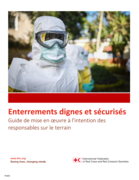
Les maladies infectieuses peuvent se transmettre lorsqu'une personne non contaminée est en contact avec les liquides organiques d'une personne contaminée décédée.
European Centre for Disease Prevention and Control, as of 10-June-20 EuroMOMONetwork, Bulletin, Week 23, 2020 Worldometer
ESTUDIO ENE-COVID19: Segunda Ronda del Estudio Nacional de Sero-Epidemiología de la Infección por SARS-CoV-2 en España; Informe preliminar 3 de Junio de 2020 Informe nº 33. Análisis de los casos de COVID-19 notificados a la RENAVE hasta el 10 de mayo en España a 29 de mayo de 2020. Equipo COVI
...

For COVID-19, as for many infectious diseases, the true level of transmission is frequently underestimated because a substantial proportion of people with the infection are undetected either because they are asymptomatic or have only mild symptoms and thus typically fail to present at healthcare fac
...
19 April 2020
To contain the spread of COVID-19 and to keep infections at a manageable level, many countries have instituted lockdowns and social distancing. In India, a nationwide 21-day lockdown was announced with effect from 25 March 2020. This lockdown is expected to avert a sudden and large in
...
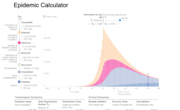
This calculator implements a classical infectious disease model — SEIR (Susceptible → Exposed → Infected → Removed), an idealized model of spread still used in frontlines of research e.g.
