
Filter
303
Text search:
Vertical
Accessibility
Featured
38
108
Language
Document type
186
41
36
19
14
6
1
Countries
21
16
16
12
10
10
9
8
7
7
7
6
6
6
6
5
5
4
4
3
3
3
3
2
2
2
2
2
1
1
1
1
1
1
1
1
1
1
1
1
1
1
1
1
1
1
1
1
1
1
Authors & Publishers
Publication Years
Category
147
26
24
14
11
4
Toolboxes
27
15
12
12
12
8
6
6
6
5
5
4
4
3
3
3
3
2
2
2
2
1
1

To meet our Strategy objectives and get within reach
of the 2030 SDG 3 target related to the three diseases,
the Global Fund needs to raise US$18 billion for the
Eighth Replenishment. That sum is essential to drive the
required pace of progress in the fight against HIV, TB
and malaria, and to m
...

Conditioned domestic financing policy, referring to the domestic financing of health projects, programs, and national responses conditioned by global health funding agencies and recipient country governments, is one mechanism to promote sustainability and country ownership. We aim to understand how
...

This Implementation Kit (I-Kit), developed by the Health Communication Capacity Collaborative (HC3), helps national and local stakeholders to design country-specific social and behavioural change communication (SBCC) campaigns that address the threat posed by substandard, spurious, falsified and fal
...

Community led-monitoring is based on the principle that «Nothing that is done for us should
be done without us”. The combination of this principle with evidence shows that community-led
monitoring is an important driver of improved service delivery and health outcomes that needs to
be re-empha
...

Offering additional pre-exposure prophylaxis (PrEP) choices has the potential to increase uptake and effective use of PrEP, and of HIV prevention overall, as it allows people to choose a method that they prefer.
In this guideline, WHO recommends an offering long-acting injectable lenacapavir (LEN
...

Guidelines on lenacapavir for HIV prevention and testing strategies for long-acting injectable pre-exposure prophylaxis. Web Annex B

These guidelines promote the delivery of people-centred health services for STIs by providing evidence-based recommendations related to decentralization, integration, task sharing and digital health. These recommendations complement existing WHO guidelines for STI testing, treatment and management,
...

On Global Handwashing Day, WHO and UNICEF have released the first-ever global Guidelines on Hand Hygiene in Community Settings to support governments and practitioners in promoting effective hand hygiene outside health care – across households, public spaces and institutions. Framing hand hygiene
...

A practical toolkot

This document aims to provide Ministry of Health guidance on the implementation of PEP and PrEP to prevent HIV transmission and improve overall health outcomes. This comprehensive approach reflects the commitment of all involved in combating HIV and enhancing public health.

National Policy

The Global Aids Strategy 2026-2031
recommended
United- Towards Ending AIDS. The Global AIDS Strategy 2026-2031 focuses global efforts for the future of the AIDS response to end AIDS as a public health threat by 2030 and sustain the HIV response after 2030. This is a strategy uniting the world.
The Strategy will shape the June 2026 United Natio
...

The guide presents a structured framework covering assessment and planning, service delivery models, integration with broader health and social services, monitoring, and sustainability. It emphasizes community leadership, human rights, equitable access and adaptation to local contexts, including clo
...
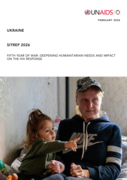
Ukraine. Sitrep 2026: Fifth year of war: deepening humanitarian needs and impact on the HIV Response
As the war in Ukraine enters its fifth year, the humanitarian crisis continues to deepen, with profound consequences for access to essential services, including health care.
Modern warfare tactics, including the widespread use of drones and repeated attacks on critical infrastructure, are increasin
...

A Global Access Framework for Country-Led.
ResponsesThis 2030 Prevention access framework focuses on one of those top-line targets, which covers primary prevention and requires that 90% of people in need of HIV prevention are using effective prevention options by 2030. This target is disaggregated
...

The Gender Assessment Tool for National HIV Responses (Gender Assessment Tool) is intended to assist countries in assessing their HIV epidemic, context and response through an intersectional gender lens, with the aim of strengthening gender-transformative, equitable and rights-based HIV responses. T
...

The manual elaborates on a wide rang of logistics management issues such as carrying assessements, procurement, storing, transporting and distribution of emergency supplies

Community-led responses (CLRs) are a vital pillar of the HIV response and central to achieving national and global targets, including the 30-80-60 commitments outlined in the 2021 Political Declaration on HIV and AIDS. These guidelines provide practical, step-by-step methods for costing and budgetin
...
Epidemic Preparedness and Response in Africa | Guidelines for the Decentralization of Laboratory Capacity
recommended
The decentralization of laboratory capacities is a critical strategy for improving epidemic preparedness and response in Africa. Centralized systems often delay case confirmation, hinder timely interventions, and exacerbate the impact of outbreaks, especially in rural and hard-to-reach areas.
Thi
...
Préparatiom et la riposte aux Épidémies er Afrique guide de Décentralisation des capacités de Laboratoire
recommended
L’augmentation en fréquence et en ampleur des urgences de santé publique en Afrique met en évidence
l’importance cruciale d’un dépistage précoce, d’une intervention rapide et d’un accès équitable aux
capacités de laboratoire. Les systèmes centralisés se sont souvent révélés
...
