
Filter
444
Text search:
Flood,
D.
Featured
Recommendations
36
New Publications
140
Language
Document type
No document type
220
Studies & Reports
108
Manuals
43
Guidelines
33
Strategic & Response Plan
14
Training Material
13
Situation Updates
8
Fact sheets
4
Dashboards/Maps
1
Countries / Regions
Global
30
Myanmar / Burma
25
India
19
Bangladesh
11
Nepal
10
Philippines
8
South Sudan
7
South–East Asia Region
6
Nigeria
5
Ethiopia
5
Ghana
5
Sierra Leone
4
Liberia
4
Kenya
4
Indonesia
4
Mozambique
4
Brazil
4
Western Pacific Region
4
Haiti
3
Malawi
3
Namibia
3
Asia
3
Guinea
2
Congo, Democratic Republic of
2
Uganda
2
Pakistan
2
Afghanistan
2
Tanzania
2
South Africa
2
Papua New Guinea
2
Colombia
2
Ecuador
2
Yemen
2
Western and Central Europe
2
Africa
2
Eastern Europe
2
Laos
2
Vietnam
2
USA
1
Zimbabwe
1
Somalia
1
Germany
1
Zambia
1
Chad
1
Cambodia
1
Thailand
1
China
1
Sudan
1
Argentina
1
Eswatini/ Swaziland
1
Ukraine
1
Greece
1
Angola
1
Lesotho
1
Sri Lanka
1
Chile
1
West and Central Africa
1
Middle East and North Africa
1
Latin America and the Carribbean
1
Eastern Europe and Central Asia
1
Paraguay
1
Fiji
1
Bhutan
1
Venezuela
1
Palestine
1
Authors & Publishers
Publication Years
Category
Countries
149
Key Resources
102
Public Health
17
Clinical Guidelines
13
Capacity Building
7
Women & Child Health
5
Pharmacy & Technologies
4
Toolboxes
Planetary Health
90
Natural Hazards
50
Mental Health
25
Global Health Education
20
COVID-19
17
Conflict
14
2.0 Rapid Response
11
NTDs
9
Disability
8
Rapid Response
8
TB
8
Pharmacy
8
Health Financing Toolbox
7
Refugee
6
Specific Hazards
4
Caregiver
4
Ebola & Marburg
3
Cholera
3
HIV
3
AMR
3
NCDs
3
South Sudan
2
Malaria
2
Typhoon
1

Thailand is exposed to flooding, landslides, drought, earthquakes, tsunamis, heat waves, forest fires, and epidemics. Thailand is also exposed to technological hazards such as chemical accidents. Flooding is the natural hazard with the most significant impact on human life, livelihoods, and the econ
...

The Strategic Tool for Assessing Risks (STAR) offers a comprehensive, easy-to-use toolkit and approach to enable national and subnational governments to rapidly conduct a strategic and evidence-based assessment of public health risks for planning and prioritization of health emergency preparedness a
...

Disaster Recovery Toolkit

Mental health problem is one of the growing major public health issues in the Asia Pacific region. It contributes to the high number of Disability Adjusted Life Years (DALYs), morbidity and mortality in the region. It is expected that leading mental health problems will occur in the low-and middle-i
...
At present at least 2.2 billion people around the world have a vision impairment, of whom at least 1 billion have a vision impairment that could have been prevented or is yet to be addressed. The world faces considerable challenges in terms of eye care, including inequalities in the coverage and qua
...
his Framework begins with a desired future scenario and considers actions and interventions necessary to get there. It advocates for holistic view to address tuberculosis. The Framework revisits challenges and actions in four layers: TB specific; challenges in health systems that influence TB care;
...
IAEA Safety Standards for protecting people and the environment

WHO Guidance for Climate Resilient and Environmentally Sustainable Health Care Facilities
recommended
The aim of this guidance is to enhance the capacity of health care facilities to protect and improve the health of their target communities in an unstable and changing climate; and to empower health care facilities to be environmentally sustainable, by optimizing the use of resources and minimizing
...
Disaster Recovery Toolkit

The COVID-19 pandemic has put significant pressure on health systems all around the world. The drastic measures established to contain its spread are creating serious impediments to economic activity (including agrifood systems) and, consequently, to livelihoods and food security and nutrition.

Sector Environmental Guidelines, Full technical Update


Disaster Management Reference Handbook Series Overview.
Floods, storms, and wind account for large proportions of displacement compared to other disasters. Floods are the most frequent type of disaster whereas wind-related disasters constitute the biggest losses in terms of economic damage, displac
...
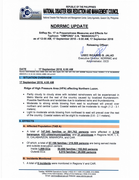
as of 12:00 AM, 17 September 2018 - 6:00 AM, 17 September 2018
Constraints, Technologies, Policies and Processes
