
Filter
291
Text search:
GMP
Featured
26
86
Language
Document type
140
50
39
33
15
7
4
3
Countries
13
12
11
11
10
9
9
8
8
7
6
6
5
5
5
5
4
4
3
3
3
3
3
3
3
2
2
2
2
2
2
2
2
2
1
1
1
1
1
1
1
1
1
1
1
1
1
1
1
1
1
1
1
1
1
1
1
1
1
1
1
Authors & Publishers
Publication Years
Category
135
25
18
16
13
12
9
Toolboxes
44
36
27
11
8
7
6
5
4
2
2
2
2
1
1
1
1
This publication describes the first WHO public-benefit Target Product Profiles (TPPs) for snakebite antivenoms. It focuses on antivenoms for treatment of snakebite envenoming in sub-Saharan Africa. Four TPPs are described in the document:
Broad spectrum Pan-African polyvalent antivenoms: products
...

The report summarizes the estimates of the burden of disease attributable to unsafe drinking water, sanitation, and hygiene for the year 2019 for four health outcomes - diarrhoea, acute respiratory infections, soil-transmitted helminthiases, and undernutrition - which are included in the reporting o
...

Ending the epidemics of HIV, tuberculosis and malaria by 2030 is within reach, but not yet fully in our grasp.
With only 11 years left, we have no time to waste. We must step up the fight now.

Vaccines are powerful weapons in the fight against pandemic viruses as shown by responses to both the 2009 H1N1 influenza and the COVID-19 pandemics. However, planning for accessing, allocating and deploying vaccines in a pandemic situation is a complex endeavour, beset with multiple challenges at a
...

Humanitarian crises exacerbate nutritional risks and often lead to an increase in acute malnutrition. Emergencies include both manmade (conflict) and natural disasters (floods, drought, cyclones, typhoons, earthquakes, volcanic eruptions, etc.). Complex emergencies are combinations of both manmade a
...
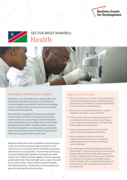
Namibia has a two-tier health system: public health under the Ministry of Health and Social Services (MoHSS) and the private health service. MoHSS‘ vision is to be the leading provider of quality health care and social services according to international set standards. Since Namibia’s independe
...

Long-term polio vaccine security – the timely, sustained, and uninterrupted supply of suitable types of affordable, quality-assured polio vaccines – is essential in the global effort to achieve and maintain a polio free world. However, fragmented approaches and short-term planning pose considera
...
Technical specifications series for submission to WHO prequalification: diagnostic assessment;TSS-3

The document “Malaria Elimination Programme Review, India 2022”, published by the WHO Country Office for India, provides an in-depth assessment of India’s progress toward malaria elimination. It evaluates the structure, implementation, and effectiveness of national and subnational malaria prog
...

The "Regional Action Plan 2017–2030: Towards a Malaria-Free South-East Asia Region" by the World Health Organization (WHO) outlines a strategic framework to eliminate malaria in the 11 countries of the WHO South-East Asia Region by 2030. It focuses on reducing transmission, particularly of Plasmod
...

World malaria report 2024
recommended
New data from the WHO reveal that an estimated 2.2 billion cases of malaria and 12.7 million deaths have been averted since 2000, but the disease remains a serious global health threat, particularly in the WHO African Region. According to WHO’s latest World malaria report, there were an estimated
...
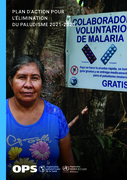
Le Plan d’action pour l’élimination du paludisme 2021-2025 a été élaboré en consultation avec les pays et les partenaires régionaux comme cadre de référence pour orienter les efforts nationaux et les contributions des donateurs et partenaires dans le but d’éliminer la maladie dans la
...

The Plan subscribes to the goals and pillars of the WHO Global Technical Strategy against Malaria 2016-2030 (GTS), while presenting key elements to address the specific challenges of the Region.
O Plano de ação para a eliminação da malária 2021-2025 foi desenvolvido em consulta com países e parceiros regionais como um marco de referência para orientar os esforços dos países e as contribuições de doadores e parceiros em prol da eliminação desta doença nas Américas. O plano sub
...
El Plan de acción para la eliminación de la malaria 2021-2025 ha sido elaborado en consulta con los países y asociados regionales como un marco de referencia para orientar las acciones de los países y las contribuciones de los donantes y de los asociados hacia la eliminación de la enfermedad en
...

Le pilier 3 de la Stratégie technique mondiale de lutte contre le paludisme 2016–2030 consiste à faire de la surveillance du paludisme une intervention de base dans tous les pays d’endémie palustre et dans ceux ayant éliminé le paludisme mais où la transmission pourrait reprendre. Ce nouve
...

El pilar 3 de la Estrategia técnica mundial contra el paludismo 2016-2030 insta a transformar la vigilancia del paludismo en una intervención básica en todos los países donde el paludismo es endémico, así como en los países que han eliminado el paludismo pero siguen siendo susceptibles de que
...
2nd edition. The purpose of this document is to present updated standardized protocols that P. falciparum-endemic countries can use to determine the prevalence of parasites with pfhrp2/3 gene deletions causing negative HRP2 RDT results among symptomatic falciparum patients. The findings should be us
...

Clinical Pharmacology: Advances and Applications, 2025:17 29–47
The WHO susceptibility test kit has been extensively used for monitoring of insecticide resistance in disease vectors for many years. Over the years, users have reported issues with these kits and potential improvements to WHO in an ad-hoc manner. To systematically determine whether the reported iss
...
