
Filter
963
Text search:
western
pacific
region
Featured
107
222
Language
Document type
376
286
140
59
46
15
12
12
9
4
1
1
1
Countries
89
37
35
23
19
18
16
16
15
14
14
10
10
9
8
8
7
7
6
6
6
6
6
6
5
5
5
4
4
4
4
4
4
4
3
3
3
3
3
3
3
3
3
3
2
2
2
2
2
2
2
2
2
2
2
2
1
1
1
1
1
1
1
1
1
1
1
1
1
1
1
1
1
1
1
1
1
1
Authors & Publishers
Publication Years
Category
202
106
80
65
61
18
12
Toolboxes
102
73
69
54
45
44
41
36
35
34
31
27
25
23
23
22
20
16
15
12
8
6
4
4
2
1

Schistosomiasis is a parasitic disease caused by infection with
Schistosoma trematodes. The disease affects poor rural communities
but has spread to urban areas and to tourists visiting endemic areas

Infographics
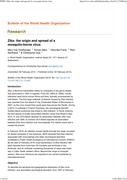
Bulletin of the World Health Organization 2016. doi: http://dx.doi.org/10.2471/BLT.16.171082
Objective: To describe the temporal and geographical distribution of Zika virus infection, and associated neurological disorders, from 1947 to February 2016.

A tool for measuring alcohol policy implementation
1. Provide treatment for mental disorders in primary care
2. Ensure wider accessibility to essential psychotropic drugs
3. Provide care in the community
4. Educate the public
5. Involve communities, families and consumers
6. Establish national policies, programmes and legislation on mental heal
...
Antimalarial drug resistance has emerged as a threat to global malaria control efforts, particularly in the Greater Mekong subregion. Drawing on data collected through more than 1000 therapeutic efficacy studies as well as molecular marker studies of Plasmodium falciparum drug resistance, the Report
...
COVID-19 has turned the world upside down. Everything has been impacted. How we live and interact with each other, how we work and communicate, how we move around and travel. Every aspect of our lives has been affected.

Practical actions in cities to strengthen preparedness for the COVID-19 pandemic and beyond
recommended
This document accompanies the interim guidance on “Strengthening Preparedness for COVID-19 in cities and urban settings”. It provides local authorities, leaders and policy-makers in cities with a checklist tool to ensure that key areas have been covered. An excel version that local authorities m
...

Weekly epidemiological update on COVID-19, 28 September 2022

Interim rapid response guidance, 10 June 2022.
It includes considerations for certain populations such as patients with mild disease with considerations for community care, patients with moderate to severe disease, sexually active persons, pregnant or breastfeeding women, children and young persons
...

Report of a global meeting on yaws eradication surveillance, monitoring and evaluation: Geneva, 29–30 January 2018. World Health Organization.

The Pharmaceutical Forum of the Americas (PFA) has previously published guidelines and organised campaigns for community pharmacists on the prevention, detection and control of arbovirus infections in 2018 with a grant from the FIP Foundation for Pharmacy Education and Research. Building on that exp
...
Le Infezioni in Medicina, n. 1, 3-10, 2019

The handbook includes evidence-based mental health interventions, drawn from the WHO mhGAP guidelines for mental, neurological, and substance use disorders (3), particularly those listed in the UHC Compendium. Evidencebased interventions to reduce population health-related stigma and discriminatio
...
Всемирная организация здравоохранения (2018). Практическое руководство по разработке и проведению имитационных учений в целях проверки и подтверждения планов обесÐ
...
No publication year indicated.
