Filter
269
Text search:
Finanzierung
Featured
23
28
Language
Document type
125
91
17
12
6
5
4
3
3
2
1
Countries
87
78
10
7
4
3
3
2
2
1
1
1
1
1
1
1
1
1
1
1
1
1
1
1
1
1
1
1
Authors & Publishers
Publication Years
Category
15
3
1
Toolboxes
118
70
31
11
8
6
5
4
4
3
2
1
1
1

Die vorliegenden Empfehlungen richten sich an alle Akteure, die mit der Unter-bringung geflüchteter Familien befasst sind, sowie an politische Entscheidungs-träger. Es ist dem Deutschen Verein ein Anliegen, sowohl die für die jeweilige Un-terbringungsform zuständigen Aufsich
...
Mit kinderfreundlichen Orten und Angeboten werden Räume und Beziehungsangebote geschaffen, in denen Kinder einfach wieder Kinder sein können. Im internationalen Kontext ist die Einrichtung von Child Friendly Spaces in Kriegs- und Krisenregionen fest etabliert. In einkommensstarken Ländern gibt es
...

Das vorliegende Policy Paper zeigt die Erfahrungen der spezialisierten Fachberatungsstellen für Betroffene von Menschenhandel - die im Bundesweiten Koordinierungskreis gegen Menschenhandel vernetzt sind - im Kontext von Flucht auf und schildert die aktuelle Situation in Deutschland aus Sicht der Fa
...

Das vorliegende Dossier fasst die wesentlichen Erkenntnisse und den aktuellen Wissensstand des Projekts „Flucht & Menschenhandel“ zusammen und möchte auf bestehende Leerstellen innerhalb der Schutz- und Unterstützungsstruktur für geflüchtete Fraün und Minderjährige, die von Menschenhandel
...
Die Europäische Kommission gegen Rassismus und Intoleranz (ECRI) wurde vom Europarat ins Leben gerufen. Sie ist ein unabhängiges Gremium, das über die Einhaltung der Menschenrechte wacht, wenn es um die Bekämpfung von Rassismus, Diskriminierung (aufgrund von „Rasse", ethnischer/nationaler Herk
...

Bundesgesundheitsblatt - Gesundheitsforschung - Gesundheitsschutz volume 63, pages1460–1469(2020)
Wie die Corona-Pandemie soziale Ungleichheit verschärft und warum wir unsere Wirtschaft gerechter gestalten müssen
Arbeit der Psychosozialen Zentren für Flüchtlinge und Folteropfer (PSZ): Dort soll ein sicherer Raum für Geflüchtete geschaffen werden, damit sie über ihre Erlebnisse und Erfahrungen sprechen und psychosoziale Beratung und Unterstützung erhalten können. Auf der Basis eines menschenrechtlichen
...
Dies ist der fünfte Bericht, den das Deutsche Institut für Menschenrechte in seiner Funktion als Nationale Menschenrechtsinstitution Deutschlands dem Deutschen Bundestag vorlegt. Der Bericht erfasst den Zeitraum vom 1. Juli 2019 bis zum 30. Juni 2020. Aus den vielfältigen menschenrechtlichen Frag
...
Dies ist der fünfte Bericht, den das Deutsche Institut für Menschenrechte in seiner Funktion als Nationale Menschenrechtsinstitution Deutschlands dem Deutschen Bundestag vorlegt. Der Bericht erfasst den Zeitraum vom 1. Juli 2019 bis zum 30. Juni 2020. Aus den vielfältigen menschenrechtlichen Frag
...
Bei der vorliegenden Publikation handelt es sich um die auf Grundlage aktueller Daten und Fakten überarbeitete Neuauflage der 2014 veröffentlichten Positionen. Nach einer kurzen Bestimmung zentraler Begriffe werden wichtige Aspekte, die mit der Aufnahme und Unterbringung sowie mit den Rechten und
...
Die durch den Forschungsbereich Migration, Flucht und Integration der FAU durchgeführte Studie untersucht Themengebiete rund um Migration und Integration in Deutschland. Auf Grundlage einer umfassenden Desktop-Recherche sowie anhand eines Scenario-Buildings entwarf die Studie mit einem interdiszipl
...
AWMF Leitlinie, 12.7.2021
Am 01. Dezember 2020 hat das Deutsche Institut für Menschenrechte seinen fünften Bericht an den Bundestag über die Entwicklung der Menschenrechtssituation in Deutschland vorgestellt. Gemäß dem Gesetz über die Rechtsstellung und Aufgaben des Deutschen Instituts für Menschenrechte (DIMRG) legt
...
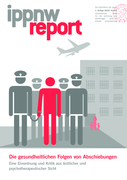
Der extrem umfangreich recherchierte und lesenswerte IPPNW-Report beleuchtet die gesund-heitlichen und humanitären Folgen der deutschen Abschiebepraxis der vergangenen Jahre. Die Publikation soll zudem gezielt Wissen vermitteln, wie Gutachten besser verfasst werden kön-nen und welche Erfahrungen d
...
Seit über einem Jahr hat die Corona-Pandemie große Veränderungen für alle Menschen in nahezu jedem Lebensbereich herbeigeführt. Geflüchtete in (Erst-) Aufnahmeeinrichtungen und Gemeinschaftsunterkünften sind in besonderem Maße von der Pandemie betroffen, da die vorgefundenen Wohnbedingungen
...
In der von medica mondiale e. V. veröffentlichten Handreichung "Stärkende Gruppenangebote" wird vorgestellt, wie stärkende Gruppenangebote für geflüchtete Frauen* stress- und traumasensibel gestaltet werden können. Auf Grundlage langjähriger Erfahrungen und in Kooperation mit einem Referent:i
...

Mit dem Projekt „Empowerment Now“ setzt Handicap International Impulse für Selbstvertretungsprozesse von geflüchteten Menschen mit Behinderung in Deutschland. In dieser Handreichung wurden unter anderem die Erfahrungen, die die beteiligten Selbstvertretenden seitdem gemacht haben, zusammengest
...

Studien der Sachverständigengruppe „Weltwirtschaft und Sozialethik“ Nr. 22
Eine interdisziplinäre Studie im Rahmen des Dialogprojektes zum weltkirchlichen Beitrag der katholischen Kirche für eine sozial-ökologische Transformation im Lichte von Laudato si'.