
Filter
318
Text search:
fragility
Featured
29
77
Language
Document type
115
112
37
25
17
5
5
1
1
Countries
42
15
13
12
9
8
7
7
7
6
6
6
5
4
4
4
4
4
4
4
3
3
3
3
2
2
2
2
2
2
2
2
2
2
1
1
1
1
1
1
1
1
1
1
1
1
1
1
1
1
1
1
1
1
1
1
1
Authors & Publishers
Publication Years
Category
88
49
18
17
11
2
1
Toolboxes
46
33
32
26
18
15
12
11
9
7
6
6
5
4
4
4
3
3
3
3
2
2
2
Wound care is a regular component of the package of care we offer in the majority of our health care facilities and represents a high volume of activities. The current practices in MSF projects are often based on the habits of each individual supervisor, the wound care material we off
...
This report is not a formal evaluation, but rather a synthesis of the experiences, observations, and recommendations of a large group of experienced post-disaster shelter and recovery experts gathered from interviews, surveys, and direct discussions, and information derived from a desk review of the
...

Country Strategic Plan Evaluations (CSPEs) encompass the WFP strategy and entirety of WFP activities during a specific period. Their purpose is twofold: 1) to provide evaluation evidence and learning on WFP's performance for country-level strategic decisions, specifically for developing the next Cou
...

Amoris laetitia: Post-Synodal Apostolic Exhortation on love in the family (19 March 2016)
The coronavirus disease 2019 (COVID-19) pandemic has created a global and gendered crisis that is compounding existing inequalities and disproportionately affecting girls and women. Emerging evidence from the COVID-19 crisis in 2020 shows school closures, disruptions in essential services and rising
...

According to the latest available estimates, more than 1 in 7 adolescents aged 10–19 is estimated to live with a diagnosed mental disorder globally. Almost 46,000 adolescents die from suicide each year, among the top five causes of death for their age group. Meanwhile, wide gaps persist between me
...
This report is the first of its kind. It brings together various data sets to present the current status of hand hygiene, highlight lagging progress, and call governments and supporting agencies to action, offering numerous inspiring examples of change.
During the COVID-19 pandemic, hand hygiene
...

This report aims to support countries in the necessary transition toward healthier, more sustainable diets by integrating biodiversity in food-based interventions to support nutrition and health. It is intended to help guide decision-makers in the health, nutrition and other sectors, to:
Consider
...
This study aimed to analyze the geographical distribution of coronavirus disease 2019 (COVID-19) and to identify high-risk areas in space and time for the occurrence of cases and deaths in the indigenous population of Brazil. This is an ecological study carried out between 24 March and 26 October 20
...

The COVID-19 pandemic led to school closures around the world, affecting almost 1.6 billion students. The effects of even short disruptions in a child’s schooling on their learning and well-being have been shown to be acute and long lasting. The capacities of education systems to respond to the cr
...

The Strategic Tool for Assessing Risks (STAR) offers a comprehensive, easy-to-use toolkit and approach to enable national and subnational governments to rapidly conduct a strategic and evidence-based assessment of public health risks for planning and prioritization of health emergency preparedness a
...
Arabic Analysis on World about Food and Nutrition; published on 22 Sep 2021 by UNICEF.
Available in different languages

This document focus on the direct consequences of the virus (morbidity and mortality) in specific populations and on the results of measures aimed at mitigating the spread of the virus, with indirect impacts on socio-economic conditions. In this complex scenario, the gender approach has not received
...

Left unabated, climate change will have catastrophic effects on the health of present and future generations. Such effects are already seen in Europe, through more frequent and severe extreme weather events, alterations to water and food systems, and changes in the environmental suitability for infe
...
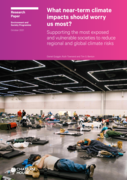
What near-term climate impacts should worry us most?
Supporting the most exposed and vulnerable societies to reduce
regional and global climate risks
This report challenges policy-makers and political leaders to tackle fossil fuel production and consumption as a health control issue, in the same way that smoking has been reduced and regulated. Fossil fuel combustion is a major source of toxic air pollution that kills 7 million people every year,
...

Against the backdrop of the COVID-19 pandemic, health is receiving unprecedented public and political attention. Yet the fact that climate change also presents us with a health crisis deserves further recognition. From more deaths due to heat stress to increased transmission of infectious diseases,
...
The humanitarian-development-peace nexus (HDPNX) is a new way of working that offers a framework for coherent joined-up planning and implementation of shared priorities between humanitarian development and peacebuilding actors in emergency settings. To advance the HDPNx in a given country a sh
...
