
Filter
676
Text search:
Ministry
of
Health
Kenya
Featured
Recommendations
48
New Publications
150
Language
Document type
No document type
377
Studies & Reports
145
Guidelines
57
Manuals
34
Strategic & Response Plan
32
Training Material
15
Situation Updates
7
Fact sheets
4
Resource Platforms
3
Infographics
2
Countries / Regions
Kenya
116
Uganda
32
Global
31
Nigeria
16
Ethiopia
16
Africa
16
Tanzania
13
Rwanda
13
Malawi
13
Zambia
10
Liberia
8
Congo, Democratic Republic of
7
Zimbabwe
7
India
7
South Sudan
6
South Africa
6
East and Southern Africa
6
Sierra Leone
5
Ghana
5
Nepal
5
Lesotho
5
West and Central Africa
5
Western and Central Europe
5
Guinea
4
Senegal
4
Ukraine
4
Cameroon
3
Somalia
3
Sudan
3
Namibia
3
Botswana
3
Madagascar
3
Middle East and North Africa
3
Latin America and the Carribbean
3
Togo
2
Pakistan
2
Chad
2
Central African Republic
2
Eswatini/ Swaziland
2
Brazil
2
Eastern Europe
2
Russia
2
Côte d’Ivoire / Ivory Coast
1
Niger
1
Philippines
1
Jordan
1
Afghanistan
1
Syria
1
Cambodia
1
Thailand
1
Indonesia
1
Bangladesh
1
Mozambique
1
Benin
1
Peru
1
North Macedonia
1
Colombia
1
Angola
1
Sri Lanka
1
South–East Asia Region
1
Eastern Europe and Central Asia
1
Asia
1
Laos
1
Canada
1
Estonia
1
Iran
1
Gabon
1
Authors & Publishers
Publication Years
Category
Countries
254
Clinical Guidelines
50
Women & Child Health
41
Public Health
39
Key Resources
30
Capacity Building
10
Pharmacy & Technologies
7
Toolboxes
HIV
89
Disability
43
Mental Health
40
COVID-19
40
TB
39
Planetary Health
30
AMR
26
Caregiver
21
NTDs
18
Refugee
14
Ebola & Marburg
13
Rapid Response
12
Conflict
9
Global Health Education
9
Pharmacy
8
Health Financing Toolbox
8
Social Ethics
7
NCDs
7
Natural Hazards
6
2.0 Rapid Response
6
Polio
4
Malaria
4
Cholera
2
Specific Hazards
1
23 December 2020 This document summarizes WHO recommendations for the rational use of personal protective equipment (PPE) in health care settings and temporary strategies during acute supply shortag
...
Children continue to be exposed to powerful food marketing, which predominantly promotes foods high in saturated fatty acids, trans-fatty acids, free sugars and/or sodium and uses a wide variety of marketing strategies that are likely to appeal to c
...

Kenya reported its first case of COVID-19 on 12 March 2020 and, as at 7 April 2020, 172 cases had been confirmed and 6 deaths reported. The Government of
...
The objectives of these WHO guidelines are to provide updated evidence- based recommendations for the treatment of persons with hepatitis C infection using, where possible, all DAA-only combinations
...

Driving progress towards rabies elimination: Results of Gavi’s Learning Agenda on rabies and new WHO position on rabies immunization

Following review of the latest evidence, WHO recommends that TB-LAMP can be used as a replacement for microscopy for the diagnosis of pulmonary TB in adults with signs and symptoms
...

The aim of these Guidelines is to provide a framework for the conservation and sustainable use of plants in medicine. To do this, the Guidelines describe the various tasks that should be carried out
...
These WHO guidelines which were updated in 2018, are valid for any country and suitable to local adaptations, and take account of the strength of available scientific evidence, the cost and resource
...
2nd edition. Essential guideline for humanitarian assistance
The two-year impact report for the Access to COVID-19 Tools (ACT) Accelerator details impact, case studies and timelines of key milestones for the Diagnostics, Therapeutics and Vaccines pillars, as well as the
...
A step towards implementation of the Convention on the Rights of Persons with Disabilities (CRPD) related to personal mobility.
The main purpose of the meeting was to review tsetse control tools, activities and their contribution to the elimination of gHAT and the monitoring thereof. Seven endemic countries provided reports
...

Schistosomiasis is a public health problem in tropical and subtropical regions of Africa, Asia, the Caribbean and South America. It is one of the n
...
This document provides up-to-date guidance on laboratory studies as well as smallscale (semi-field) and large-scale field trials to assess the efficacy and determine field application rates of new molluscicide products for control
...


Olashore et al.
Child Adolesc Psychiatry Ment Health (2017) 11:8 DOI 10.1186/s13034-017-0144-9
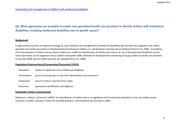
Q3: What approaches are available to enable non-specialized health care providers to identify children with intellectual disabilities, including intellectual disabilities due to specific causes?
