
Filter
1150
Text search:
World
Health
Organization
(South-East-Asia)
Featured
140
303
Language
Document type
513
257
179
67
53
24
19
14
12
6
3
2
1
Countries
97
77
59
37
28
27
27
20
15
13
13
13
12
11
9
7
7
7
6
6
6
6
5
5
5
5
5
5
5
4
4
4
4
3
3
3
3
3
3
2
2
2
2
2
2
2
2
2
2
2
1
1
1
1
1
1
1
1
1
1
1
1
1
1
1
1
1
1
1
1
1
1
1
1
1
1
1
1
1
1
1
1
1
Authors & Publishers
Publication Years
Category
266
151
112
97
64
41
18
Toolboxes
107
83
71
66
61
48
44
43
41
36
30
30
30
24
23
19
15
14
12
12
11
11
8
6
1

The Guidelines on promotive and preventive mental health interventions for adolescents - Helping Adolescents thrive (HAT), provide evidence-informed recommendations on psychosocial interventions to promote mental
...
Interim guidance. 12 May 2021. The Continuity of essential health services: Facility Assessment Tool can be used by countries to rapidly assess the capacity of health facilities to maintain the prov
...
A module from the suite of health service capacity assessments in the context of the COVID-19 pandemic, Interim Guidance 20 October 2020.
This self-assessment tool is designed for acute health-care
...
Interim Guidance, 12 July 2021; This tool was developed to assess present and surge capacities for the treatment of COVID-19 in health facilities. It allows health facilities to assess the availabil
...

Every year, an estimated 15 million babies are born preterm – before 37 weeks of pregnancy. That is more than 1 in 10 live births. Approximately 1 million children die each year worldwide due to complications from their early birth. Those that survive often face a lifetime of ill-
...
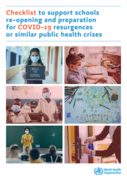
The checklist is aligned with, and builds upon, existing COVID-19-related WHO guidelines and is structured around protective measures related to: 1) hand hygiene and respiratory etiquette; 2) physical distancing; 3) use of masks in schools; 4) environmental cleaning and ventilation; and 5) respectin
...

14 January 2021
This practical guide can be used to help countries monitor and analyse the impact of COVID-19 on essential health services to inform planning and decision-making. It provides practical recommendations on how to use key performance i
...
The framework responds to the demand from Member States and partners for guidance on how the health sector and its operational basis in health systems can systematically and effectively address the
...

This report aims to support countries in the necessary transition toward healthier, more sustainable diets by integrating biodiversity in food-based interventions to support nutrition and health. It is intended to help guide decision-makers in the
...
WHO's Health in the Green Economy sector briefings examine the health impacts of climate change mitigation strategies considered by the Intergovernmental Panel on Climate Change in their Fourth Asse
...

The 2021 WHO health and climate change global survey report provides a valuable snapshot of the overall progress governments have made in addressing the health risks of climate change. The findings
...
The WHO Quality Toolkit: Navigating tools to improve the quality of health services helps easy identification and access to a wide range of WHO published materials to improve the quality of health s
...

The 2030 health-related Sustainable Development Goals call on countries to end AIDS as a public health threat and also to achieve universal health
...
The ongoing COVID-19 pandemic has shown that public financial management (PFM) should be an integral part of the response. Effectiveness in financing the health response depends not only on the level of funding but also on the way public funds are a
...

Providing quality, stigma-free services is essential to equitable health care for all and achieving global HIV goals and broader Sustainable Development Goals related to health. Every person has the
...
The Global Health Expenditure Report delves into the intricate landscape of global economies and health systems. This year, it focuses on health sp
...

Infographics
The 2024 World Malaria Report shows that the malaria burden remains overwhelmingly concentrated in Africa. The continent accounted for 94% of global cases and 95% of malaria-related deaths in 2023. Although the number of malaria cases increased glob
...

This document consolidates, for the first time, WHO recommendations on the prevention, testing, treatment and monitoring of hepatitis B and C, and includes testing strategies for hepatitis D. Drawing on a decade of evidence-based guidance issued between 2015 and 2025, it provides a single, practical
...
