
Filter
852
Text search:
European
Union
EU
Featured
49
208
Language
Document type
410
244
75
36
29
23
12
9
9
2
1
1
1
Countries / Regions
123
36
31
29
26
23
18
16
15
15
12
10
10
9
8
8
8
7
7
7
7
6
6
6
6
5
5
5
5
4
4
4
4
4
4
4
4
4
4
3
3
3
3
3
3
3
3
3
3
3
3
2
2
2
2
2
2
2
2
2
2
2
2
2
2
2
2
2
2
1
1
1
1
1
1
1
1
1
1
1
1
1
1
1
1
1
1
1
1
1
1
1
1
Authors & Publishers
Publication Years
Category
229
60
31
20
16
7
6
Toolboxes
94
89
75
55
54
53
43
32
26
23
23
23
23
14
11
10
9
9
6
6
4
3
3



This guideline provides advice in regards to applications for Marketing Authorisations for antimicrobial veterinary medicinal products (VMPs) on the data required and the methodology to be used for performing an assessment of the risk to public health from antimicrobial resistance (AMR) due to use o
...

The toolkit offers advice on how national public health authorities could engage with primary care prescribers so as to promote appropriate and responsible use of antibiotics. The toolkit contains template materials and some suggested key messages for health professionals, idea
...
Climate change, increasing population densities, and intensified globalisation in trade, travel and migration are among the most important factors shaping the 21st century. Each impacts upon population health and the risk of infectious disease, particularly those originating at the human-animal-envi
...

Preparedness planning is essential in order to respond effectively to outbreaks, including single case occurrences of highconsequence infectious diseases (HCID), such as the importation of a viral haemorrhagic fever (VHF) case

Only 8,730 asylum applications were registered in the EU+ in April, the lowest since at least 2008, and a massive 87% decrease from pre-COVID-19 levels in January and February.
The European Asylum Support Office (EASO) has released a special report
...
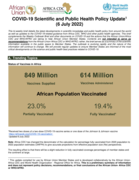
This bi-weekly brief details the latest developments in scientific knowledge and public health policy from around the world as well as updates to the COVID-19-related guidance from Africa CDC, WHO and other public health agencies.

A training tutorial for healthcare professionals
This ECDC tutorial presents the fundamental concepts of personal protective equipment (PPE) and barrier nursing to support preparedness in hospitals across Europe. It provides practical information on the proper use of PPE at the point of care, inclu
...

This document updates the 2009 ECDC guidance on chlamydia control in Europe. It was developed by a technical expert group which conducted a critical review of the scientific evidence on the epidemiology of chlamydia and the effectiveness of screening programmes.
The aim of this guidance is to suppo
...
Irresponsible pharmaceutical companies fuel the proliferation of superbugs through supply chain pollution, the European Public Health Alliance (EPHA) reports. The advocacy group uncovered lapses such as dirty production and inadequate waste disposal
...
A tutorial for trainers in healthcare settings
Version 2: 2 Dec 2014
"The document focuses on an extended set of PPE components, which includes goggles, respirators, gloves,
coveralls and footwear. Used properly, these PPE components can provide effective protection even from airborne
transmissi
...
Fokusstudie der deutschen nationalen Kontaktstelle für das Europäische Migrationsnetzwerk (EMN), Working Paper 80
Accessed: 22.03.2019

This document provides guidance on the application of non-pharmaceutical countermeasures to minimise the spread of the 2019 novel coronavirus (2019-nCoV) in the population. Some of the measures proposed refer specifically to certain phases of the epidemic (containment or mitigation phases), and can
...

The focus of the current quarterly edition of Eurohealth (from the European Observatory on Health Systems and Policies) is Antimicrobial Resistance (AMR) and contains the following articles:
• Strengthening implementation of AMR national ac
...
Wearing a face mask can help reduce the spread of COVID-19 in the community by reducing the release of respiratory droplets from asymptomatic / pre-symptomatic individuals or those with mild non-specific symptoms. The use of face masks for this purpose may be adopted to reduce the societal impact as
...
