
Filter
211
Text search:
disability-adjusted
life
years
(DALY)
Featured
20
51
Language
Document type
121
57
11
10
5
2
2
2
1
Countries
23
11
8
8
5
5
5
4
4
4
3
3
3
2
2
2
2
2
2
1
1
1
1
1
1
1
1
1
1
1
1
1
1
1
1
1
1
1
1
Authors & Publishers
Publication Years
Category
71
25
24
8
6
4
Toolboxes
32
14
13
12
11
11
10
5
4
4
4
3
2
2
2
1
1
1
1
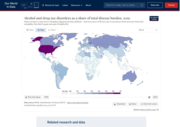
Disease burden is measured in Disability-Adjusted Life Years (DALYs) – both from
...

The article "The burden of chronic obstructive pulmonary disease and its attributable risk factors in the Middle East and North Africa region, 1990–2019" provides an analysis of the prevalence, mortality, and disability-
...

Background: Peripheral artery disease is a growing public health problem. We aimed to estimate the global disease burden of peripheral artery disease, its risk factors, and temporospatial trends to inform policy and public measures.
Methods: Data on peripheral artery disease were modelled using the
...

The global burden of disease (GBD) study provides information about fatal and non-fatal health outcomes around the world.
The objective of this work is to describe the burden of mental disorders among children aged 5–14 years in each of the six r
...
The Global Burden of Disease (GBD) 2010 Study has published disability-adjusted life year (DALY)
...

The WHO Global Burden of Disease (GBD) study measures the burden of
disease using the disability-adjusted life year metric (
...

Published OnlineJuly 14, 2021https://doi.org/10.1016/S2214-109X(21)00164-9. New Lancet research offers the first comprehensive analysis of the growing footprint of noncommunicable and injury-related neurological disorders to India’s overall disease burden.
Takeaways from 1990 to 2019 In terms
...

Mental health problem is one of the growing major public health issues in the Asia Pacific region. It contributes to the high number of Disability Adjusted
...
Background: A recent report by the Institute for Health Metrics and Evaluation (IHME) highlights that mental health receives little attention despite being a major cause of disease burden. This paper extends previous assessments of development assistance for mental health (DAMH) in two significant w
...

The burden of diabetes is enormous, positioning it as one of the main challenges facing public health today. Currently, it is estimated that 62 million people are living with diabetes in the Region of the Americas and projections show its prevalence will continue rising over the following
...

In 2015, the United Nations set important targets to reduce premature
cardiovascular disease (CVD) deaths by 33% by 2030. Africa disproportionately
bears the brunt of CVD burden and has one of the highest risks of dying
from non-communicable diseases (NCDs) worldwide. There is currently
an epide
...

The burden of diabetes is enormous, positioning it as one of the main challenges facing public health today. Currently, it is estimated that 62 million people are living with diabetes in the Region of the Americas and projections show its prevalence will continue rising over the following
...

Background: Worldwide, maternal hypertensive disorders complicate one in ten pregnancies. As a result of changes in the life styles of society, currently, it is becoming a common public life encount
...
7. Rev Panam Salud Publica. 2020;44:e13
Haiti faces a double burden of disease. Infectious diseases continue to be an issue, while non-communicable diseases have become a significant burden of disease. More attention must also be focused on the increase in worrying public health issues such as road
...
Reduced healthy life expectancy due to the high burden of both mental ill health and noncommunicable diseases (NCDs) is a major public health concern in the European Region. The links between mental disorders and major NCDs are well established.
In
...

Background
Cardiovascular diseases (CVDs) are one of the global leading causes of concern due to the rising prevalence and consequence of mortality and disability with a heavy economic burden. The objective of the current study was to analyze the trend in CVD incidence, mortality, and mortality-to-
...
Psoriasis, which can involve the skin, nails and joints, is a chronic, painful, disfiguring and disabling noncommunicable disease (NCD) for which there is no cure. It negatively impacts on quality of life. Some of those who suffer from the disease d
...

The Global Burden of Disease (GBD) study, a collaborative endeavour of the World
Health Organization (WHO), the World Bank and the Harvard School of Public Health,
drew the attention of the international health community to the burden of neurological
disorders and many other chronic conditions. T
...

The World Health Organization (WHO) is releasing the second edition of its Global Accelerated Action for the Health of Adolescents (AA-HA!) guidance. The document aims to equip governments to respond to the health and well-being challenges, opportunities and needs of adolescents.
The guidance pro
...
