Filter
841
Text search:
blood
transfusion
Featured
119
307
Language
Document type
494
148
81
56
25
15
8
3
3
3
2
1
1
Countries
121
33
29
25
23
22
22
18
18
18
16
16
16
15
14
12
11
9
9
8
7
6
6
5
5
5
5
5
5
4
3
3
3
3
3
3
3
3
3
3
3
2
2
2
2
2
2
2
2
2
2
2
1
1
1
1
1
1
1
1
1
1
1
1
1
1
1
1
1
1
1
1
1
1
1
Authors & Publishers
Publication Years
Category
450
105
73
32
26
21
20
Toolboxes
46
41
39
38
29
24
23
17
15
13
12
9
7
7
5
5
5
4
2
2
1
1
1



Department of Technical Support Services, Division of Laboratory Services, Ministry of Health
The provision of safe and efficacious blood and blood components for transfusion or manufacturing use involves a number of processes, from the sele
...
This interim guidance to national health authorities and blood transfusion services outlines the steps required to collect convalescent whole blood
...

External quality assessment (EQA) is an important component of quality systems for blood transfusion services. Establishing external quality assessment programmes for screening of donated
...
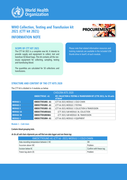
To provide supply & equipment to collect, test and transfuse 50 blood bags.
The new Collection testing and transfusion kit 2021 is specially designed for emergency settings where
...

Access to safe blood and blood products is recognized as one of the key requirements for delivery of modern health care in the journey towards health for all. The foundation of safe and sustainable
...

The World Health Organization’s (WHO) global report for the year 2019 indicates that sub-Saharan Africa (SSA) has a very high maternal mortality rate (MMR) with a 2017 point estimate of 542 (UI 498 to 649) maternal deaths per 100 000 live births, accounting for approximately 66% of estimated globa
...
La sécurité du traitement hospitalier et la réalité des soins sont des
préoccupations majeures dans les systèmes de santé. La transfusion sanguine a fait l’objet de procédures juridiques et d’études
au Canada, en Angleterre, en France
...

The five hepatitis viruses have different epidemiological profiles, and their impact, duration, and transmission route also vary. The most common transmission routes contributing to the spread of hepatitis are exposure to infected blood via
...

Chagas disease is a zoonosis caused by the protozoa Trypanosoma cruzi. It is transmitted to humans by contact of triatomine bug faeces with a break in the skin (often caused by a bite from the triatomine bug), or with mucous membranes. Transmission by contaminated
...

A century after its discovery, Chagas' disease still represents a major public health challenge in Latin America. Moreover, because of growing population movements, an increasing number of cases of imported Chagas' disease have now been detected in non-endemic areas, such as North America and some E
...
Chagas disease is caused by Trypanosoma cruzi. Infection is transmitted to humans when bitten by Triatominae (reduviid, kissing, or assassin) bugs in South and Central America, Mexico, and very rarely in the US. Less commonly, T. cruzi is transmitted via ingestion of sugar cane juice or food contami
...