
Filter
23
Text search:
Resnikoff,
S.
Featured
5
3
Language
Document type
11
7
3
2
Countries
4
1
1
Authors & Publishers
Publication Years
Category
5
3
1
Toolboxes
11
5

Since 1996, trachoma has been targeted for elimination as a public health problem worldwide. The active trachoma criterion for national elimination as a public health problem is a TF1–9 < 5%, sustained for at least two years in the absence of antibiotic mass drug administration (MDA), in each formerly endemic EU. Using A, F and E, health ministries and their partners have made considerable progress towards achieving this criterion in formerly endemic EUs worldwide. In 2002, an estimated 1517 million people lived in EUs in which EU-wide implementation of the A, F and E components of SAFE were thought to be needed for the purposes of global elimination of trachoma as a public health problem; by June 2021, that number had fallen to 136.2 million, a 91% reduction. Approximately 85% of the 136.2 million people living in EUs needing A, F and E in June 2021 were in WHO’
...

Report of the Joint World Health Organization–Brien Holden Vision Institute Global Scientific Meeting on Myopia | University of New South Wales, Sydney, Australia 16–18 March 2015

Trichiasis surgery for trachoma
recommended
3rd edition

Plan stratégique 2022-2030 de l’ICTC
The World Health Organization (WHO) endorses the use of population-based prevalence surveys for estimating the prevalence of trachoma. In general, the prevalence of TF in children aged 1–9 years and the prevalence of TT in adults aged ≥ 15 years are measured at the same time in any district bein
...
The World Health Organization (WHO) endorses the use of population-based prevalence surveys for estimating the prevalence of trachoma. In general, the prevalence of TF in children aged 1–9 years and the prevalence of TT in adults aged ≥ 15 years are measured at the same time in any district bein
...

At present at least 2.2 billion people around the world have a vision impairment, of whom at least 1 billion have a vision impairment that could have been prevented or is yet to be addressed. The world faces considerable challenges in terms of eye care, including inequalities in the coverage and qua
...


Trachoma is the leading infectious cause of blindness (2). It is characterized by repeated
conjunctival infection with particular strains of Chlamydia trachomatis. This scars the conjunctivae and,
in some cases, leads to trichiasis with or without entropion. The abrasive action of eyelashes can
d
...
The Fifty-first World Health Assembly adopted resolution WHA51.11 in 1998, which targets the
global elimination of trachoma as a public health problem by 2020 (1). The strategy recommended
to achieve that goal is encapsulated by the acronym “SAFE”, which represents: Surgery for
individuals wi
...
En 1998, la Cinquante-et-Unième Assemblée mondiale de la Santé a adopté la résolution
WHA51.11 qui vise l’élimination mondiale du trachome en tant que problème de santé publique
à l’horizon 2020 (1). La stratégie recommandée pour atteindre cet objectif est récapitulée dans
le sig
...
La quincuagésima primera Asamblea de la Salud Mundial aprobó la resolución WHA51.11 en
1998, que busca la eliminación mundial del tracoma como problema de salud pública para el 2020
(1). La estrategia recomendada para lograr ese objetivo está encapsulada por las siglas "SAFE", que
represent
...
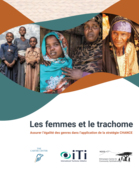
Assurer l’égalité des genres dans l’application de la stratégie CHANCE
Surveys are needed to guide trachoma control efforts in Mozambique, with WHO guidelines for intervention based on the prevalence of trachomatous inflammation–follicular (TF) in children aged 1–9 years and the prevalence of trichiasis in adults aged 15 years and above. We conducted surveys to com
...
3rd edition April 2018 - draft version
This Essential List for Diabetic Retinopathy contains recommendations for a range of essential itemsrequired at community / primary level (for screening); at secondary and tertiary levels (for treatment and follow up). It also contains recommendations for i
...
A systematic analysis for the Global Burden of Disease Study 2019. The Lancet Vol.399 Issue 10341 p.2129-2154
Human resources for health (HRH) include a range of occupations that aim to promote or improve human health. The UN Sustainable Development Goals (SDGs) and the WHO Health Workforce 2030 s
...
