
Filter
66
Text search:
DNDi
-
Drugs
for
neglected
diseases
initiative
Featured
7
4
Language
Document type
31
8
6
5
5
5
3
2
1
Countries
9
7
4
2
2
2
1
1
1
1
1
1
1
Authors & Publishers
Publication Years
Category
13
8
2
1
Toolboxes
49
2
2
1
1
1
1
1
1
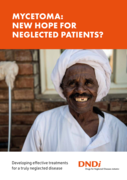
Mycetoma is a slow-growing bacterial or fungal infection, most often of the foot, that may spread to other parts of the body and can cause severe deformity. It is a debilitating disease that most often affects poor people in rural areas with limited access to health care.
Accessed on 04.04.2023
The Drugs for Neglected Diseases
...

Die Initiative Medikamente gegen vernachlässigte Krankheiten (Drugs for Neglected
...
La Iniciativa Medicamentos para Enfermedades Olvidadas (DNDi) es una organización internacional sin fines de lucro que proporciona tratamientos seguros, eficaces y asequibles para los pacientes más desatendidos, desde el laboratorio hasta su llega
...
L’initiative Médicaments contre les Maladies Négligées (DNDi) est une organisation internationale à but non lucratif spécialisée dans la recherche, le développement et la mise à dispositio
...
A Iniciativa Medicamentos para Doenças Negligenciadas (DNDi) é uma organização internacional sem fins lucrativos que disponibiliza medicamentos seguros, eficazes e acessíveis para doenças negligenciadas, desde o laboratório até sua chegada Ã
...

DNDi’s long-term goal for sleeping sickness, also known as human African trypanosomiasis (HAT), is to develop and register two new drugs that are
...
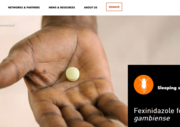
DNDi is now striving to make fexinidazole available to the majority of people who have T.b. gambiense sleeping sickness. We are supporting a three-year access and pharmacovigilance study that began in 2020 and have so far carried out in-coun
...
Leishmaniasis is a climate-sensitive disease. Changes in temperature, rainfall, and humidity can have strong impacts on
the sandfly vector, altering their distribution and influencing their survival and population sizes. Increased temperatures shorten vector development time, reduce Leishmania para
...

This is a summary of the following peer-reviewed, scientific article:
Comparative Evaluation of Immunoassays to Improve Access to Diagnosis for Chagas Disease in Colombia.

Full Perscribing information on Fexinidazole Tablet for oral use
INDICATIONS AND USAGE
Fexinidazole Tablets are indicated for the treatment of both the first-stage (hemolymphatic) and second-stage
...
1 billion people are at risk of infection with leishmaniasis, a neglected disease strongly linked to poverty. There’s no single, simple cure: current treatments are complex and need to be adapted to the form of the disease and geographical region.
...
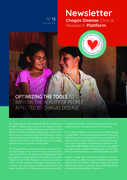
To support its R&D activities on Chagas disease, DNDi launched the Chagas Clinical Research Platform (CCRP). The platform brings together partners, experts, and stakeholders to provide support for e
...

Chagas is a parasitic disease that affects over 6 million people in the
world. As the disease typically remains asymptomatic for years, new cases
often go unnoticed and unreported, and most people with the disease
are unaware of their condition.
...

La enfermedad de Chagas es parasitaria y afecta a más de 6 millones
de personas en el mundo. Como normalmente es asintomática durante
años, los nuevos casos suelen no detectarse ni reportarse y la mayoría
de las personas con la enfermedad no tiene conciencia de su condición.
Se diagnostica
...
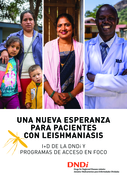
La leishmaniasis es una enfermedad tropical desatendida sensible
al clima, trasmitida por la picadura de insectos flebótomos y
se calcula que amenaza a mil millones de personas en todo el mundo.
Esta enfermedad altamente compleja se presenta de varias formas
clínicas, causadas por 20 especies
...

Visceral leishmaniasis, the most severe form of leishmaniasis also known as kala-azar, is a life-threatening disease caused by Leishmania parasites which are transmitted by female sandflies. Visceral leishmaniasis causes fever, weight loss, spleen and liver enlargement, and, if not treated, death. P
...

Cutaneous leishmaniasis is a painful disease that exerts a serious toll on societies around the world that are afflicted by it. Although not life-threatening, the skin ulcers and scars it causes can lead to isolation and psychosocial pathologies due to social stigma, and its occurrence is often asso
...
Leishmaniasis is among the most neglected diseases. The most common form is cutaneous leishmaniasis that forms lesions on the skin.
The only treatment available
...

Website last accessed on 14.04.2023
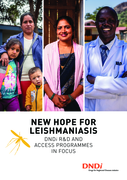
Health workers Luke (Kenya), Juliana (Colombia), and Shishu (India) share the same hope for their patients with leishmaniasis: simple, oral treatments. For th
...
