
Filter
15
Featured
4
2
Language
Document type
5
3
3
2
1
1
Countries / Regions
3
2
Authors & Publishers
Publication Years
Category
3
2
1
1
1
1
1
1
1
1
1
Toolboxes
6
5
3
2
2
2
1
1
1
1
1
1
1
1
1
1
1
1
1
1
1


Lessons learned from recent public health events such as the COVID-19 pandemic, Ebola virus disease, Zika virus disease outbreaks, and other public health threats, including earthquakes and floods, have highlighted the need for countries to continuously develop, strengthen, and maintain capacities r
...

WHO guidelines for clinical management of arboviral diseases: dengue, chikungunya, Zika and yellow fever
recommended
The new WHO guidelines provide clinical management recommendations for four of the most widespread arboviruses affecting humans: dengue, chikungunya, Zika, and yellow fever.
An integrated approach is vital, as these four diseases often present with similar symptoms, especially in the early stages
...
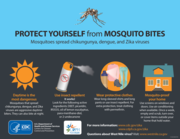
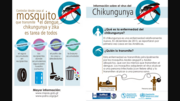
The poster is a public health communication tool designed to prevent the transmission of diseases such as chikungunya, dengue and Zika. The poster emphasises that Aedes mosquitoes bite aggressively during the day and sometimes at night, and recommends the key prevention strategies.
Accessed on 27
...

Toolkit regarding Zika Virus
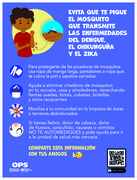
Para protegerte de las picaduras de moquitos usa ropa de manga larga, pantalones o ropa que te cubra la piel y zapatos cerrados
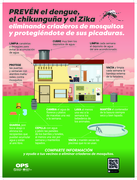
Arbovirus (arthropod-borne virus) is defined as any virus that is transmitted to humans and/or other vertebrates by certain species of blood-feeding arthropods, mostly insects (flies and mosquitoes) and arachnids (ticks). Arbovirus is a descriptive term based on transmission by vectors with particul
...
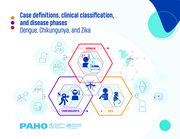
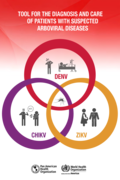
Case definitions, clinical classification, and disease phases Dengue, Chikungunya, and Zika
recommended
A person who lives in or has traveled in the previous 14 days to areas with dengue transmission, and presents with acute fever that has typically lasted 2 to 7 days, and two or more of the following clinical manifestations: nausea or vomiting, exanthema, headache or retro-orbital pain, myalgia or ar
...
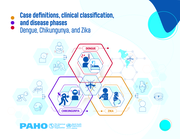
The purpose of this document is to present concise information on the current case definitions for dengue, chikungunya, and Zika proposed by PAHO, as well as information on the clinical phases and severity classification of dengue and chikungunya.
Zika and dengue viruses remain significant public health threats. These viruses share the same Aedes (Stegomyia) mosquito vectors and geographic distributions but infections cannot be readily distinguished clinically and need to be differentiated from each other, and from other circulating arboviral
...
Version corregida. En la actualidad, las guías basadas en la evidencia constituyen una de las herramientas más útiles para mejorar la salud pública y la práctica clínica. Su finalidad es formular intervenciones con sólidas pruebas de eficacia, evitar riesgos innecesarios, utilizar los recurso
...

The school and a community teaching modules are aimed at preventing vector-borne diseases through community participation. Meanwhile, the interactive toolkit is meant to be help raise awareness on health, sanitation and vector control. These materials will help volunteers and practitioners foster di
...
It is Zika virus (ZIKV) that most often causes these neurological effects it appears to be the only arbovirus than can cause congenital malformations such as microcephaly. In any case, more scientific tests are needed to establish the causal relationship between the virus and this malformation (7-10
...
