
Filter
46
Breadcrumb:
Disaster Preparedness
Featured
4
9
Language
Document type
8
8
8
7
7
3
2
2
1
Countries
5
1
1
1
1
1
1
1
Authors & Publishers
Publication Years
Category
17
5
3
2
2
1
1
1
1
1
1
1
1
1
Toolboxes
14
8
8
7
7
5
5
4
4
3
2
2
2
2
2
2
2
2
1
1
1
1
1
1
1
1
1
1
1
1
1
1
1
1
1
1
1
1
1
1
1
WHO subsequently developed a standardized methodology for risk assessments, based on the Rapid Risk Assessment of Acute Public Health Events manual. To attain the highest possible level of objectivity, accuracy and reproducibility, the standardized RRA approach is applied by those conducting public
...
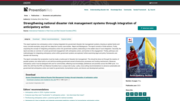
The webpage describes a 2025 report by the International Federation of Red Cross and Red Crescent Societies on how governments can integrate anticipatory action into national disaster risk management systems, using global examples and case studies to show why and how anticipatory approaches should b
...

The International Federation of Red Cross and Red Crescent Societies (IFRC) is the world’s largest volunteer-based humanitarian network. With our 190 member National Red Cross and Red Crescent Societies worldwide, we are in every community reaching 160.7 million people annually through long-term s
...
Here you can download the report in English, French, Spanish and Arabic.
The World Disasters Report 2026 warns that harmful information and dehumanising narratives are increasingly undermining trust, putting the lives of humanitarian workers and communities at risk. In polarized and politically cha
...
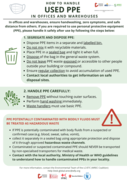
How to Handle PPE in Offices and Warehouses (WREC)
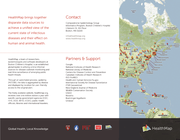
Global Health, Local Information.
The freely available Web site 'healthmap.org' and mobile app 'Outbreaks Near Me' deliver real-time intelligence on a broad range of emerging infectious diseases for a diverse audience including libraries, local health departments, governments, and international tra
...

ProMED
recommended
ProMED - the Program for Monitoring Emerging Diseases - is an Internet-based reporting system dedicated to rapid global dissemination of information on outbreaks of infectious diseases and acute exposures to toxins that affect human health, including those in animals and in plants grown for food or
...
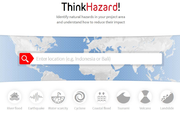
As an online disaster risk visualization tool, ThinkHazard! aims to provide users with information to make risk-informed choices. This is the first platform of its kind, allowing anyone to quickly find information on 8 different types of hazards in their search area. All information is open source a
...
The latest disease outbreaks around the world notified to the World Health Organization.
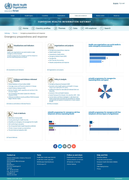
Launched in 2016, the European Health Information Gateway (Gateway) is a powerful tool and easy way to access health data, information and resources for all 53 Member States in the European Region. The Gateway was conceptualized as a platform to facilitate access to integrated health information, un
...
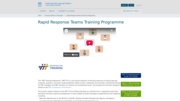
The “RRT Training Programme” (RRT TP) is a structured collection of learning resources including learning materials, guidance, and tools enabling Member States to plan, implement and evaluate customized training for RRT managers and RRT members at national and subnational levels. This programme
...

This channel is an introduction to simulation exercises and their value as part of wider emergency preparedness to raise awareness among a non-technical audience.

With an estimated population of about 5 million and an annual growth rate of 8 per cent, Dar es Salaam, Tanzania, is Africa’s fastest growing city.1 Over 70 per cent of the people live in informal, unplanned settlements with inadequate infrastructure. In addition, heavy rainfalls twice a year
...

The GHEC framework is designed to provide guiding principles for standardizing health emergency workforce structures to strengthen the capacity of countries in responding to health emergencies, and to enhance collaboration between countries by better connecting regional and global surge response mec
...

This multi-hazard Health Emergency Alert and Response Framework provides guidance for coordinating emergency response in countries, under the global Health Emergency Preparedness, Resilience and Response (HEPR) framework. It outlines the public health functions, coordination systems and actions need
...


The document is a report by an expert group that presents a framework for improving future pandemic preparedness and emergency response, particularly in the context of India but with relevance to global health systems. It analyzes lessons learned from COVID-19 and past epidemics, identifies key weak
...

The COVID-19 pandemic is the most severe health crisis in a century, exposing deep gaps in the world’s defences against epidemics and pandemics, and teaching us painful
lessons. One of them is that in our intimately connected world, pathogens can spread around the world very quickly, demanding sy
...
Training material and online courses
UThe UNDAC Handbook is intended as an easily accessible reference guide for members of an UNDAC team before and during a mission to a disaster or emergency. The Handbook is not an authoritative instruction, but rather represents an accumulation of institutional memory related to processes and proced
...
