
Filter
676
Featured
175
4
Language
Document type
318
88
85
42
40
32
21
12
10
10
9
5
4
Countries
47
47
36
31
21
20
19
18
17
14
14
14
13
12
11
11
10
9
8
6
6
6
5
5
5
5
5
4
4
4
3
3
3
3
3
3
2
2
2
2
2
2
2
2
2
2
2
2
1
1
1
1
1
1
1
1
1
1
1
1
1
1
1
1
1
1
1
1
1
1
1
1
1
1
1
1
1
1
1
Authors & Publishers
Publication Years
Category
234
111
25
8
7
6
2
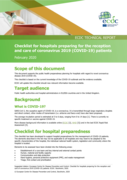
Checklist for hospitals preparing for the reception and care of coronavirus 2019 (COVID-19) patients
recommended
This checklist has been developed to support hospital preparedness for the management of COVID-19 patients.
Elements to be assessed have been divided into the following areas:
Establishment of a core team and key internal and external contact points
Human, material and facility capacit
...

Online Resouce with guidelines, posters, e-learning courses for healthcare settings and community health
Washing hands is the best way to prevent the spread of germs and diseases. Dirty hands can carry pathogenic germs that can sicken a person or spread diseases to others. Microorganisms such as bacteria, viruses, parasites, fungi and various chemicals can enter our bodies directly when we touch our fa
...

Water, sanitation, hygiene, and waste management for SARS-CoV-2, the virus that causes COVID-19
recommended
Updated Interim guidance 29 July 2020
The provision of safe water, sanitation and waste management and hygienic conditions is essential for preventing and for protecting human health during all infectious disease outbreaks, including of coronavirus disease 2019 (COVID-19). Ensuring evidenced-based
...

Interim guidance 19 March 2020
Los servicios de emergencias médicas prehospitalarias (SEM) facilitan atención inicial de soporte vital básico y/o avanzado y traslado de heridos o enfermos desde el lugar donde ocurre la emergencia hasta el centro sanitario donde le van a prestar cuidados definitivos. Los SEM también pueden pre
...


La capacidad de respuesta de un hospital puede ser superada por la llegada masiva de pacientes que soliciten atención médica como consecuencia de una situación de emergencia. Ante este escenario, se debe considerar si el establecimiento de salud está organizado para garantizar la gestión integr
...

Prevención y control de infecciones y nuevo coronavirus (COVID-19): precauciones estándares y uso de equipos de protección personal
Agenda
Visión general de la historia natural del COVID-19
Precauciones estándares
Precauciones adicionales según mecanismos de transmisión
Evaluación de ri
...

Interim Version 24, February 2020
This checklist has been prepared with the aim of supporting hospital managers and emergency planners in achieving the above by defining and initiating actions needed to ensure a rapid response to the COVID-19 outbreak. The checklist is structured on eleven key co
...

24 ФЕВРАЛЯ 2020
г. // ПРЕДВАРИТЕЛЬНАЯ РЕДАКЦИЯ
В системе здравоохранения больницы играют важнейшую роль в обеспечении населения основной медицинской помощью, особе
...

La evolución de los acontecimientos y el esfuerzo conjunto de la comunidad científica mundial, hangeneradogran cantidad de información que se modificarápidamente con nuevas evidencias. Este documento pretende hacer unresumen analítico de la evidencia científica dispo
...

ObjetivoEl objetivodel documento es servir de guía de actuación para el manejo casos de COVID-19 en atención primaria.3.Recomendaciones generalesSe recomienda la colocación de información visual (carteles, folletos, etc.) en lugares estratégicosde los centros de atenció
...

En general se proponen las siguientes recomendaciones: - Los trabajadores sanitarios deberán extremar al máximo las medidas de higiene de manos con agua y jabón.- Se deben colocar una mascarilla quirúrgica durante el contacto con pacientes que presentan clínica respir
...



Par ailleurs l’existence d’éléments épidémiologiques en faveur d’une sous-estimation du nombre réel de cas de COVID-19 et de l’existence d’une transmission communautaire soutenue dans une zone géographique pour lesquels les deux critères ci-dessus ne sont pas observés pourra être
...
