
Filter
1221
Featured
88
46
Language
Document type
378
174
159
111
76
71
57
51
46
30
26
20
14
5
3
Countries
209
41
20
16
16
15
11
8
7
7
7
7
6
6
6
6
5
5
5
5
5
5
5
5
4
4
4
3
3
3
3
3
2
2
2
2
2
2
2
2
2
2
2
2
2
2
2
2
1
1
1
1
1
1
1
1
1
1
1
1
1
1
1
1
1
1
1
1
1
1
1
1
1
1
1
1
Authors & Publishers
Publication Years
Category
131
115
45
18
7
7
1
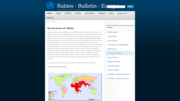
Classical rabies caused by RABV occurs worldwide besides some isolated countries and Western Europe that are regarded rabies free. Carnivores, especially of the canidae family represent the principal reservoir species and are responsible for the maintenance of the infectious cycle and hence for the
...
All lyssaviruses have evolved closely with distinct natural reservoir hosts. The latter are animals species in which a pathogen of an infectious disease are maintained independently. For lyssaviruses, these are a wide range of mammalian species within the Carnivora and Chiroptera (bats) orders with
...
For more than 100 years, the clearest route to elimination of dog-mediated rabies has been via mass vaccination of the animal hosts. It’s worked in plenty of countries. Still, in others, like India, which grapples with a third of the world’s rabies burden, large populations of free-roaming, hard
...

Rabies is a fatal zoonotic disease most often transmitted to people via bites from infected dogs. This course provides a general introduction to rabies, and the One Health approach currently taken to prevent it. It consists of seven video-lectures, demonstration videos, and lessons learnt from peopl
...

World Rabies Day is the biggest event on the global rabies calendar, coordinated by GARC and it has been commemorated every year on September 28 – the anniversary of the death of Louis Pasteur – since 2007. World Rabies Day aims to raise awareness and advocate for rabies elimination globally. It
...
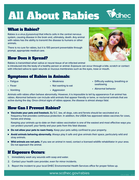
Rabies is a virus (Lyssavirus) that infects cells in the central nervous
system, causing disease in the brain and, ultimately, death. Any animal
with rabies has the ability to transmit the disease to humans or other
animals.
There is no cure for rabies, but it is 100 percent preventable through
...

Rabies is transmitted when saliva or neural tissue of an infected animal is introduced into the body. Exposure can occur through a bite, scratch, or contact with saliva to broken skin or mucous membranes such as the eyes or mouth, BUT rabies is preventable! Vaccinations for your pets and livestock a
...
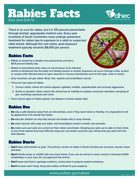
There is no cure for rabies, but it is 100 percent preventable through prompt, appropriate medical care. Every year hundreds of South Carolinians must undergo preventive treatment for rabies due to exposure to a rabid or suspected rabid animal. Although the cost varies, post-exposure treatment typic
...

Rabies is a fatal but preventable viral disease. It can spread to people and pets if they are bitten or scratched by a rabid animal. In the United States, rabies is mostly found in wild animals like bats, raccoons, skunks, and foxes. However, in many other countries dogs still carry rabies, and most
...

The incubation period (the time the virus spreads from the peripheral nerves near the site of the bite via the spinal cord to the brain – see transmission and pathogenesis) ranges in general between 2 and 3 month (2 weeks to 6 years are reported) depending on the site of infliction, the amount of
...
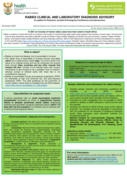
Rabies is a fatal viral disease, but is preventable in humans. The rabies virus is transmitted to humans through virus-laden saliva from a rabid animal, mostly dogs. The virus is shed in the saliva of an infected animal and can be introduced into another body through bites, scratches and any other
...

Rabies is a viral zoonotic disease that causes progressive and fatal inflammation of the brain and spinal cord. Clinically, it has two forms:
Furious rabies – characterized by hyperactivity and hallucinations.
Paralytic rabies – characterized by paralysis and coma.

The desired impact of the OH JPA is a world better able to prevent, predict, detect and
respond to health threats and improve the health of humans, animals, plants and the
environment while contributing to sustainable development. The OH JPA aims to work
towards this vision in the following way:
...

Cutaneous leishmaniasis (CL) is a parasitic disease caused by infection with a vector-borne protozoan parasite of the genus Leishmania spp. The parasite is transmitted by the bite of an infected phlebotomine sand fly. Infection results in skin lesions which take a long time to heal and may leave per
...

Leishmaniasis is a vector-borne disease with a wide variety of parasite species, reservoirs, and vectors involved in transmission. It is caused by different species of the protozoa Leishmania and is transmitted to animals and humans through a bite of insects in the Psychodidae family. Its presence i
...

PLoS Negl Trop Dis 16(10): e0009774. Although the practice of communication is often called upon when intervening asn involgvingcommunties affected by NTD's, the disciplinary framewokr of healt communication research has been largely absent from NTD strategies. To illustrate how practices conceptual
...

We developed an integrated vector surveillance (IVS) proposal for cutaneous leishmaniasis (CL) and visceral leishmaniasis (VL) in the Americas, based on eco-epidemiological studies conducted by researchers of the Leishmaniasis Research Network of Argentina. For CL, the transmission was explained in
...

El pian es una treponematosis endémica, un grupo de infecciones bacterianas crónicas causadas por espiroquetas del género Treponema, entre las que se encuentran también la sífilis endémica (bejel) y el mal de pinto. El pian es la más frecuente de las tres.

Le pian fait partie d’un groupe d’infections bactériennes chroniques que l’on désigne couramment par le terme « tréponématoses endémiques ». Ces maladies sont dues à des bactéries spiralées appartenant au genre Treponema, qui comprend aussi la syphilis endémique (béjel) et la pinta
...

Фрамбезия относится к группе хронических бактериальных инфекций, в совокупности называемых эндемическими трепонематозами. Возбудителями этих заболеваний, к котÐ
...
