
Filter
625
Featured
44
76
Language
Document type
183
145
76
41
34
30
19
18
18
17
15
13
11
2
Countries
21
20
18
10
10
9
8
5
5
4
4
3
3
3
3
3
3
3
3
3
3
3
3
3
3
3
3
3
3
3
3
2
2
2
2
2
2
2
2
2
2
2
2
2
2
1
1
1
1
1
1
1
1
1
1
1
1
1
1
1
1
1
1
1
1
1
1
1
1
1
1
1
1
1
1
1
1
1
1
1
1
1
1
1
1
1
1
1
1
1
1
1
1
1
1
1
1
1
1
1
Authors & Publishers
Publication Years
Category
79
32
8
4
2
2

This tool enables a rapid, systematic review of pharmacy curricula at the national or institutional level to evaluate their robustness in delivering the expected content and competencies. It can also assist institutions in designing strategies to strengthen AMR curricular content, and to facilitate
...

Essential medicines are those that satisfy the priority health care needs of a population. They are selected with due regard to disease prevalence and public health relevance, evidence of efficacy and safety and comparative cost-effectiveness. They are intended to be available in functioning health
...
The WHO Model List of Essential Medicines and Model List of Essential Medicines for Children are updated and published every two years, intended as a guide for countries or regional authorities to adopt or adapt in accordance with local priorities and treatment guidelines for the development and upd
...
List of available resources and courses

WHO Antibiotic Categorization AWaRE
recommended
Online Database: Provides recommendations for 21 common infectious diseases; Classifies antibiotics into three groups based on the potential to induce and propagate resistance; Identifies antibiotics that are priorities for monitoring and surveillance of use
WHO Global Essential Medicines
recommended
Database of the essential lists for 137 countries based on the national essential lists repository
Ces orientations opérationelles ont pour but de soutenir les pays dans le processus d’introduction d’un antibiotique. Leur objectif est de garantir un accès rapide aux antimicrobiens et l’utilisation appropriée de ces produits ainsi que des résultats optimaux pour les patients, tout en ré
...
La résistance aux antimicrobiens (RAM) constitue une menace pour la santé mondiale, la sécurité alimentaire et la réalisation des Objectifs de développement durable (ODD) à l'horizon 2030. Il est essentiel de s'attaquer à la RAM pour préserver la capacité des pays à traiter les maladies c
...
La promotion du bon usage et l’utilisation appropriée des antimicrobiens sont à la base du quatrième objectif du Plan d’action mondial pour combattre la résistance aux antimicrobiens de l’Organisation mondiale de la Santé (OMS), adopté par les États Membres lors de la Soixante-Huitième
...

Objective To determine whether adding urine culture to urinary tract infection diagnosis in pregnant women from refugee camps in
Lebanon reduced unnecessary antibiotic use.
Antimicrobial resistance (AMR) is impacting our health, economies and development. Up to 5.2 million people may die because of resistant bacterial infections across the Western Pacific Region from 2020-2030. Childbirth, surgery, cancer treatment and other interventions will become impossibly d
...
The primary objective of this curriculum is to equip health and care workers with the essential knowledge and competencies necessary for delivering safe and effective care. By doing so it aims to significantly reduce HAIs and combat antimicrobial resistance, thereby safeguarding both patient and HCW
...

Until fairly recently, debates about how to tackle the looming threat of antibiotic resistance have tended to focus on how to come up with new antibiotics
La résistance aux antimicrobiens (RAM) est une réponse
évolutive naturelle à l’exposition aux antimicrobiens, qui
a été aggravée par des comportements humains, tels que
l’utilisation abusive et excessive d’antimicrobiens, l’utilisation
d’antimicrobiens dans l’agriculture et la
...
Animicrobial resistance (AMR) was declared by the World Health Organization (WHO) as one of the
top 10 health threats facing humanity. The effects of AMR are far-reaching as it cuts across sectors and affects food safety,
nutrition security, livelihoods, environment and, consequently, attainment o
...
Implementing the global action plan on antimicrobial resistance: first quadripartite biennial report
The first quadripartite biennial report summarizes progress in the implementation of multisectoral national action plans, actions by the quadripartite organizations, actions by the global governance structures, key environmental dimensions, highlights areas for accelerated action, and shares case st
...
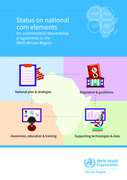
Antimicrobial resistance (AMR) is one of the world’s top 10 public health threats. The World Health Organization (WHO) in the African Region, using the Antimicrobial Stewardship assessment tool, has assessed Member States progress on strengthening national capacity need for effective implementatio
...

Antimicrobial resistance (AMR) has emerged as a leading cause of death in the African region, surpassing fatalities from malaria, HIV, and TB. In response to this critical threat, the region has adopted the AMR Global Action Plan and the African Union Framework for Antimicrobial Resistance Control 2
...

National action plans on antimicrobial resistance (AMR) often overlook the critical intersection of gender, despite evidence that exposure and susceptibility to infection, health-seeking behaviours, as well as antimicrobial prescribing and use patterns are all influenced by gender.
